

Review · TOURS
Philosophical Tour in Athens
Athens talks back on this philosophy walk. You’ll move site to site, and the tour keeps ancient ideas active with speakers and multimedia rather than just a lecture. It is a small, private-style experience that ties each landmark to a clear theme in ethics, psychology, and the good-life question.
I especially love how Lampros links old-school philosophy to today, including how reasoning works in modern life (yes, the future of AI comes up). I also liked the pacing, with time to sit in cooler spots when the sun gets serious, plus short videos to make the concepts click.
One possible drawback: this is a thinking tour. If you want only photos and quick facts, the reflective style may feel a bit heavy, and you should plan for a steady walking rhythm over about 2 hours 30 minutes.
In This Review
- Key things I’d circle before you go
- A Small-Group Philosophy Walk Through Athens
- Meeting at the Acropolis Area, Then Settling Into a 2.5-Hour Rhythm
- Theatre of Dionysus and Herod Atticus Odeon: Tragedy With a Psychology Angle
- The Prison of Socrates and the Allegory of the Cave
- Democracy, Views, and the Happiness Lesson From Philopappos to Pnyx
- Keramikos, Epicurus, and the Stoicism Thread Through Roman Agora
- Mnisikleous Stair Lunch Atmosphere, Then Lysikratous Square and Anafiotika
- What the Speakers and Multimedia Actually Add
- Price and Value for a Philosophical Walking Tour in Athens
- Who This Tour Suits Best
- Should You Book the Philosophical Tour in Athens?
- FAQ
- Where does the tour start and end?
- What time does it start?
- How long is the tour?
- Is it private or group-based?
- What group size is included?
- Is the tour offered in English?
- Are admission tickets included?
- Are service animals allowed?
- What if weather is bad, and what is the cancellation policy?
Key things I’d circle before you go
- Private group up to six people, so the guide can actually track your questions
- Multimedia support (speakers, short videos) used at outdoor stops
- Real Athens locations tied to Socrates, Plato, Aristotle, Stoicism, Epicurus, and democracy
- Big viewpoint breaks like Philopappos and Pnyx, with the Parthenon and Acropolis in range
- Happiness taught multiple ways through different schools, not just one story
- Modern connections that can range from psychology to AI and self-reflection
Not settled on one yet? These are the other Athens trips that made our review list.
- All Day Cruise -3 Islands to Agistri,Moni, Aegina with lunch and drinks included
★ 5.0 · 4,958 reviews





A Small-Group Philosophy Walk Through Athens

This tour is built for people who like ideas with their sightseeing. You’ll walk through Athens as a kind of open-air classroom, where landmarks are treated like evidence in a debate about how to live.
The format helps a lot: it is private, in English, and geared to your group. That also means the guide can slow down or speed up based on what you care about most.
And for the price, think value, not just the sticker. At $90.11 per person, it still makes sense because it is not just “see a few ruins,” it’s guided interpretation, speakers, and a structured route that hits major philosophy-linked stops.
Meeting at the Acropolis Area, Then Settling Into a 2.5-Hour Rhythm
It starts at 11:00 am near the Acropolis area (the meeting point is listed as Acropoli, Athens 117 42, Greece). You’ll finish back at the same meeting point, so you can plan the rest of your day without a travel puzzle.
Plan on a walking tour with frequent short stops, plus a couple of moments that feel like you are watching a movie outdoors. If you’re going in warm weather, bring water and wear shoes you can trust for uneven stone.
Lampros also does something practical: he shares the meeting location in advance so you can find him without stress. That matters when Athens is busy and everyone is holding their phone at face level.
Theatre of Dionysus and Herod Atticus Odeon: Tragedy With a Psychology Angle
You begin at the Theatre of Dionysus Eleuthereus, the birthplace of tragedy. The big idea here is not just ancient theatre trivia, it’s why Athenians treated tragic drama like a kind of mental medicine, linked to how judgment can go wrong.
The tour then ties in Carl Jung and the role tragedy can play in helping you become your best self. You’ll also hear the guide connect tragedy with other ways of thinking, including Buddhism and evolution psychology. Even if you don’t buy every comparison, it gives you a fresh lens for why stories move people.
Next stop is Herod Atticus Odeon, described as one of the world’s best-known open-air theatres. Here the theme shifts toward persona, animus, and anima, so the conversation turns from outer spectacle to inner identity.
A small consideration: open-air theatres can be busy, and the acoustics and crowds can make it harder to hear every word at every second. The guide uses the group’s focus points, and you’ll get more out of it if you stay close and listen for the main takeaway.
The Prison of Socrates and the Allegory of the Cave
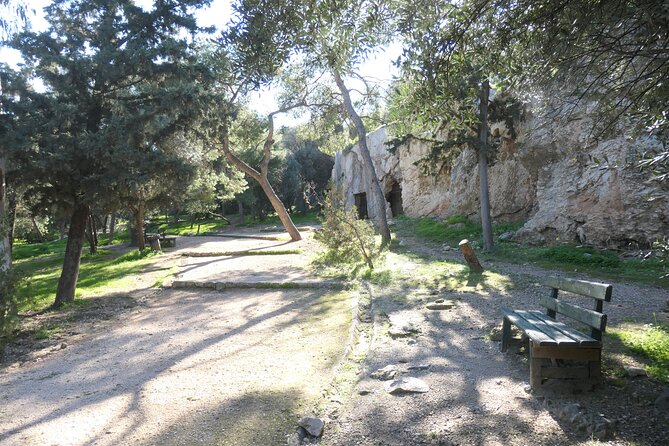
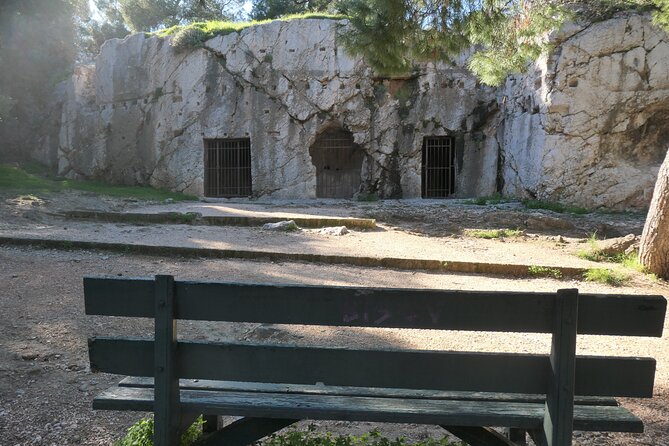
At the Prison of Socrates stop, the theme sharpens to Plato and the allegory of the cave. This is where the tour starts to feel less like walking and more like thinking in a guided way.
The “value” of stopping at a named philosophical site is that your brain stops treating the story as abstract. Instead, you are standing in the environment that shaped how Greeks talked about perception, illusion, and truth.
You’ll also notice the tour style here: the guide doesn’t just say the moral of the story. He keeps looping back to how the idea can change how you judge, interpret, and decide in real life.
If you’re sensitive to abstract talk, this is still manageable because the stop length is short and the guide uses multimedia support to keep you oriented.
Democracy, Views, and the Happiness Lesson From Philopappos to Pnyx
You move toward the site linked with the birth of democracy, at Eglise D’agios Dimitrios Loumbardiaris. The point is not only that democracy started in Athens, it’s that civic life and philosophy grew in the same place and time.
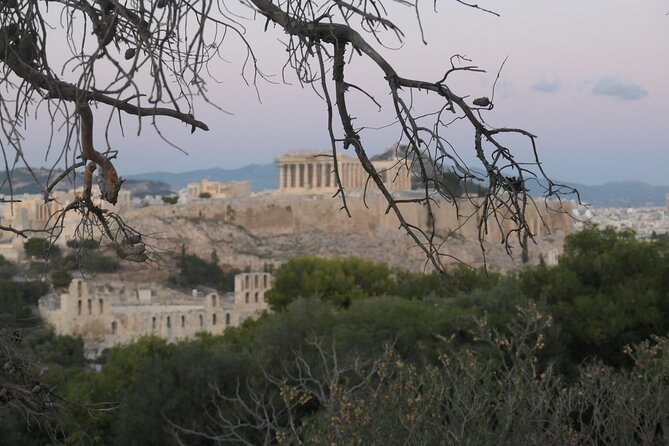
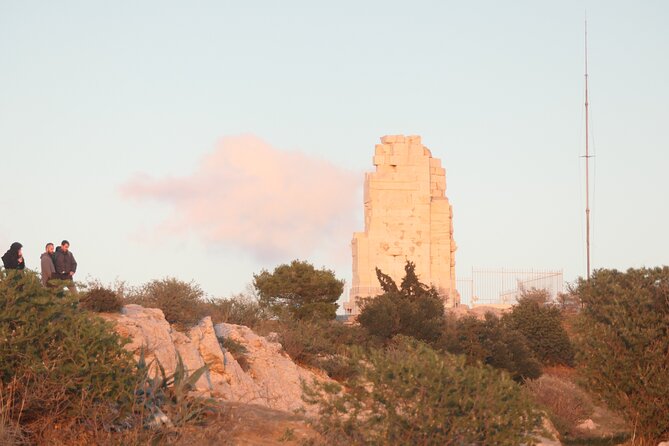
From there you climb into view territory at the Philopappos Monument. This is one of the stops I’d pick even if you had no interest in philosophy, because you get a strong view toward the Parthenon and the Acropolis.
The theme at Philopappos is happiness, linked to Plato and Socrates. You’ll hear it framed as a practical question: not just what feels good, but what helps a person live better with clarity and self-control.
Then comes Pnyx, with a stop length of about 15 minutes and an admission ticket included. Pnyx is the assembly area of Athenian citizens, so it fits democracy perfectly. The guide also brings in Aristotle’s perspective of eudaimonia, described as blissful wellbeing, and the idea of Socrates’ secret place.
Drawback to flag: Pnyx is a hill. It’s worth it, but it’s not flat stroll territory. If you have mobility limits, you’ll want to pace yourself early and keep an honest pace with the group.
- Athens: Cape Sounion & Poseidon Temple Sunset Half-Day Trip★ 4.8 · 8,241 reviews
- All Day Cruise -3 Islands to Agistri,Moni, Aegina with lunch and drinks included★ 5.0 · 4,958 reviews
- Athens, Piraeus, and Coastline: Blue Hop-On Hop-Off Bus★ 3.9 · 4,849 reviews
- Greek Food Walking Tour in Athens★ 5.0 · 4,740 reviews
Keramikos, Epicurus, and the Stoicism Thread Through Roman Agora
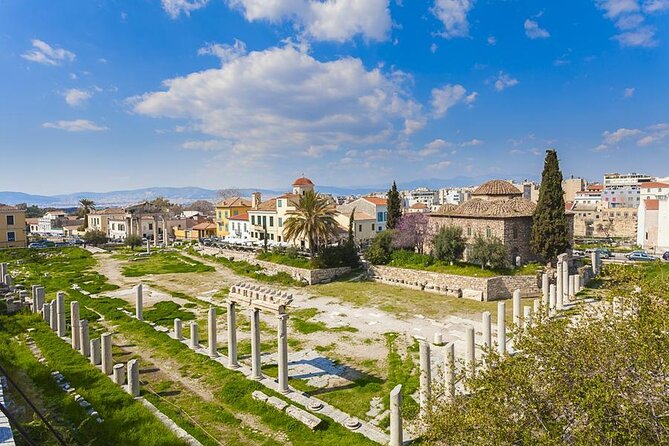
At Keramikos Archaeological Site, you’re at the ancient cemetery of Athens. That sounds heavy, but it works as philosophy, because Epicurus is about how to build peace with what life gives you.
The tour connects this stop with Epicurian happiness and the Epicurus garden concept. The contrast is striking: a place of death talk becomes a lesson about tranquillity and how the mind can change your experience.
After that, the route includes a stop where Stoicism was born, plus a theme that philosophy, theatre, and democracy are all tied to Athens acting out those ideas in public. You’ll also pass by what the tour describes as the most beautiful street in Athens, which is a nice reset from the heavier concepts.
Then you reach the Roman Agora, where the tour frames Stoicism as a philosophy of life. You’ll hear the idea taught as something practical, not just a set of rules to memorize.
One of the most intriguing bits is the mention of the first meteorological station in the world, offered here as a sign that the Greeks mixed observation and thought. The exact technical details might not be the star of the stop, but it reinforces a theme: philosophy and science shared an attitude, notice the world carefully.
Mnisikleous Stair Lunch Atmosphere, Then Lysikratous Square and Anafiotika
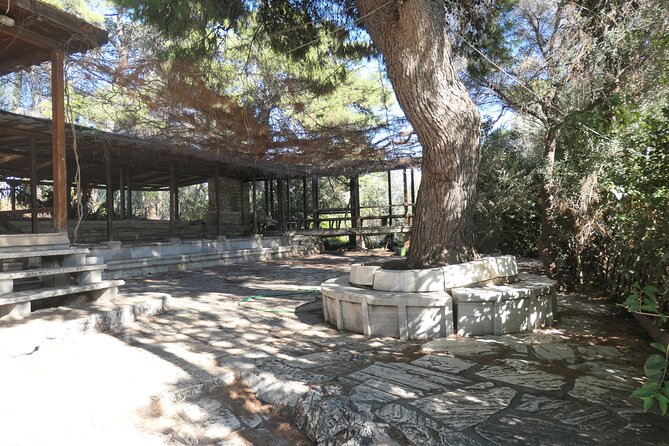
The itinerary builds in a discussion point, described as the place for philosophers to talk, and you get to experience the atmosphere of the Mnisikleous stair. The tour calls this also a best place for lunch, which is a smart move if you want food nearby without losing your momentum.
After lunch time, you head to Lysikratous Square. Here the theme is Nietzsche and the Apollonian and Dionysian sides of Athens. Even if you only know Nietzsche from headlines, the guide can translate the idea into something you can feel while standing in the square.
Finally, you reach Anafiotika, described as feeling like a Cycladic island. It is a nice closing note because it shifts from named philosophers to mood and place, a chance to take photos and absorb a different Athens texture without it turning into a shopping detour.
A practical note: the “island feeling” part is real in the sense of ambience and architecture, but it still sits inside a city. Keep your expectations flexible, and use it as a soft landing after the more intense stops.
What the Speakers and Multimedia Actually Add
This tour is not only about where you stand. It also tells you why you’re standing there, using speakers and multimedia presentations during the walk.
I like this approach because philosophy can turn into a blur if it’s all verbal. Short videos plus targeted audio help you anchor the core ideas, then you can walk and reflect instead of frantically taking notes.
It also keeps the group engaged. One of the best lessons from past guests was that Lampros adapts to different levels, so you’re not stuck in a one-speed lecture. If you’re new to Socrates and Plato, you’ll still get structure. If you already studied the ideas, you’ll get enough prompts to go deeper.
There’s also a very human element: the tour includes personal, interactive discussion. That’s rare in outdoor city tours where guides feel stuck in “talking at people” mode.
Price and Value for a Philosophical Walking Tour in Athens
At $90.11 per person, you are paying for more than access to ruins. You are paying for interpretation, a tight route, and guide-led conversation backed by multimedia.
The tour also highlights group discounts and the idea that you can pay one price for a group up to six people. In real terms, that means it can be cost-effective if you travel with friends or family who also enjoy thinking.
Booking about 21 days in advance is a clue that this tour has steady demand. If your schedule is fixed, I’d plan ahead rather than hoping a slot appears at the last minute.
One more value angle: admission tickets are mostly described as free at several stops, with Pnyx marked as admission ticket included. That helps you avoid the budget surprise of multiple paid sites.
Who This Tour Suits Best
This is a strong fit if you:
- Want philosophy tied to real places, not just a textbook recap
- Enjoy guided questions and discussion
- Like modern connections, including psychology and AI-type reflections
- Prefer a small group setting where the guide can respond to your curiosity
It may feel less ideal if you:
- Want a fast, casual sightseeing loop with minimal talking
- Prefer purely historical dates and facts without interpretation
- Get tired by walking plus reflection in the same session
Should You Book the Philosophical Tour in Athens?
Yes, if you want Athens to change how you think, not just how you photograph it. I’d book it early in your trip because the route gives you a framework for understanding what you see afterward, from the logic of democracy to why happiness shows up across different schools.
Skip it only if your top priority is rest and short stops, with little mental work. This tour is built for a mind-on journey, and that’s a feature, not a flaw.
FAQ
Where does the tour start and end?
The tour starts at Acropoli, Athens 117 42, Greece, and it ends back at the same meeting point.
What time does it start?
The start time is listed as 11:00 am.
How long is the tour?
The duration is about 2 hours 30 minutes.
Is it private or group-based?
It is described as a private tour or activity. Only your group participates.
What group size is included?
The tour notes a group of up to six people.
Is the tour offered in English?
Yes, it is offered in English.
Are admission tickets included?
Admission is listed as free for several stops, and the Pnyx stop lists an admission ticket as included.
Are service animals allowed?
Yes, service animals are allowed.
What if weather is bad, and what is the cancellation policy?
The experience requires good weather. If it is canceled due to poor weather, you will be offered a different date or a full refund. Free cancellation is available up to 24 hours in advance for a full refund.
The Rest of Athens



Every Other Athens Write-Up
- All Day Cruise -3 Islands to Agistri,Moni, Aegina with lunch and drinks included
★ 5.0 · 4,958 reviews

Everything else we have written up around Athens






Tours, side by side.
 ★ 4.8Athens: Acropolis, Parthenon & Acropolis Museum Guided TourFrom $409,316 reviews
 ★ 4.6Athens: Acropolis and Parthenon Guided Walking TourFrom $385,882 reviews
 ★ 5.0Greek Food Walking Tour in AthensFrom $874,740 reviews
 ★ 4.3Athens: City Sightseeing Hop-On Hop-Off Bus TourFrom $254,520 reviews
 ★ 4.6Athens: Mythology of Delphi, Museum and Arachova Guided TourFrom $314,008 reviews
 ★ 4.9Zakynthos: Shipwreck Beach with Blue Caves Land & Sea TourFrom $583,774 reviews
 ★ 5.0Best of Athens Half Day Private TourFrom $913,714 reviews
★ 4.8Athens: Acropolis, Parthenon & Acropolis Museum Guided TourFrom $413,579 reviews