
Review · MYCENAE, EPIDAURUS & NAFPLIO
Corinnt Canal, Epidaurus, Nafplio and Mycenae, Private Day Tour
A day that starts with ships and ends with kings. This private route ties together the Corinth Canal and two UNESCO heavyweights, Epidaurus and Mycenae, with enough time to actually wander instead of sprint. You get hotel or port pickup in an A/C vehicle, plus commentary from an English speaking driver while you travel between sites.
In This Review
- What I like most: the pacing and the logistics
- A key consideration: entrance fees and guides inside sites
- Highlights that make this tour worth your time
- Entering the Peloponnese with a plan that starts on time
- Corinth Canal: the ship shortcut you can actually see
- Epidaurus theatre: why people talk about acoustics
- Sanctuary of Asklepios: ancient healing beyond the myths
- Epidaurus Museum: the quiet payoff if you still have energy
- Nafplio: the payoff town break between ancient sites
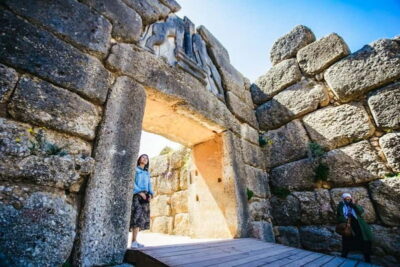
- Mycenae: cyclopean walls, Lion Gate area, and the Tomb of Agamemnon
- Treasury of Atreus: the lintel detail you should not skip
- Museum stop at Mycenae: when you want context without extra driving
- How private driving and English commentary work here
- Price and value: why $312.38 can be fair for a private day
- Who should book this Argolis day trip
- Should you book this tour or choose another plan?
- FAQ
- What locations does this private day tour cover?
- How long is the tour?
- What time does the tour start?
- Is pickup from Athens or Piraeus included?
- Are entrance fees included?
- Does the driver provide commentary in English?
- Can the driver enter the archaeological sites with you?
- Is there a skip-the-line option for tickets?
- Is the tour family-friendly, and are child seats available?
What I like most: the pacing and the logistics
I love how the day is built for real time on your feet, with real stops for the theatre, the sanctuary, Nafplio old town, and the Mycenae acropolis area. I also love the private setup, because you can tweak the flow to your group, rather than being stuck to a rigid bus schedule.
More of Mycenae, Epidaurus and Nafplio

A key consideration: entrance fees and guides inside sites
The big downside is straightforward: the entrance fees are not included, and the driver generally does not enter the archaeological sites. If you want a licensed guide inside Epidaurus and Mycenae, plan for an added cost.
Highlights that make this tour worth your time
- Corinth Canal views you can’t get from the highway, plus time to appreciate how ships use it
- Epidaurus theatre acoustics, with the classic detail about hearing even a match strike far up the rows
- Asklepios sanctuary context for why Epidaurus mattered for healing in Greek and Roman times
- Nafplio’s “slow down” break, including time in town for photos and choosing your own lunch
- Mycenae’s cyclopean fortifications and Tomb of Agamemnon, timed so you can look without rushing
- Skip-the-line help for the entrance tickets, reducing stress at busy moments
Entering the Peloponnese with a plan that starts on time
This is a full day out of Athens, starting around 8:00 am, usually returning about 8 to 9 hours later. In practice, travel time plus site time can push it closer to 9.5 hours, so treat this as a true day trip, not a quick add-on.
The best part is how the itinerary is sequenced. You start with Corinth Canal, then move to Epidaurus for the theatre and healing sanctuary, then shift to Nafplio for the emotional reset of a seaside town, then close with Mycenae where the morning’s ancient Greece turns into Late Bronze Age power.
You also get pickup from Athens center hotels or Piraeus hotels, and pickup and drop-off at the Piraeus ferry port. If you are coming in by cruise, that one detail matters. It turns a port day into an organized excursion instead of a puzzle of taxis and timing.
Corinth Canal: the ship shortcut you can actually see
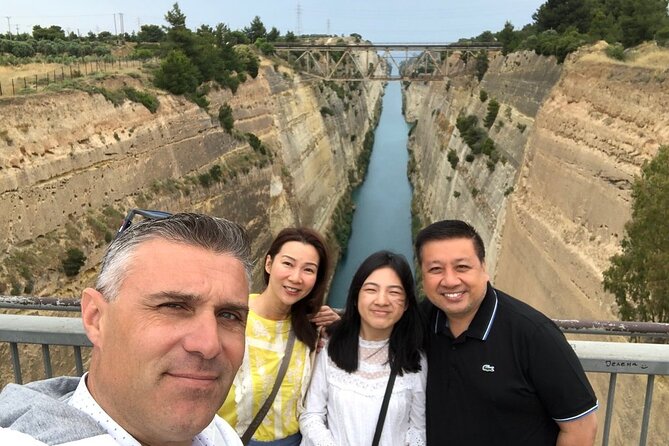
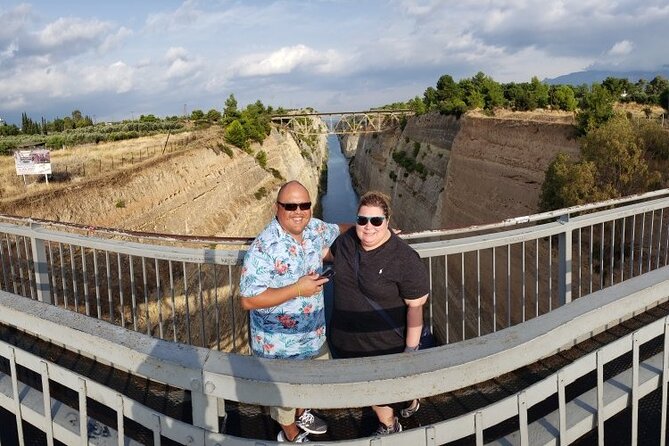
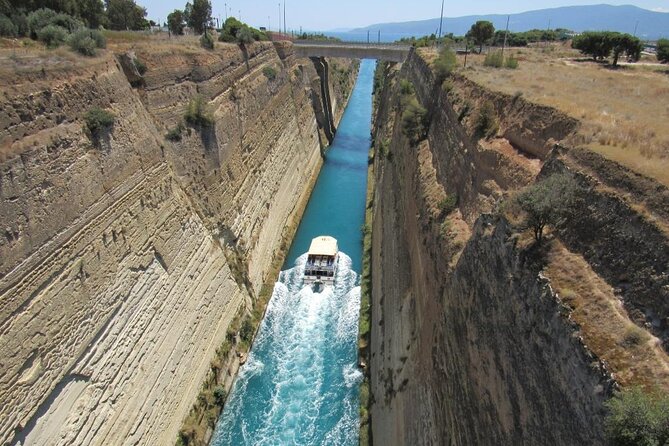
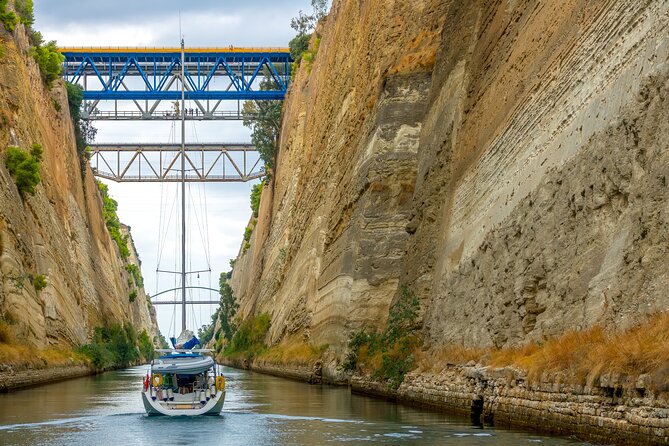
Corinth Canal is only about 6.3 km long, but it has an outsized role in Greek maritime routes. The canal links the Gulf of Corinth with the Saronic Gulf, and it physically separates the Peloponnese peninsula from the mainland, like a man-made hinge that changes how routes work.
Here is why this stop is more interesting than a quick roadside photo. The canal is narrow, and still it saves ships a huge detour, reported as 185 nautical miles. You also get strong perspective on the scale: about 26 feet deep, with widths changing from roughly 69 feet at the bottom to around 82 feet at the surface, and walls that rise about 170 feet.
Timing is tight in a good way. You have about 30 minutes here, with free admission ticket. You are not expected to treat it like a full museum visit. Instead, you use the short window for photos and for that wow moment when you realize how engineering can reshape geography for modern travel.
Practical tip: If you care about photos, do it early in the stop, before the busier moments. You will also want to dress for sun and wind. Canal views can be bright, and the breeze can change fast.
Epidaurus theatre: why people talk about acoustics
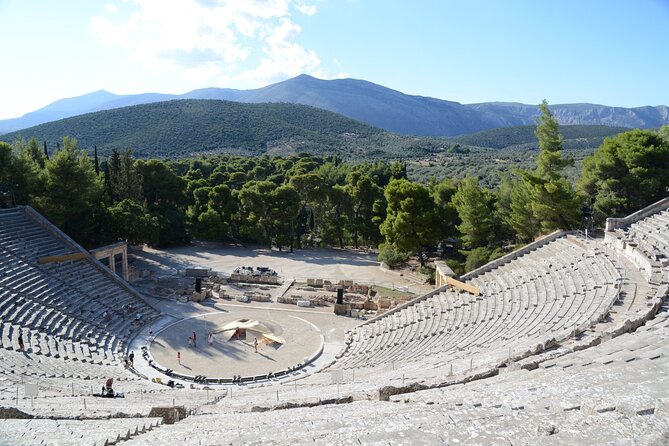
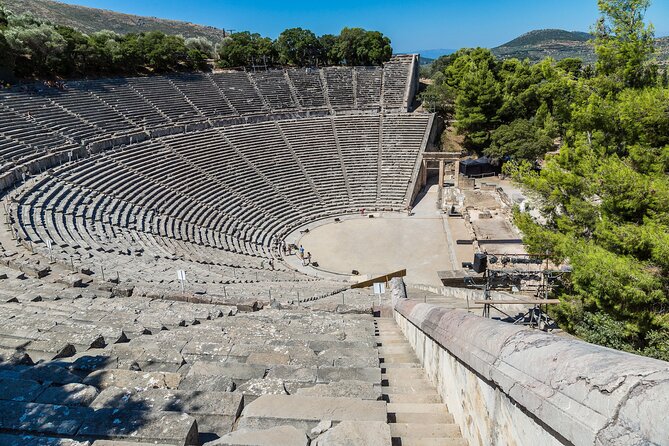
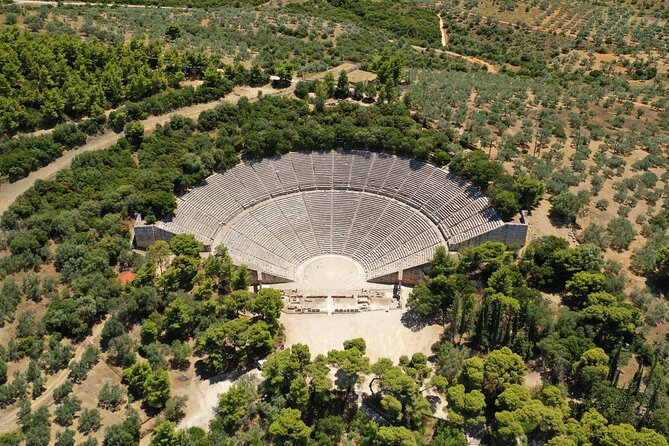
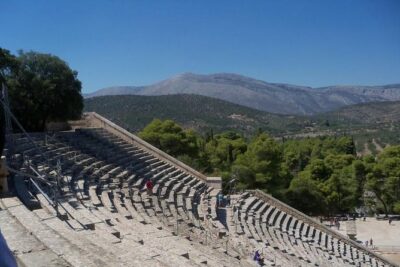
Epidaurus is one of the most preserved and best known classical theatres in Greece, and the itinerary hits the right basics. The theatre was built around 330 to 20 BC, then enlarged in the mid 2nd century AD. What matters for your visit is the structure: 55 rows of seats on a natural slope facing the stage area, with a backdrop of greenery.
The headline feature is the famous acoustics. The theatre is known for carrying sound clearly across long distances, with the classic example that even a whisper or a sound like a struck match can be heard nearly 60 meters away. You are standing in the kind of design that makes you appreciate Greek engineering, not only Greek art.
You get about 30 minutes at this stop, and it is not included in admission fees in the itinerary summary. Epidaurus itself is priced separately, and you should budget for entry. Plan for a slightly longer pause if you want to sit and look around from different rows, but don’t fall behind the group. This day is carefully balanced around travel time.
A small reality check: 30 minutes goes by fast in a theatre. Bring patience for the viewing, then move when your driver calls it. It is the only way you will still have time for the sanctuary and Nafplio later.
More Athens bookings just for your own group
- Best of Athens Half Day Private Tour★ 5.0 · 3,714 reviews
- Athens Full Day Private Tour★ 5.0 · 2,903 reviews
- Athens Airport Private Arrival Transfer with Meet & Greet★ 4.5 · 1,495 reviews
- Athens Airport to Athens Hotels Private Arrival Transfer★ 5.0 · 947 reviews
Sanctuary of Asklepios: ancient healing beyond the myths
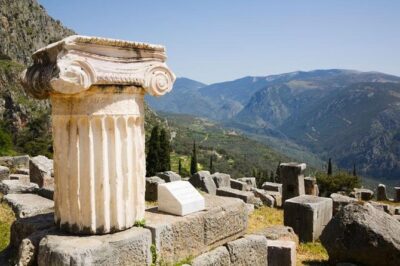
Right behind the theatre theme is something completely different but tied to the same place: the Sanctuary of Asklepios. This sanctuary sits in the mild hinterland around Epidaurus, famous for mineral springs and a tradition of healing that spread through Greek and Roman worlds.
You do not have to be a medicine nerd to enjoy it. What makes this stop land is the storytelling the site naturally invites. The sanctuary belonged to the coastal town of Epidaurus, but its reputation grew far beyond the region. It is often described as the birthplace of medicine and associated with large numbers of dependent healing facilities across the eastern Mediterranean, said to be more than two hundred.
As you walk around, you get a sense of how the site shifts from divine stories into practical observation. The monuments and remains are connected to the practice of medicine in antiquity, including the idea that healing moved from purely god-driven faith into systematic case descriptions and accumulated knowledge.
You have about 30 minutes at the sanctuary, and like the theatre, it is part of the paid Epidaurus entry plan. If you are the type who likes to read inscriptions or see votive offerings up close, take your time at the points that catch your eye, then keep moving. This is not a “wander for hours” site on a fixed day trip.
Epidaurus Museum: the quiet payoff if you still have energy
The Epidaurus Archaeological Museum is located within the sanctuary complex. You get around 30 minutes here, and it includes architectural pieces and objects connected to the sanctuary.
This is a helpful stop because it gives you the physical objects behind the big ideas. You can see inscribed columns and pedestals, altars, bronze medical equipment, sculpted votive offerings, tablets, and representations connected to the temple, as well as parts of a structure called the Tholos.
If you are tired after the theatre and sanctuary walk, the museum is a good “rest without stopping” option. It is not only scenic. It is also interpretive, so you can connect what you saw outdoors with artifacts that explain the setting.
If you have mobility limits, prioritize the theatre first, then ask your driver where to focus most. The private format helps here, because you can spend a little more time with what you care about, and less on what you do not.
Nafplio: the payoff town break between ancient sites
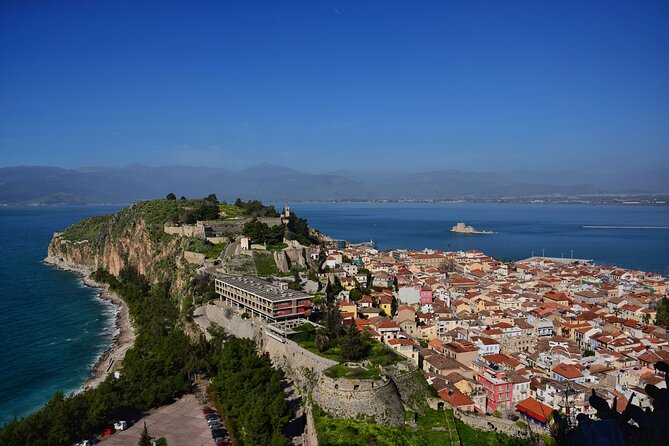
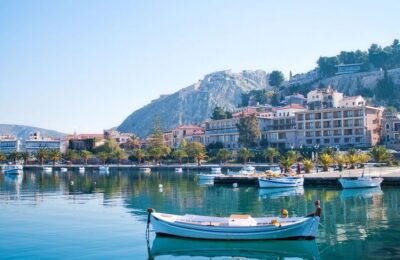
Then comes the change of pace: Nafplio. This town is often described as one of the most beautiful in the Argolis area, and it earns that reputation with variety. You get ancient walls and medieval fortifications, plus castles and monuments, Ottoman fountains, and Venetian or neoclassical architecture.
What I like about including Nafplio is that you can actually breathe. After Epidaurus, your brain is full of chronology. Nafplio resets it with streets you can wander, views that invite photos, and a real meal choice.
This stop runs about 1 hour, with admission free. The town also matters historically. Nafplio was the first capital of the newly born Greek state, between 1823 and 1834, which helps explain why you see so many layers of governance and culture.
There is even a mythology angle. The town is linked to Nafplios, described as the son of Poseidon and the daughter of Danaus. You do not need to recite it. You just notice that Greek myth is not a separate topic here. It is part of how people explain place.
Lunch reality: meals are not included. You choose your own spot in town. For a practical reference point, one commonly recommended place that came up in real day-trip planning is Mitato. Ask your driver for a simple option that fits your walking tolerance and the time you have.
Mycenae: cyclopean walls, Lion Gate area, and the Tomb of Agamemnon
Mycenae is where the day’s scale ramps up. It sits on a hilltop, reached on the road between the Argolic Gulf and routes north. The site shows settlement since the Neolithic period around 4000 BC, but the big peak is the Late Bronze Age, 1350 to 1200 BC.
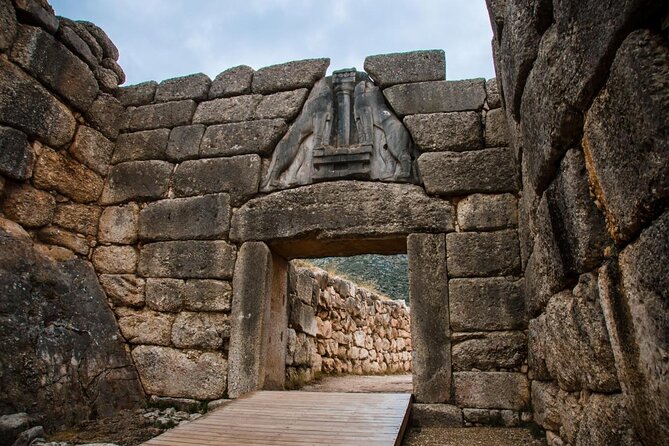
That is why the remains feel so “heavy” even before you reach the main features. During this period, the acropolis was surrounded by massive cyclopean walls, described as built in three stages around 1350, 1250, and 1225 BC. There is also a natural defensive gap on one flank where a ravine did part of the job.
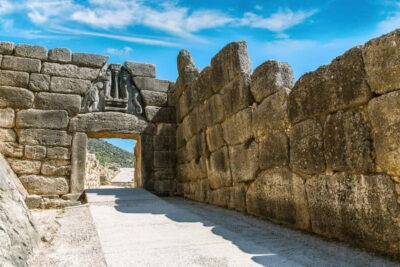
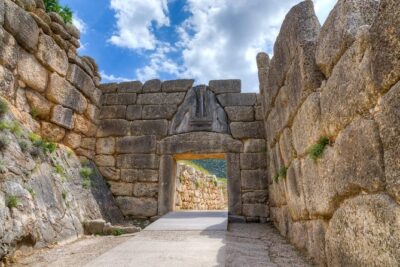
If you want the highlights you should look for in the time you have, this itinerary points you toward the key areas. You can see mentions of the palace summit, the wall-painted Cult Center, the main gate area called the Lion Gate, and Grave Circle A, tied to burial of Mycenaean royalty. There is also a tunnel built in cyclopean masonry leading to a subterranean fountain around 1225 BC.
Time is limited, but the route is still structured. You get about 1 hour at the archaeological site, and then a separate paid stop at the Tomb of Agamemnon area.
Admission: Mycenae entry is not included in the base price, but it is listed as a set fee for visiting Mycenae. Budget accordingly.
Treasury of Atreus: the lintel detail you should not skip
The Treasury of Atreus, also called the Tomb of Agamemnon, is a tholos or beehive tomb on Panagitsa Hill, constructed around 1250 BC. The architecture is what you came for, but the detail that sticks is the doorway lintel.
The stone lintel over the entrance is listed as weighing about 120 tons, with dimensions around 8.3 x 5.2 x 1.2 meters. That is the kind of fact that makes the stop feel bigger than the time block allows.
You have about 30 minutes here. Use it to look at the entrance and then do one slow scan back over the tomb structure. Even without a guide inside, your eyes can catch the beehive shape and the way the structure controls movement.
If you are prone to rushing, this is a good place to slow down, because the physical scale is the star.
Museum stop at Mycenae: when you want context without extra driving
After the outdoor site, the itinerary includes the Archaeological Museum of Ancient Mycenae. The museum is built in the archaeological site, which helps. You do not lose time crossing town or transferring to another venue.
You get about 30 minutes, and because it sits on site, it is often the easiest way to understand what you are seeing in your limited day window. The museum is particularly useful if the outdoors feels like a maze of walls and gate areas. Here, you can make sense of objects and site development.
Admission is not included in the base, but it is part of the Mycenae entry budget you already planned for.
How private driving and English commentary work here
The private format is not only about the car. It is also how information flows. The driver provides commentary in fluent English while you travel between stops.
But there is one important boundary: the driver generally cannot enter the archaeological sites. That is not a deal breaker, but it changes what you get depending on how you like to travel.
If you want a more formal narrative inside Epidaurus and Mycenae, the option is there: a private licensed guide can escort you in the sites on request or availability, for an additional 350 euros. That can be worth it if you love inscriptions, art history, or you want tight accuracy on myths versus facts.
From the way guides and drivers are discussed for this company, the experience often hinges on the person behind the wheel and voice. Names that have come up include Apostle, Vasilis, Dominik, Sakis, Spyros, Nicos, George, Tassos, Mario, Tolis, and Dina. Even when someone is not a formal site guide, good en-route storytelling can make the whole drive more meaningful.
Practical move: if you care about inside-site explanations, request the licensed guide early, and share your interests. Otherwise, plan to enjoy the sites as strong visual encounters plus en-route context from the driver.
Price and value: why $312.38 can be fair for a private day
At $312.38 per person, this is not a budget bus tour. But private day trips in the Peloponnese are rarely cheap, because you are paying for real-time transportation, pickup, vehicle comfort, and coordination across multiple sites.
So what makes this price feel more reasonable?
- You get pickup and return from Athens hotels or the port.
- You get an A/C, insured, non-smoking vehicle suitable for your group size.
- You get help with skip-the-line ticket purchasing, which saves time and frustration.
- You get personalized pacing, meaning your group can spend more time where it matters to you.
The main cost you need to add on your own is entrance fees. Epidaurus and Mycenae each have listed entry costs, and that is where your real budget lands. If you add one formal licensed site guide, there is also the 350 euros option.
Bottom line: this tour is a good value if you want a smooth day without car rental stress, and you care about seeing both Epidaurus and Mycenae. If you are cost-first and happy to drive yourself, you might find cheaper options. But for most people coming from Athens, the convenience is the selling point.
Who should book this Argolis day trip
This tour fits best if you:
- Want to cover Epidaurus and Mycenae in one day without wrestling with multiple taxis and tickets.
- Prefer a private plan you can adapt, especially with families or mixed interests.
- Like day trips that include both “big ruins” and a human pause in a town like Nafplio.
- Want an easy structure where transportation and timing are handled, while you still have time to roam.
You might want to think twice if you:
- Hate paying separate site entrance fees.
- Expect the driver to act as an inside site guide.
- Want a slow, multi-hour museum-and-cafe kind of day. This plan is built for a full, active day.
Should you book this tour or choose another plan?
If your priority is seeing Epidaurus and Mycenae with clean logistics and a flexible private pace, I would book this. The stops line up well: canal for engineering scale, Epidaurus for acoustics and healing context, Nafplio for a real town break, and Mycenae for Late Bronze Age power.
The decision comes down to one question. Do you want to pay extra for better inside-site interpretation? If yes, the licensed guide option can upgrade the day in a meaningful way. If not, you can still have a very satisfying visit using the driver’s English commentary plus your own walking time inside the time you have.
If you do book, I’d budget for entrances up front and pack for a long day, sun, and stairs. Then enjoy the best kind of Greek day trip, one where the driving does not feel like wasted time.
FAQ
What locations does this private day tour cover?
It covers Corinth Canal, Epidaurus (including the Ancient Theatre and Sanctuary of Asklepios), the Epidaurus Archaeological Museum, Nafplio, and Mycenae (including the Citadel and Treasury of Atreus, plus the Archaeological Museum of Ancient Mycenae).
How long is the tour?
The tour is listed as about 8 to 9 hours.
What time does the tour start?
The start time is 8:00 am.
Is pickup from Athens or Piraeus included?
Yes. You can get pickup from Athens center hotels or Piraeus hotels, and also from the Piraeus ferry port. Drop-off is at the same location as pickup.
Are entrance fees included?
No. Entrance fees to the sites are not included, and the tour lists fees specifically for Epidaurus (€20 per person) and Mycenae (€20 per person).
Does the driver provide commentary in English?
Yes. The driver provides commentary in fluent English during the trip between sites.
Can the driver enter the archaeological sites with you?
No. The driver provides en-route commentary but cannot enter the archaeological sites. A licensed guide can be arranged for inside the sites on request/availability.
Is there a skip-the-line option for tickets?
Yes. The tour includes skip the line service to purchase the appropriate entrance tickets in advance.
Is the tour family-friendly, and are child seats available?
Yes. It is described as family-friendly, and child seats are available upon request.
The Rest of Athens





Every Other Athens Write-Up
- All Day Cruise -3 Islands to Agistri,Moni, Aegina with lunch and drinks included
★ 5.0 · 4,958 reviews



Mycenae, Epidaurus and Nafplio

Everything else we have written up around Athens




Mycenae, Epidaurus & Nafplio, side by side.
 ★ 4.8From Athens: Mycenae, Epidaurus & Nafplio Full Day TripFrom $332,438 reviews
 ★ 4.5From Athens: Mycenae, Epidaurus & Nafplio Full-Day TourFrom $331,580 reviews
 ★ 4.54-Day Classical Greece Tour: Epidaurus, Mycenae, Olympia, Delphi, MeteoraFrom $766732 reviews
 ★ 4.8Athens: Ancient Corinth & Nafplio Full Day Trip with SwimFrom $44523 reviews
 ★ 4.5Mycenae and Nafplion Day Trip from Athens with Official guideFrom $78501 reviews
 ★ 4.2Argolis: Full-Day Tour in Mycenae & NafplioFrom $41350 reviews
 ★ 4.53-Day Classical Greece Tour: Epidaurus, Mycenae, Nafplion, Olympia, DelphiFrom $520342 reviews
 ★ 5.0Mycenae, Epidaurus, Nafplio Full Day Private Tour from AthensFrom $229270 reviews
Sits on these lists