
Review · METEORA MONASTERY TOURS
Full-Day Meteora Tour from Thessaloniki by Train
Sky-high monasteries make the whole trip feel special. This full-day tour pairs a train ride to Kalambaka with a van ride up to Meteora’s active cliff monasteries and hermit caves. Two things I really like are the rail scenery on the way out, and the way your guide turns legends and monastery life into something you can picture. The main drawback is the day is long, and if the trains run late, you will feel it.
When everything clicks, it turns into a smooth rhythm: guide talk, photo stops, then stair and viewpoint moments that hit hard in the best way. I’ve seen this trip described as running well with guides such as Katerina and drivers like Dinos, who handle tight roads with confidence and help the group get good angles for photos. Just keep expectations realistic: you are trading time for convenience, and Meteora’s vertical terrain asks for sturdy shoes and patience.
In This Review
- Key Things to Know Before You Go
- Meteora From Thessaloniki, The Train-to-View Formula
- The Rail Journey: What the Thessaloniki to Kalambaka Day Really Feels Like
- Kalambaka Pickup and the Mercedes Sprinter Van Ride Up
- Saint Nicholas of Anapafsas and Roussanou: First Views and Real Stair Work
- Great Meteoron Monastery: The Giant, the Name, and the Organized Monastic Shift
- Varlaam and the Artwork Story Behind the Walls
- Holy Trinity (Agia Triada) and Agios Stefanos: Most Steps, Easiest Access
- Lunch, Timing, and the One Hour in Kalambaka Town
- Price and Value: Paying $59 for a Full-Experience Day
- Who Should Book This Meteora Day Trip (and Who Might Prefer a Slower Plan)
- Should You Book This Full-Day Meteora Train Tour?
- FAQ
- What time does the tour start?
- How long is the full-day Meteora tour?
- Does the price include train tickets and transport?
- Are monastery entrance fees included?
- Is lunch included?
- What should I wear to visit the monasteries?
- Is the tour dependent on weather?
Key Things to Know Before You Go
- Round-trip train fare is part of the deal, starting at 8:15 am from Thessaloniki railway station
- Mercedes van transfer from Kalambaka includes air-conditioning and Wi-Fi for the ride up and between stops
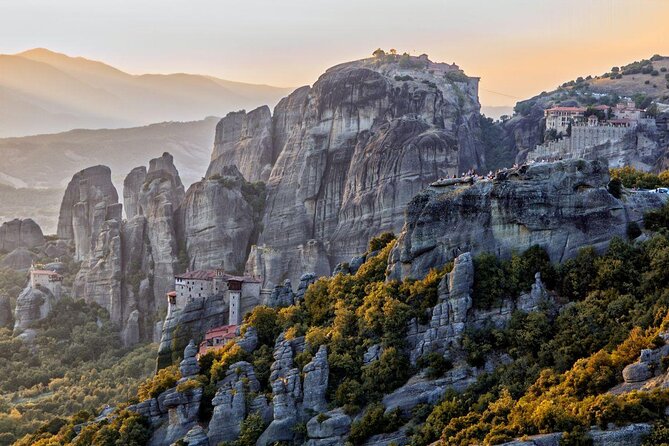
- Three monastery visits with a guide focus on active sites and the stories behind them
- Badovas hermit caves and nearby monastery exteriors add variety beyond the interiors
- Expect stairs and steep climbs, including about 140 steps for the Holy Trinity area on this route
- You get about an hour in Kalambaka town, so you can reset before heading back to Thessaloniki
More ways to see the Meteora rocks and monasteries

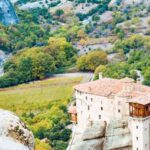

Meteora From Thessaloniki, The Train-to-View Formula
Meteora is one of those places where the setting does half the work. You’re not walking through a flat “attraction.” You’re riding rails through Greece, then switching into a van climb toward cliff monasteries that look like they were set there by legend.
What makes this tour practical is the structure. You start at Thessaloniki at 8:15 am, ride the train to Kalambaka, then your driver meets you and takes you up to the monasteries. You’re not left trying to solve timing, connections, or local transport mid-day. And because you have a guide, you don’t just see stone and paint. You learn why these places were built where they are.
The other big plus is the balance of experiences. You get Panoramic viewpoint time while moving between sites, plus guided stops at major monasteries. And you also get a change of pace with the hermit caves of Badovas, which helps break up the “monastery, monastery, monastery” feeling.
The only caution I’d flag is timing. Greek trains can run late. Some people have reported waiting on a platform longer than expected, even late into the day. So if you are the type who hates schedule stress, plan your trip with a little slack and do your best to stay calm if a connection feels tight.
The Rail Journey: What the Thessaloniki to Kalambaka Day Really Feels Like
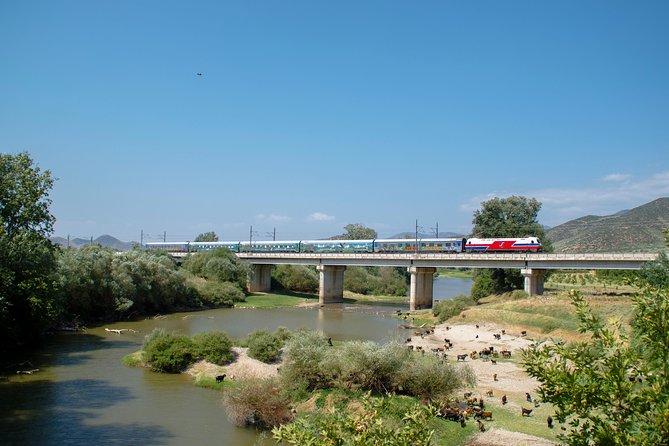
This day starts with train travel, and that matters. The ride gives you an early taste of the Greek countryside before you hit the intense vertical drama of Meteora. The tour provides tickets and uses a route that can involve a train change at Paleofarsalos station, so you should be ready to follow the group and watch the platform information.
You’ll also be dealing with the reality of train comfort. The tour cap is up to 34 travelers, so the train portion might feel lively. Based on past experiences shared with this tour, seating can range from pleasantly manageable to crowded depending on the specific train connection that day. It’s not the part to judge the whole trip by.
Here’s what you can do to make the rail portion work for you:
- Bring a water bottle or rely on the mineral water included by the tour, then top up later in Kalambaka.
- Wear layers. Early morning can feel cooler, and train cars vary.
- Keep your eyes on the departure signs during train transfers. One traveler noted that the wording on a ticket transfer could be confusing if you are not already paying attention.
If you’re short on time in Greece, a train day can still be a good deal. But it is still a full day out of your schedule, so treat it as the main event.
Kalambaka Pickup and the Mercedes Sprinter Van Ride Up
Once you reach Kalambaka, you meet an English-speaking driver at the station. From there, the tour uses a comfortable Mercedes Sprinter van with Wi-Fi and air-conditioning. This matters because the roads around Meteora are narrow and winding, and you want local confidence behind the wheel.
This is also where the trip shifts from “travel mode” to “experience mode.” You move from station to cliff in a way that feels coordinated, with the group staying together. Along the route, you’ll see the dramatic stone formations and valley views that make Meteora famous.
The driver experience can make a noticeable difference. People have described drivers such as Dinos and Sotos as skillful on tight roads, plus helpful with photo angles. Even if you are not a serious photographer, it’s a relief when the vehicle knows where to stop for safe quick pictures.
If you get motion sick, it’s still worth noting. The van ride is not the worst kind of driving, but it is more curvy than a typical city transfer. Plan accordingly, especially if you are traveling with someone sensitive to winding roads.
Saint Nicholas of Anapafsas and Roussanou: First Views and Real Stair Work
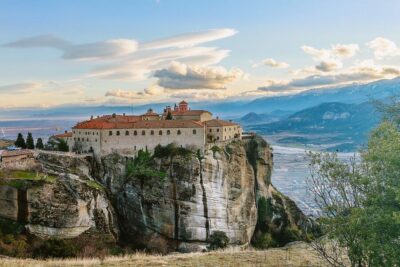
The tour’s first big monastery encounter is the Holy Monastery of Saint Nicholas of Anapafsas, founded at the end of the 14th century. The name Anapafsas is tied to different explanations, including the idea that it may relate to being a first stop for pilgrims who needed rest before continuing upward.
This stop is a good introduction because it sets the stage: the scale of the rock, the way the monastery fits into the cliff, and the fact that these were built for solitude and safety. You’re also starting to feel the day’s pace, because even though the tour includes “a small amount of walking,” Meteora is still stair country.
Then you move to the Holy Monastery of Roussanou. This one is often described as more accessible than some other rocks because it sits at a lower elevation. Roussanou also has a history shaped by the 20th century. It suffered severe damage during World War II, later becoming a convent in 1988.
If you want to understand why Meteora is more than scenic views, Roussanou helps. It reflects how these communities changed over time, not just how they looked when they were first built. And it’s a reminder that “active monastery” means living history, with people still using the sites, not just visiting them.
Dress rules apply at every stop. Plan for modest clothing: women should not wear short skirts and should have long sleeves, and men cannot wear shorts. The sites are religious spaces, and you’ll want to respect that without scrambling mid-day.
Great Meteoron Monastery: The Giant, the Name, and the Organized Monastic Shift
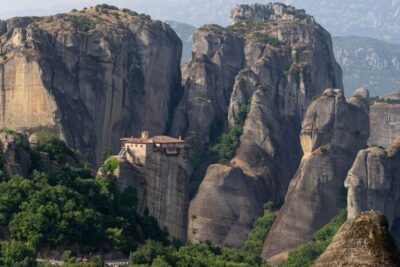
Next comes Great Meteoron Monastery, often treated as the anchor site. It’s described as the biggest and oldest monastery in Holy Meteora, and the name connects to the idea of being “suspended in the air.” That word is the whole Meteora story in one glance: the geology is the dramatic backdrop, and human life built on it anyway.
The guide context here matters. Great Meteoron was founded by Saint Athanasios the Meteorite, who is also credited with organizing systematic monastic life (koenovion). So when you look at the rock and then at the monastery, you can hear the logic behind the layout: this was not random. It was structured community life in an extreme setting.
Time can be tight at this stop, since the tour is managing several monastery stops in one day. But even a shorter visit at Great Meteoron gives you a strong sense of scale. It’s also a place where you can get the classic Meteora feeling: cliff walls, painted surfaces, and that wide sky presence that makes you look up without meaning to.
A practical note: even if your body is tired, try to take a moment to slow down here. It’s easy to race for photos and miss what the architecture is doing. Great Meteoron is the best place in the route to remember that you’re looking at a whole system, not just a view.
Other ways around Thessaloniki
- Thessaloniki: Full-Day Bus Trip to Meteora★ 4.8 · 3,471 reviews
- Thessaloniki: OTE Tower Rotating Experience with Light Meal★ 4.6 · 857 reviews
- Full-Day Trip to Meteora from Thessaloniki★ 4.5 · 542 reviews
- Thessaloniki Hop-on Hop-off Sightseeing Bus Tour★ 4.0 · 473 reviews
Varlaam and the Artwork Story Behind the Walls
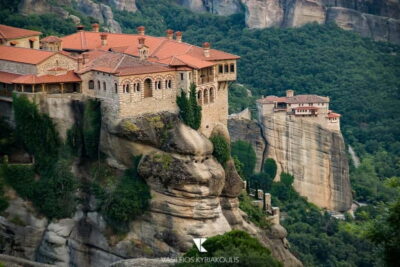
After the main giant, you move to Varlaam Monastery, described as the second biggest monastery and located opposite Great Meteoron. Varlaam’s origins are tied to the mid-14th century and to Hosios Varlaam.
What makes Varlaam especially interesting is the emphasis on what’s inside the church space. The Catholicon was built in honor of Agioi Pantes in 1541 to 1542, with main church decorations arriving around 1548. There’s also a strong art-historical thread connected to wall paintings attributed to Frago Catelano, described as a famous hagiographer from Thebes.
Even if you don’t care about art theory, this is one of those moments where a guide makes a big difference. The site becomes easier to read. You start noticing how patronage, time periods, and religious intent shape what you see.
The route also includes views and exteriors of nearby monasteries along the way. That matters because Meteora’s power is partly the “whole system” effect. You’re surrounded by other sites on the rocks, each with its own story and access level.
Varlaam is often a good compromise stop if you want variety. It’s not just another cliff look. The explanation gives it weight.
Holy Trinity (Agia Triada) and Agios Stefanos: Most Steps, Easiest Access
This part of the day is where your legs will either feel fine or start negotiating with you. The Holy Trinity Monastery (Agia Triada) is described as one of the more difficult to reach. It is perched on a steep rock, and visitors follow a pathway that starts near the foot of the rock before climbing about 140 steps.
The payoff is the panoramic view once you get up. More importantly, the history is specific: the monastery was organized since 1362, referenced in a document by Symeon Uressis Palaeologos. So when you feel that climb, you understand it as part of the design, not just a random obstacle.
If Agia Triada sounds like too much, the tour also includes Agios Stefanos, described as the most accessible. Here, instead of climbing a lot of steps, you cross a small bridge to enter. Monastic life on this rock goes back to the early 12th century, with founders like Hosios Antonios and Hosios Philotheos connected to rebuilding efforts in 1545.
Agios Stefanos includes two cathedrals: an older 16th century chapel badly damaged during WWII and the Greek Civil War, and an 18th century main cathedral dedicated to Saint Charalambos, which includes his holy relics. That combination makes it a powerful stop if you like history that shows continuity and disruption.
If you are building your day strategically, think of these as two ends of the spectrum. Agia Triada is the endurance stop with high reward views. Agios Stefanos is the “save your knees, still get a true monastery experience” stop.
And throughout, keep your camera ready. The clifftop monasteries and the stone formations in between are the whole point of Meteora, and you’ll pass enough viewpoints to fill a day’s worth of photos.
Lunch, Timing, and the One Hour in Kalambaka Town
Your day is long, roughly 13 hours. That includes the train ride, transfers, several monastery visits, and the ride back. The tour provides mineral water, but the big meal question is lunch.
Here’s the practical catch: the tour summary says lunch is included, but another part of the details lists lunch as not included. That means your confirmation should clarify what you actually get. If lunch is not included on your booking, plan to eat in Kalambaka during your free time.
You have about one hour of free time in Kalambaka town after saying goodbye to your driver and guide in the late afternoon. That’s enough to walk a main street, grab a snack, and reset. It is not enough for a deep dive into the town, but it can help you come off the rocks without feeling wiped out.
I like the way that hour is built in. Meteora is intense. You need a breathing space, and Kalambaka is the right kind of contrast.
Also, plan for the return to Thessaloniki. The day ends back at the meeting point, and because the rail segments can be delayed, it’s smart to avoid scheduling any tight plans for the evening back in Thessaloniki.
Price and Value: Paying $59 for a Full-Experience Day
This trip is priced around $59 for the day. That price is what makes it attractive if you are visiting Thessaloniki and want Meteora without figuring out transport on your own.
What you get for that cost:
- Round-trip train fare from Thessaloniki to Kalambaka
- A guided monastery experience
- Transfer by air-conditioned van with Wi-Fi
- Mineral water
What you pay extra for:
- Entrance fees noted at about 3 euros per person at each monastery
- Lunch, depending on your booking details (the information provided includes conflicting statements)
So is it good value? In my view, yes, if you want an all-in structure. Meteora is one of those places where time spent planning often costs more than the ticket. You’re effectively buying coordination plus interpretation. And the guide component matters here, because the real value is understanding why each monastery sits the way it does and what legends and historical shifts shaped it.
If you are willing to travel independently, you could potentially reduce cost. But the tradeoff is you’ll spend mental energy on timing, stairs, ticketing, and logistics. This tour removes those chores.
One more value point: group size is capped at 34, and the experience includes a comfortable vehicle. That should keep the day from feeling like a chaotic herd, as long as the train connection portion doesn’t turn into a squeeze.
Who Should Book This Meteora Day Trip (and Who Might Prefer a Slower Plan)
This tour fits best if you:
- Want to see Meteora in one day and keep the planning simple
- Like guided context, especially legends and monastery history
- Are comfortable with stairs and a day that runs long
- Prefer rail travel from Thessaloniki rather than full bus-only logistics
It might be less ideal if you:
- Are extremely schedule-sensitive and hate potential delays on train connections
- Have mobility limits that make steep stairs hard
- Want the freedom to linger at fewer sites more slowly
One lesson worth taking seriously is that Meteora can tempt you to rush. A one-day tour is efficient, but even a perfect day leaves you wanting more time at the places that grab you. If Meteora is a top priority and you can spare nights, a longer stay in the Kalambaka area can let you return for different light and a calmer pace.
Should You Book This Full-Day Meteora Train Tour?
If you want Meteora without the stress of transportation planning, I’d say yes, book it. The combination of train access from Thessaloniki, van transfer from Kalambaka, and a guide-led route through major monasteries gives you a complete Meteora day instead of a half-formed visit.
Book it with two realistic expectations. First, the itinerary is stair-heavy, and the climbs will be part of the day, not an occasional inconvenience. Second, trains can be late, so give yourself a buffer mentally and avoid tight evening plans in Thessaloniki.
If you’re flexible, this tour is a strong value at around $59, especially because you get rail fare, transfers, and guided monastery time packaged together.
FAQ
What time does the tour start?
The tour starts at 8:15 am at Thessaloniki railway station.
How long is the full-day Meteora tour?
It runs about 13 hours.
Does the price include train tickets and transport?
Yes. The tour includes round-trip train fare to Kalambaka and transport by air-conditioned vehicle with Wi-Fi.
Are monastery entrance fees included?
No. Entrance fees are listed as about 3 euros per person at each monastery.
Is lunch included?
The details provided are mixed. The tour summary says lunch is included, but another section lists lunch as not included, so check your booking confirmation.
What should I wear to visit the monasteries?
You’ll need appropriate clothing. Women should not wear short skirts and should have long sleeves. Men are not allowed to wear shorts.
Is the tour dependent on weather?
Yes. It requires good weather, and if it is canceled due to poor weather, you will be offered a different date or a full refund.
Every Other Thessaloniki Write-Up


Other Ways Around Thessaloniki
The Meteora Rocks, More Visits
Everything else we have written up around Thessaloniki




Meteora Monastery Tours, side by side.
 ★ 4.8Thessaloniki: Full-Day Bus Trip to MeteoraFrom $583,471 reviews
 ★ 4.7Athens: Meteora Monasteries Day Trip with Caves and LunchFrom $662,964 reviews
 ★ 4.8Athens: Meteora Monasteries Day Tour with LunchFrom $652,196 reviews
 ★ 4.8Athens: Meteora Tour with Local Guide and Greek LunchFrom $631,561 reviews
 ★ 4.5Athens: Meteora Monasteries, Caves & Coastal Stopovers with LunchFrom $881,432 reviews
 ★ 4.5From Athens: Delphi and Meteora 2-Day Guided TourFrom $271825 reviews
 ★ 4.54-Day Classical Greece Tour: Epidaurus, Mycenae, Olympia, Delphi, MeteoraFrom $766732 reviews
 ★ 4.5Athens: Meteora Monasteries, Hermit Caves Tour with PickupFrom $87724 reviews
Sits on these lists