
Review · ACROPOLIS & PARTHENON TOURS
Athens: Acropolis Guided Walking Tour without Entry Ticket
Stone and stories, two hours up on the Acropolis. This guided route is built to make the ruins feel readable, from the Acropolis gateway to the mythology tied to what you see. You get a clear walk, a licensed guide, and enough stops to keep your brain busy without rushing you off the hill.
What I like most is the way the guide turns stones into context, not just facts. On Spanish tours, guides like Juan are known for detailed, easy to follow explanations, and that matters a lot on a site as dense as the Acropolis. I also love the small-group feel, because you can ask questions and get answers in real time, not after the group has moved on.
One thing to plan for: the tour price is for the guide only, not the Acropolis entry ticket. You must buy your entry ticket in advance, and the time slot rules depend on the season and your tour start time.
In This Review
- Key Highlights You Should Know Before You Go
- First Steps at the Metro Acropolis Entrance
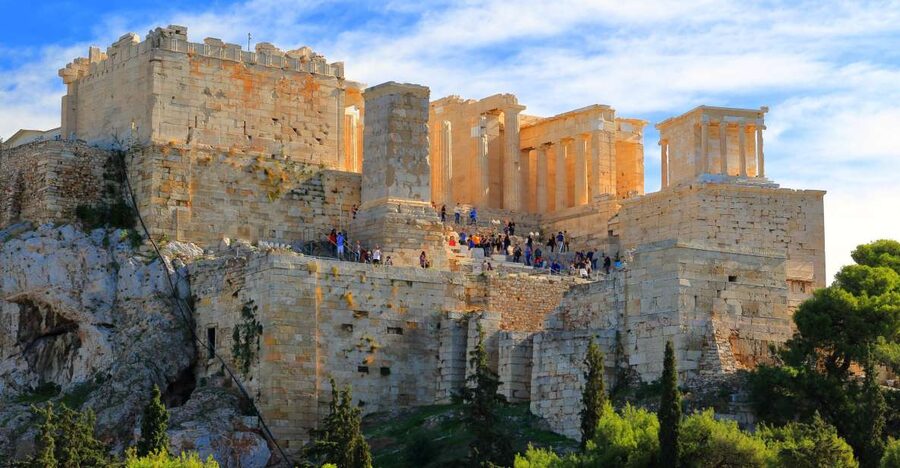
- Propylaea and Parthenon Views: Reading the Gateway
- Theater of Dionysus: Athens Where Plays Were Public Religion
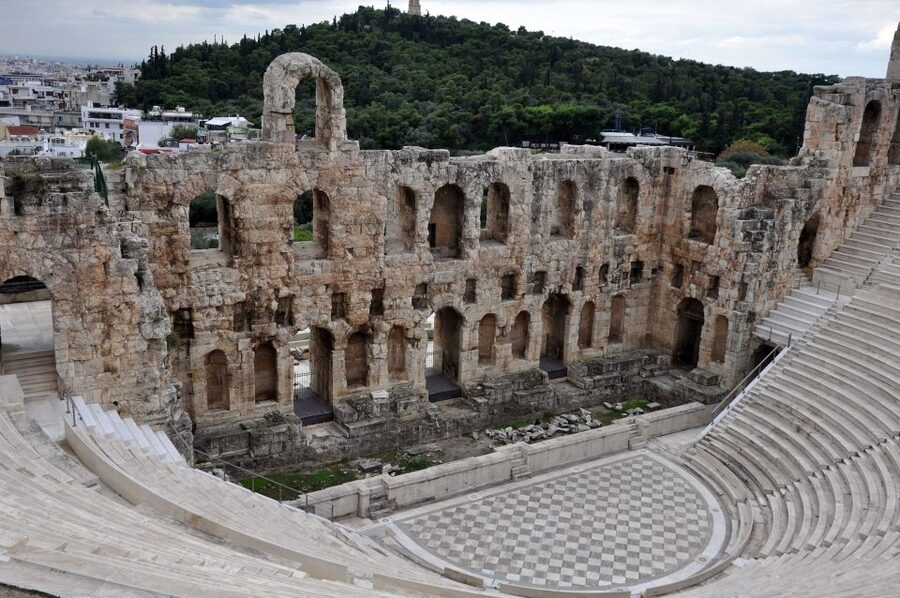
- Odeon of Herodes Atticus: When Stone Implies an Audience
- Erechtheion, Caryatides, and Temple of Athena Nike
- Temple of Asclepius: A Detour into Healing Myths
- Tickets Matter: Acropolis Entry Rules and Time Slots
- Small-Group Pace and Free Time to Stay Longer
- Is This 2-Hour Spanish Tour Worth $32.75?
- Should You Book This Acropolis Walking Tour?
- FAQ
- Is the Acropolis entry ticket included in this tour?
- Where do I meet the guide?
- How long is the guided walking tour?
- What language is the live guide?
- Do I need to buy the Acropolis ticket before the tour?
- Are strollers or wheelchairs allowed?
- If I buy the ticket at the office, where should I go and when?
- What if there is no availability for the entry ticket?
- Do I get time to explore after the guided part?
Key Highlights You Should Know Before You Go

- Licensed Spanish guide who connects each ruin to the stories and rituals tied to it
- Small group Q&A, so you can slow down for the parts that matter to you
- Theater of Dionysus with its scale explained, including the 17,000 spectator capacity
- Propylaea, Parthenon, and Athena Nike worked into one walk, so you get the big picture fast
- Caryatides and Erechtheion shown as more than pretty statues, with the naming explained
- Free time after the tour so you can linger at your own pace
Other ways up the Acropolis, side by side




First Steps at the Metro Acropolis Entrance
This is a walking tour that starts right where you want to be, at the entrance of the Metro station Acropolis on the street level. The meeting point is also easy to locate if you are using public transit, which is a win in Athens, where getting oriented can cost time.
Aim to arrive 10 to 5 minutes early. That buffer matters because the group needs to gather, your guide needs to check everyone in, and then you start moving. The tour also ends back at the same meeting point, so you do not have to figure out a second pickup location or manage a complicated handoff.
The tour lasts about 2 hours, and the guide language is Spanish. The “without entry ticket” setup changes how you should think about your day: you are buying time with the guide and structure for the visit, while the entry pass is your responsibility.
If you are traveling with a baby stroller, plan differently. Baby strollers are not allowed, and non-folding wheelchairs and electric wheelchairs are also not allowed. The site is uneven and steep, so this restriction is practical even if you are not sure why it exists.
Propylaea and Parthenon Views: Reading the Gateway
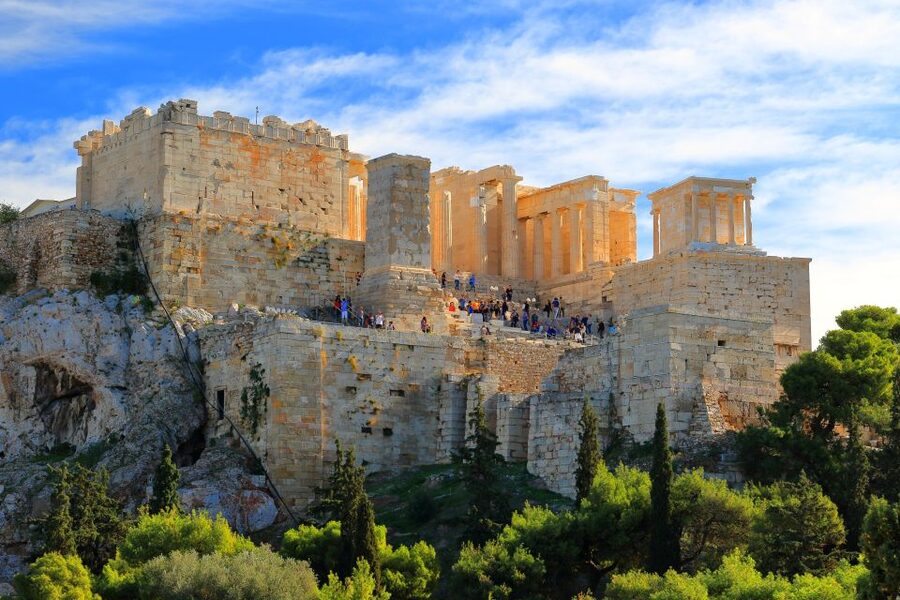
The walk builds around the main idea of the Acropolis: it is a monumental citadel that feels like a stage. The route takes you through the Propylaea, the gateway into the rocky hilltop area, and then on toward the Parthenon zone.
Seeing the Propylaea early is smart because it gives you orientation. Without that, you can end up “photo hopping” and missing the logic of how the spaces connect. With a guide, you get a sense of procession and purpose, not just individual sights.
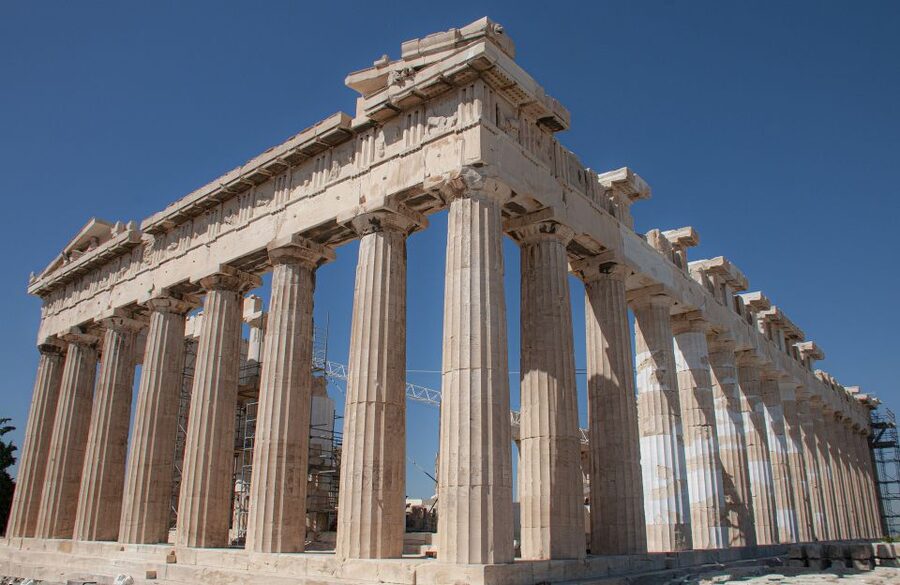
The tour also includes the Parthenon and the Acropolis dedicated to Athena, the goddess protector of the city. That framing helps you interpret what you see, because it tells you why Athena is showing up in the architecture and naming, not just in schoolbook terms.
A key detail here is that the guide does more than point and move. The commentary links the ruins to the festivals and religious life of ancient Athens. That is what turns the walk from a checklist into something that feels like you understand what the site was for.
Theater of Dionysus: Athens Where Plays Were Public Religion
One of the big draws is the stop at the theater of Dionysus. The guide explains its purpose and scale, including the fact that it held 17,000 spectators. That number alone makes the place feel different. It is not a small local venue, it is a major public space.
The tour also connects the theater to festivals honoring the Greek god, and it specifically mentions that it was used for ceremonies related to the birth of the Greek god. Even if you do not know the myths in advance, this kind of context helps you see the theater as part of community life.
Here is the practical benefit: when you understand that a theater could be tied to religious festival activity, you stop thinking of it as just an entertainment building. You start seeing it as a place where belief and culture played out in front of large crowds.
The downside is simple timing. The Acropolis can be hot and crowded, and your viewing time can feel shorter than you want if you are visiting mid-day. Having a guide helps you manage that by choosing the angles and keeping you moving without making it feel like a sprint.
Odeon of Herodes Atticus: When Stone Implies an Audience
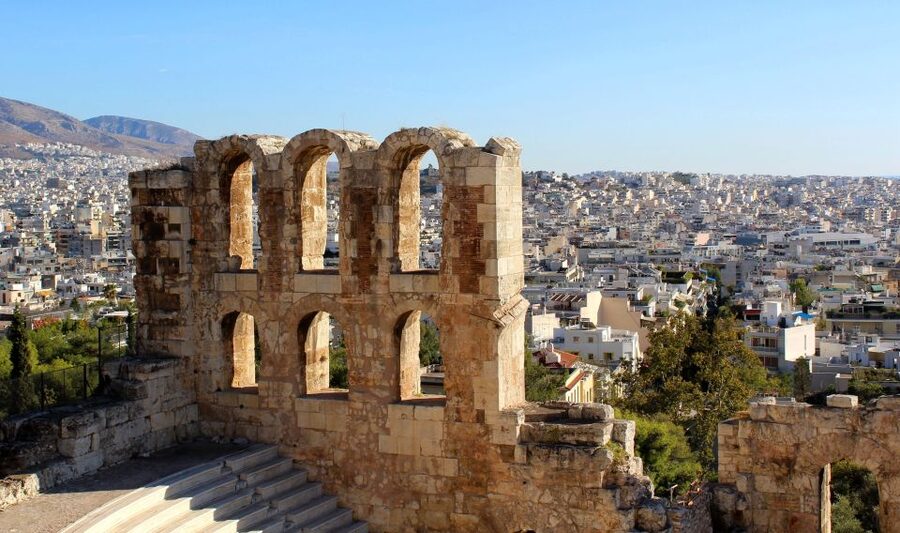
Another highlight is the Odeon of Herodes Atticus, described as a giant stone theater. You are not just looking at a dramatic structure, you are being guided through how it functioned as a major performance space.
This stop is valuable because it gives you contrast. The theater of Dionysus shows you one kind of stage, while the Odeon shows another form and scale of stone-built performance. When you see them together through a guide’s framing, you get a more complete picture of how performance space mattered.
The guide’s mythology and history commentary also helps you understand the naming and the idea that rulers and communities invested in architecture that lasted. On the Acropolis, context is what makes the stones feel connected rather than random.
And yes, it can still be crowded. One reason this tour rates highly is that guides tend to keep explanations going smoothly even when the group has to thread through other visitors. That makes the difference between a walk that is informative and one that feels stressful.
Erechtheion, Caryatides, and Temple of Athena Nike
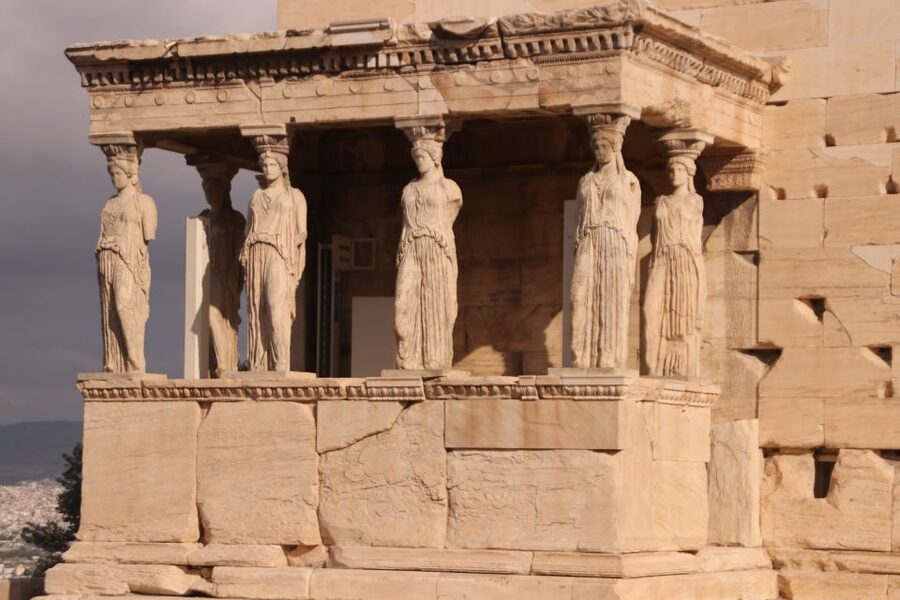
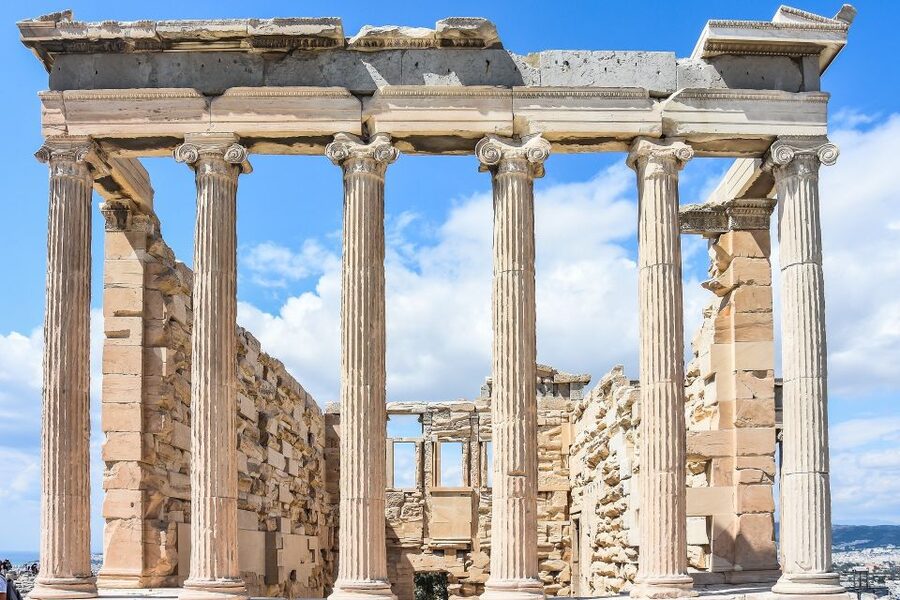
If you enjoy architectural details, this part of the route is where you start noticing “why these shapes exist.” The tour includes the Erechtheion, named after the demi-god Erechtheus, plus the Caryatides stone carvings and the Temple of Athena Nike, called the smallest temple on the Acropolis.
The value of having a guide here is that these are not just pretty monuments. The names matter, and the guide helps you connect the identity behind the building to what you are looking at.
The Caryatides are the kind of object that can look like a photo backdrop until someone explains the significance. With a guide, you understand them as sculptural figures tied to the site’s overall architectural language.
The Temple of Athena Nike being the smallest temple is an especially useful detail. It changes your expectations. You will look harder, not assume the biggest structure is automatically the most interesting. That shift is exactly what a good guide brings.
If you want more than pictures, ask questions here. The tour’s format is designed for interaction, and this is the moment when your curiosity will probably be at its highest.
Other Athens bookings where a guide comes along
- Athens: Cape Sounio & Poseidon Temple Trip with Audio Guide★ 4.4 · 4,521 reviews
- Athens: Mythology of Delphi, Museum and Arachova Guided Tour★ 4.6 · 4,008 reviews
- Acropolis: Acropolis and Parthenon Guided Walking Tour★ 4.7 · 3,442 reviews
- From Athens: Delphi Full Day V.R. Audio Guided Tour★ 4.6 · 3,028 reviews
Temple of Asclepius: A Detour into Healing Myths
The tour also includes the temple of Asclepius. That stop gives you a different angle on ancient Athens because you are seeing the Acropolis as more than politics and big public festivals. Asclepius is tied to healing, and the guide uses the site’s mythology and archaeological context to connect that association to what remains.
This is one of those stops that can be easy to overlook if you are only chasing the biggest names. But it is valuable because it broadens the story. You see the Acropolis as a place that served different roles in the lives of Athenians, not a single-purpose monument.
In a two-hour tour, you want variety, and Asclepius adds it. You walk away with more than the “top hits,” and the guide helps connect the smaller stop to the larger religious picture of the hill.
Tickets Matter: Acropolis Entry Rules and Time Slots
This is the part that can make or break your day. The tour does not include the Acropolis entry ticket. You are required to buy the ticket previously by the visitor, and you can buy online.
The time slot rule depends on season and tour start time. In low season (01/11 to 31/03), if your tour starts at 09:15, you have to buy an entry ticket for 09:00-10:00. If the tour starts at 14:30, the required entry time slot is 14:00-15:00.
In high season (01/04 to 31/10), the rules shift. For a tour starting at 08:15, you need an entry ticket for 08:00-09:00. For a tour starting at 17:00, you need 17:00-18:00.
That can sound fiddly, but it matters because entry times are timed. Buy the wrong slot and you can end up stuck with a ticket that does not match your schedule.
If you cannot get the ticket because there is no availability, the info says the provider will help you. If you plan carefully and buy early, you can usually avoid the last-minute scramble.
If you choose to buy at the ticket office, go to the ticket office area of the South entrance about 30 minutes before your tour time. After you receive the tickets, you must walk to the meeting point, which is less than 2 minutes from the ticket office.
Small-Group Pace and Free Time to Stay Longer
This tour is designed as a walking experience with a live licensed guide, and it tends to be a small-group format. That matters because it keeps the pace human. You get explanations without your guide constantly stopping, restarting, and losing people to the crowd.
A common issue at the Acropolis is that heat and congestion can make a guided experience feel rushed. The tour’s structure helps. You get stops that are interesting and spaced in a way that you can actually process, especially when your guide keeps the story going instead of just listing sights.
After the guided portion, you get free time to stay longer and explore the outstanding site at your own pace. I like this arrangement because it gives you control. If there is a corner you want to revisit for better photos or just to stare at details longer, you can.
So treat those extra minutes as your personal buffer. Use some for slow viewing, save some energy for the uphill paths, and do not overload yourself with a second big plan right after.
Is This 2-Hour Spanish Tour Worth $32.75?
At $32.75 per person for a 2-hour Spanish guided walk, the value depends on what you want to buy. This price is for the guide and structure. It does not include the Acropolis entry ticket, so your real day cost will be the guide fee plus your entry pass.
If you already plan to visit the Acropolis anyway, the guide can pay you back quickly. The guide’s explanations connect named landmarks like the Propylaea, Parthenon, theater of Dionysus, Erechtheion, Odeon of Herodes Atticus, Caryatides, Temple of Athena Nike, and Temple of Asclepius into one story. That means less guesswork, fewer dead-end photo moments, and more understanding as you walk.
The strongest “value signal” is the consistent praise for organization and for guides who explain history and mythology in a way that stays pleasant even in heat and crowds. When the guide is good, the site feels less overwhelming.
If you are a total mythology minimalist and you just want a slow self-guided wander, you might decide to skip the tour and put that money toward extra entry time. But if you want a fast, structured overview with real context, this is a fair price.
Also, the small-group style plus time for questions makes it feel less like a lecture and more like a guided conversation.
Should You Book This Acropolis Walking Tour?
Book it if you want a structured 2-hour way to understand the Acropolis, especially if you like hearing how myths, festivals, and named places connect. The combination of Propylaea, major theaters, Athena-related spots, and the smaller details like Caryatides is a strong mix for a limited time visit.
Do not book it if you already know you will not handle ticket planning well. The entry ticket is not included, and the time slot rules by season can be easy to miss. If that kind of logistics stresses you out, consider a package that bundles entry or schedule extra time for ticket confirmation.
If you do book, arrive early for the Metro Acropolis meeting point, double-check your entry time slot, and save energy for the walk uphill. You will come away with a much clearer sense of what you saw and why it mattered.
FAQ
Is the Acropolis entry ticket included in this tour?
No. The guided tour price does not include the Acropolis entry ticket. You must buy the ticket in advance.
Where do I meet the guide?
Meet your guide at the entrance of the Metro station Acropolis, on street level. The tour ends back at the meeting point.
How long is the guided walking tour?
The duration is 2 hours.
What language is the live guide?
The live tour guide is Spanish.
Do I need to buy the Acropolis ticket before the tour?
Yes. The ticket must be bought previously by the visitor. You can buy it online.
Are strollers or wheelchairs allowed?
Baby strollers are not allowed. Non-folding wheelchairs and electric wheelchairs are also not allowed.
If I buy the ticket at the office, where should I go and when?
If you buy at the ticket office, go to the ticket office area of the South entrance about 30 minutes before the tour time, then walk to the meeting point, which is less than 2 minutes away.
What if there is no availability for the entry ticket?
If you cannot get the ticket because there is no availability, the provider says they will help you.
Do I get time to explore after the guided part?
Yes. After the tour, you have free time to stay longer and explore the site at your own pace.
The Rest of Athens



Every Other Athens Write-Up
- All Day Cruise -3 Islands to Agistri,Moni, Aegina with lunch and drinks included
★ 5.0 · 4,958 reviews



The Acropolis, Other Ways Up

Everything else we have written up around Athens





Acropolis & Parthenon Tours, side by side.
 ★ 4.4Athens: Acropolis & up to 5 Archaeological Sites Combo PassFrom $4812,619 reviews
 ★ 4.2Athens: Acropolis Ticket with Optional Audio or Live GuideFrom $4211,055 reviews
 ★ 4.8Athens: Acropolis, Parthenon & Acropolis Museum Guided TourFrom $409,316 reviews
 ★ 4.6Athens: Acropolis and Parthenon Guided Walking TourFrom $385,882 reviews
★ 4.8Athens: Acropolis, Parthenon & Acropolis Museum Guided TourFrom $413,579 reviews
★ 4.6Athens: Acropolis and Parthenon Guided Walking TourFrom $385,882 reviews
★ 4.8Athens: Acropolis, Parthenon & Acropolis Museum Guided TourFrom $413,579 reviews
 ★ 4.0Athens: Acropolis Ticket with Audio GuideFrom $473,575 reviews
 ★ 4.7Acropolis: Acropolis and Parthenon Guided Walking TourFrom $363,442 reviews
 ★ 5.0Acropolis monuments & Parthenon Walking Tour with Optional Acropolis MuseumFrom $422,678 reviews
Sits on these lists