
Review · ACROPOLIS & PARTHENON TOURS
Athens & Acropolis Highlights: Greek Mythology Small-Group Tour
Myths make the Acropolis click into place. This 4-hour small-group walk connects Greek legends to the stones you see, and you might get guides like Irene, Dani, or Michael who are great at making the stories make sense. I especially love how Greek mythology is woven into real architecture, and I also like the guided pacing through the biggest highlights without making you rush. One possible drawback: Acropolis and Agora tickets are not included, so you’ll need to budget extra and plan for the steep, stair-heavy climb.
The tour starts at the Arch of Hadrian area near the Temple of Olympian Zeus and ends in the Ancient Agora zone, so you’re not shuttled around the city. You also get a mobile ticket and a fun Athens map, which helps if you want to keep exploring on your own afterward.
Main thing to plan for: at the Acropolis, you cannot bring strollers, backpacks, or big bags. Bring good shoes, carry a small amount of water, and keep your daypack options simple.
In This Review
- Key highlights at a glance
- Getting Oriented Near the Temple of Olympian Zeus
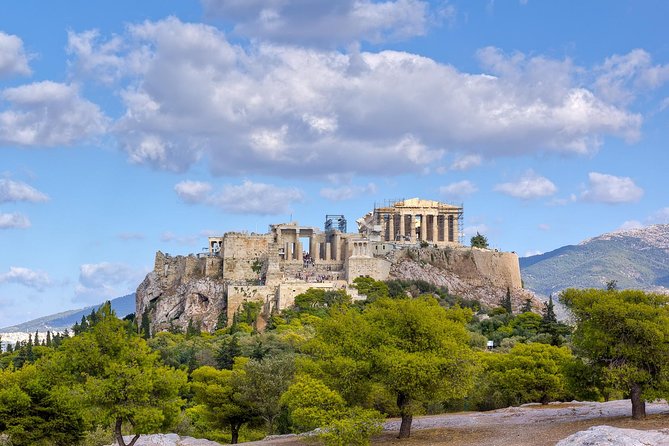
- Acropolis Time: Parthenon, Athena Nike, Erechtheion, and Friends
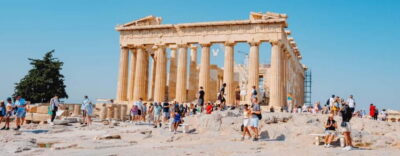
- The Parthenon, not just a famous photo
- Temple of Athena Nike, wingless and symbolic
- Erechtheion, and why it mattered so much
- Stairs, uneven ground, and the Acropolis bag rules
- Theatre of Dionysus: Where Plays Took the Spotlight
- Ancient Agora: The City’s Politics, Trade, and Justice
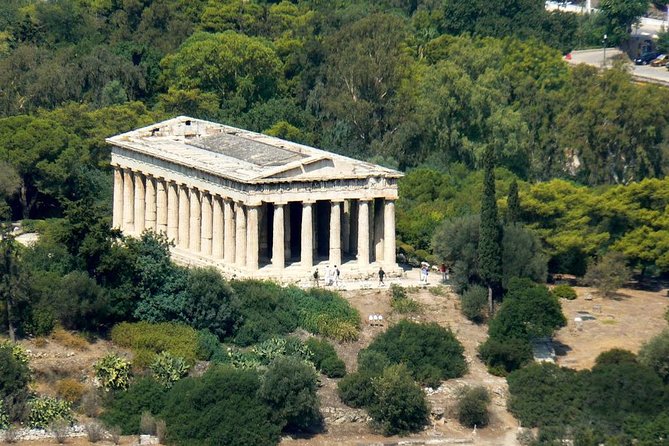
- Temple of Hephaestus: A Best-Preserved Stop With Two Deities
- Price and What You Actually Pay for
- Tickets, Shoes, and Bag Rules That Can Make or Break the Day
- How the Best Guides Make Myth Feel Useful
- Who This Tour Suits Best
- Should You Book This Athens and Acropolis Highlights Tour?
- FAQ
- How long is the Athens and Acropolis highlights tour?
- What is the price, and are entrance fees included?
- Where do I meet the guide, and where does the tour end?
- Is this a small group tour, and how many people are in the group?
- What language is the tour offered in?
- Do I need a ticket on my phone?
- Are there any bag or stroller restrictions for the Acropolis?
Key highlights at a glance
- Myth meets monuments: You learn why gods like Athena, Nike, and Dionysus matter to what you’re standing in front of
- Prime Acropolis views: Parthenon plus the smaller, easy-to-miss temples like Athena Nike and the Erechtheion
- The Theatre of Dionysus context: Find out why this is tied to the early rise of Greek drama
- Agora as the city’s engine: Politics, justice, shopping, and religion in one “daily life” setting
- A best-preserved temple payoff: Hephaestus gets the kind of focus ruins lovers appreciate
- Small group size: Maximum 15 people makes it easier to stay together in crowds
Other ways up the Acropolis, side by side




Getting Oriented Near the Temple of Olympian Zeus
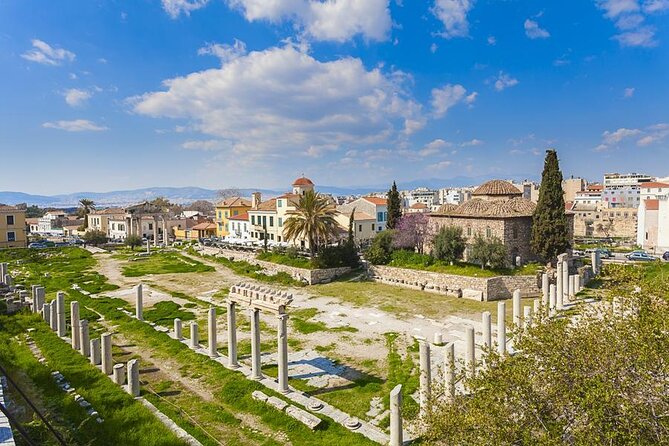
You start where a lot of first-time visitors lose their bearings: the Arch of Hadrian area, right by the Temple of Olympian Zeus. From here, you can understand how Athens feels in layers. There’s modern city noise, but the ancient “backbone” is still there if you know what to look for.
The guide takes you through the Olympeion from the outside. Even when you do not go inside, the scale is a story. This was one of the greatest temples of Zeus in the ancient world, and it sets the tone for how big Greek religion could be when it got government support and money behind it.
Practical note: this first stop is shorter, so it’s not a slow warm-up. It is more like a quick orientation so you can follow the rest of the tour without constantly asking, wait, where are we in the story?
Acropolis Time: Parthenon, Athena Nike, Erechtheion, and Friends
This is the main event, and it is not subtle. The Acropolis portion takes about 1 hour 30 minutes, and the focus is on the monuments that define classic Athens at its height.
Here’s what makes this approach valuable: you get context before you hit the busiest viewpoints. Instead of looking at the Parthenon as a postcard, you learn how the complex worked as a sanctuary, with Athena at the center. That makes the details easier to read.
The Parthenon, not just a famous photo
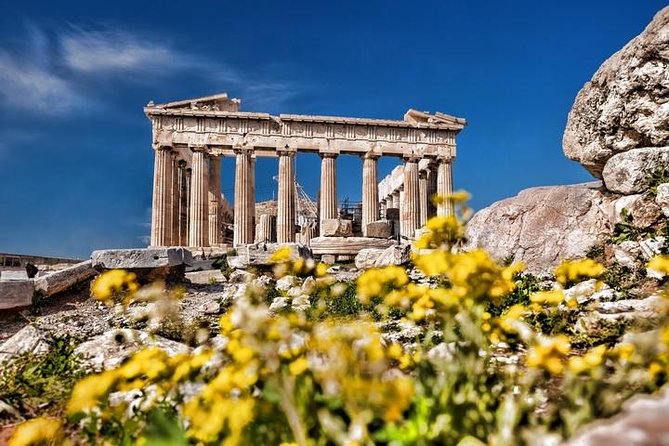
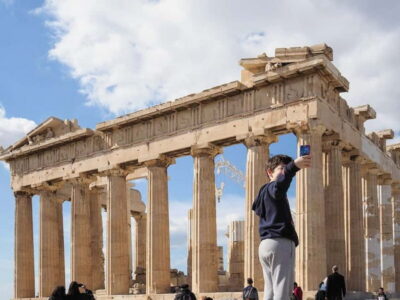
You’ll spend dedicated time at the Parthenon, which was built in the mid-5th century BCE and dedicated to Athena Parthenos. The guide talks about it as a culmination of the Doric order, meaning it represents a high point of that plain, sturdy style. When you notice the proportions and the rhythm, it starts to feel less like a single building and more like a designed statement.
Temple of Athena Nike, wingless and symbolic
One quick, important stop is the Temple of Athena Nike. It is tied to victory in Greek mythology through Nike, and the guide explains the legend about a cult statue with no wings so victory would not leave Athens. It is the kind of small myth detail that makes you see symbols instead of just stone.
Erechtheion, and why it mattered so much
At the Erechtheion, you’ll learn it was built to house a very old wooden cult statue of Athena. That detail helps you understand why the Acropolis wasn’t only about big public ceremonies. It also held sacred objects connected to tradition, identity, and civic pride.
- Athens: Acropolis & up to 5 Archaeological Sites Combo Pass★ 4.4 · 12,619 reviews
- Athens: Acropolis, Parthenon & Acropolis Museum Guided Tour★ 4.8 · 9,316 reviews
- Athens: Cape Sounion & Poseidon Temple Sunset Half-Day Trip★ 4.8 · 8,241 reviews
- Athens: Acropolis and Parthenon Guided Walking Tour★ 4.6 · 5,882 reviews
Stairs, uneven ground, and the Acropolis bag rules
The Acropolis climb can be steep and the surfaces are uneven. I would treat this as a real walking day, not a casual stroll. Wear shoes with good grip, bring water, and plan for sun.
Also take the bag rules seriously. At the Acropolis, strollers, backpacks, and big bags are not allowed, and the tour warns not to bring them. That means you should travel light with a small, carryable option (and know you may have limited places to store larger items).
The drawback here is simple: if you are not comfortable with steps and crowding, the Acropolis will feel like work. The trade-off is that you get guided clarity in the place that is easiest to misread on your own.
Theatre of Dionysus: Where Plays Took the Spotlight
Next comes the Theatre of Dionysus Eleuthereus, where the tour connects Greek religion to culture in a very direct way. Dionysus is linked to wine and grape harvest, and this theatre is described as the oldest founded theatre in Athens.
What makes this stop click is the connection to authors. You learn that works by Aeschylus, Sophocles, Euripides, and Aristophanes were performed here, tied to early first performances of major plays. It turns the seating area into something more human. You start imagining voices in the space, not just ruins in the landscape.
Time is tight at about 15 minutes, so you want to pay attention right away. If you only glance, you miss the “why this place mattered” part.
Ancient Agora: The City’s Politics, Trade, and Justice
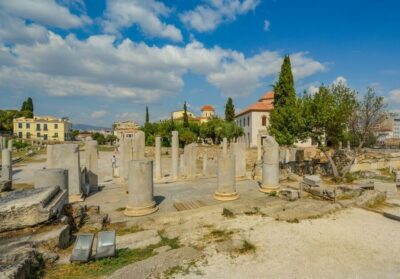
After the Acropolis, the mood changes. The Ancient Agora is not about height and skyline views. It is about daily life and how Athens ran.
You’ll spend about 1 hour at the Agora, and the guide frames it as the heart of ancient Athens: political and administrative activity, commerce, social life, religion, and even the seat of justice. That combination is why the Agora is more than a stroll through old stones. It is where civic identity was practiced.
If you like understanding systems, this part is a win. The myths help, but the Agora gives you the non-myth part too, the real-world machinery behind the stories.
One practical consideration: the Agora area can still be hot and exposed. Expect walking time, and plan to slow down if you need shade breaks. The best guides tend to work with the group’s pace, and I’d use the stops to hydrate.
Temple of Hephaestus: A Best-Preserved Stop With Two Deities
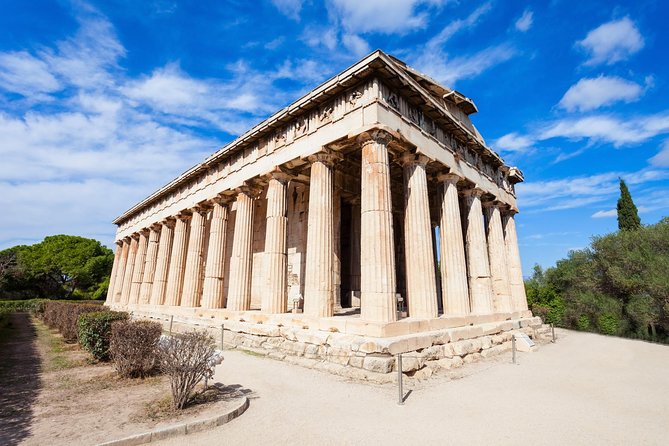
You finish with the Temple of Hephaestus, which the tour describes as one of the best preserved ancient temples in the world. That matters because well-preserved ruins are easier to interpret. You can notice more, and the building looks like it still belongs to the ancient city instead of being an outline.
This is also a smart myth and craft connection. The tour explains that the temple was worshipped by two deities important to merchants and workshop owners: Hephaestus, protector of metallurgists, and Athena Ergani, protector of potters and cottage industries. In other words, Athens was not only building palaces for gods. People worshipped for practical work, skills, and livelihoods.
It makes the ending feel satisfying, not abrupt. You go from the political and social hub to a temple that reflects the trade-focused life that kept the city going.
Price and What You Actually Pay for
The tour price is listed at $54.42 per person, and it is a fair deal for what you get: an expert certified guide, small group size (max 15), a map, and a structured route through the biggest iconic sites.
But the important part is the add-on costs. Acropolis admission is necessary for the 2-hour and 4-hour options, and it is listed as €30 per person. For the longer option, the Ancient Agora admission is listed as €20 per person.
So the value equation is: you’re not only buying a walk, you’re buying guided interpretation plus reduced stress in a crowded area. If you would otherwise wander and struggle to make sense of Doric orders, sanctuary purpose, and the links between gods and civic identity, the guide time can easily justify the base fee.
One tip: if you do not want to lose time at ticket windows, the tour notes you can pre-purchase entry tickets for you. That’s worth considering, especially if your schedule is tight.
Tickets, Shoes, and Bag Rules That Can Make or Break the Day
This tour is built around iconic open-air sites, so your logistics should be simple.
- Wear: good walking shoes. Expect uneven ground and stairs.
- Bring: water and sun protection. A hat helps a lot.
- Pack light for the Acropolis: strollers, backpacks, and big bags are not allowed.
- Think about youth discounts: an ID card or passport is required for people under 25 for possible discounts.
- Use the mobile ticket: you’ll have a mobile ticket rather than a paper voucher.
Also, the tour depends on good weather. If weather turns ugly, you may be offered a different date or a full refund. That flexibility is useful in Athens, where conditions can change quickly.
Finally, sound can be tricky in outdoor sites packed with people. To hear the guide clearly, I recommend staying close when the group shifts locations, not hanging back to take your own sweet time photo marathon.
How the Best Guides Make Myth Feel Useful
This tour is not only about what you see. It is about how you understand it.
The guide approach described across the experience tends to do two things really well:
1) connect myths to specific parts of each site, and
2) explain why the story shows up in stone form, not just in a bedtime reading.
You’ll hear the mythology basics, but you’ll also get the architecture meaning. That combination is why people who know little Greek mythology often leave with a stronger sense of who Athena is, what Nike symbolizes, and why Dionysus ends up tied to theatre.
It also helps that guides in this program are often described as asking questions and keeping the group together. In ruins, that matters. If you drift even a little, you lose the storyline, and Athens has plenty of places to wander into confusion.
Even if you are not a mythology expert, the guide helps you build a simple map in your head. Start with the goddess or god, then connect it to the temple name, and finally tie it to what the place was used for in civic life.
Who This Tour Suits Best
This fits best if you want three things:
- the big Acropolis monuments without getting lost in what to prioritize
- a myth-first explanation so the details stick
- a route that also gives you the Agora, not just the Parthenon
It is also a good choice if you like small groups. With a maximum of 15 people, you are more likely to hear your guide and keep up.
You might want to consider another style of tour if:
- you dislike steep climbs and uneven surfaces
- you need to bring a backpack or larger bag into the Acropolis area
- you prefer wandering slowly with zero structure
Should You Book This Athens and Acropolis Highlights Tour?
If you want a first-timer-friendly Athens overview that goes beyond photo ops, I think this is a strong booking. The biggest reason is focus: you see the monuments that shape the Acropolis, you get the Agora’s civic context, and your guide turns Greek mythology into a practical way to interpret what you’re looking at.
Book it if:
- you love mythology or want it explained in plain terms
- you want a guide to connect Parthenon details to Athena and civic life
- you prefer a small group day with a clear route
Skip it or pair it carefully if:
- you absolutely cannot handle a steep, stair-heavy climb
- you need to carry a backpack or stroller, since Acropolis rules restrict those items
- you are trying to keep costs ultra-low, because entry fees are extra
If you do book it, do one simple thing: plan for sun, bring water, pack light, and show up ready to look at stone like it has a story. That is when this tour really pays off.
FAQ
How long is the Athens and Acropolis highlights tour?
The tour lasts about 4 hours.
What is the price, and are entrance fees included?
The listed price is $54.42 per person. Entrance fees are not included. Acropolis admission is necessary for the 2-hour and 4-hour option (€30 per person), and Ancient Agora admission is necessary for the 4-hour option (€20 per person).
Where do I meet the guide, and where does the tour end?
You meet at the Arch of Hadrian, Leof. Vasilisis Amalias 50, Athina 105 58, Greece. The tour ends at the Ancient Agora of Athens, Athens 105 55, Greece.
Is this a small group tour, and how many people are in the group?
Yes, it is a small group tour with a maximum of 15 travelers.
What language is the tour offered in?
The tour is offered in English.
Do I need a ticket on my phone?
Yes, the tour includes a mobile ticket.
Are there any bag or stroller restrictions for the Acropolis?
Yes. Strollers, backpacks, and big bags are not allowed at the Acropolis, and you should not take them on the tour.
The Rest of Athens



Every Other Athens Write-Up
- All Day Cruise -3 Islands to Agistri,Moni, Aegina with lunch and drinks included
★ 5.0 · 4,958 reviews



The Acropolis, Other Ways Up

Everything else we have written up around Athens





Acropolis & Parthenon Tours, side by side.
 ★ 4.4Athens: Acropolis & up to 5 Archaeological Sites Combo PassFrom $4812,619 reviews
 ★ 4.2Athens: Acropolis Ticket with Optional Audio or Live GuideFrom $4211,055 reviews
 ★ 4.8Athens: Acropolis, Parthenon & Acropolis Museum Guided TourFrom $409,316 reviews
 ★ 4.6Athens: Acropolis and Parthenon Guided Walking TourFrom $385,882 reviews
★ 4.8Athens: Acropolis, Parthenon & Acropolis Museum Guided TourFrom $413,579 reviews
★ 4.6Athens: Acropolis and Parthenon Guided Walking TourFrom $385,882 reviews
★ 4.8Athens: Acropolis, Parthenon & Acropolis Museum Guided TourFrom $413,579 reviews
 ★ 4.0Athens: Acropolis Ticket with Audio GuideFrom $473,575 reviews
 ★ 4.7Acropolis: Acropolis and Parthenon Guided Walking TourFrom $363,442 reviews
 ★ 5.0Acropolis monuments & Parthenon Walking Tour with Optional Acropolis MuseumFrom $422,678 reviews
Sits on these lists