
Review · MUSEUMS
Athens: National Archaeological Museum Ticket w/ Opt. Audio
A single ticket can turn Athens into an ancient Greek timeline. With a pre-booked e-ticket for the National Archaeological Museum, you scan in fast and roam room by room at your own pace, with an optional self-guided audio tour.
I love that the ticket is built for efficiency, not waiting around, and you get in on your scheduled date and time. I also love the payoff inside: you walk through major Greek discoveries, including the mask of Agamemnon and the famed Antikythera mechanism, plus big sculpture moments like Zeus and Poseidon.
One thing to plan for: the museum is huge, and the self-guided experience can feel a bit like finding your way through a maze, especially if your audio does not match your route perfectly or if certain rooms are closed during your visit.
In This Review
- Key highlights to know before you go
- National Archaeological Museum, the big reason Athens is worth a museum day
- Tickets and entry lines: how to get in without wasting time
- Price and value: is $30 worth it for a self-guided museum visit?
- A smart museum route: don’t try to see everything in one go
- Agamemnon, Antikythera, and other “you’ve seen this in books” artifacts
- Zeus, Poseidon, and Aphrodite: how the sculpture halls change the mood
- The Santorini floor: when volcanic history becomes part of Greek antiquity
- How long should you stay, and when to go to beat crowds and heat
- Pair it with Plaka and Old Town using the included audio tour
- Common snags to plan for, from audio hiccups to signage gaps
- Should you book this National Archaeological Museum ticket?
- FAQ
- Where is the nearest metro stop to reach the museum?
- How do I enter the museum with this ticket?
- What is included in the ticket price?
- Is there a live guide included?
- What language is the audio guide?
- What should I bring with me?
- What age rules should I know?
- What are the museum opening hours?
- How long do I have to use the ticket?
- Can I get a refund if my plans change?
Key highlights to know before you go
- Fast entry with your e-ticket, so you do not lose your time budget to ticket lines
- Optional English audio that can help you stitch the museum together
- World-famous artifacts like the Agamemnon death mask, Antikythera mechanism, and the Cup of Nestor
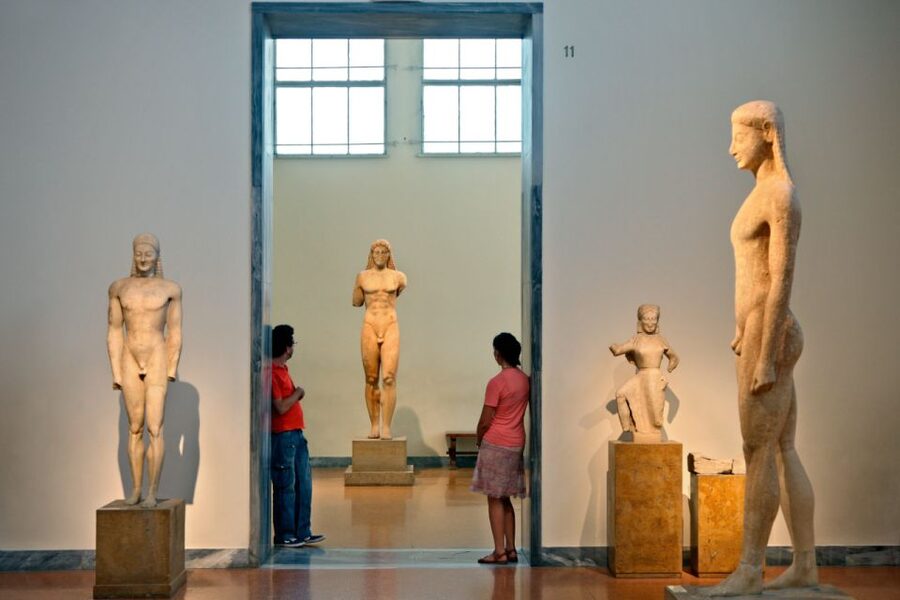
- Sculpture power in standout rooms featuring Zeus, Aphrodite, and Poseidon
- Time-period layout, with multiple galleries across Greek antiquity and a Santorini floor
- Plan for navigation, because you may want a simple strategy to avoid backtracking
Other Athens collections worth the ticket





National Archaeological Museum, the big reason Athens is worth a museum day
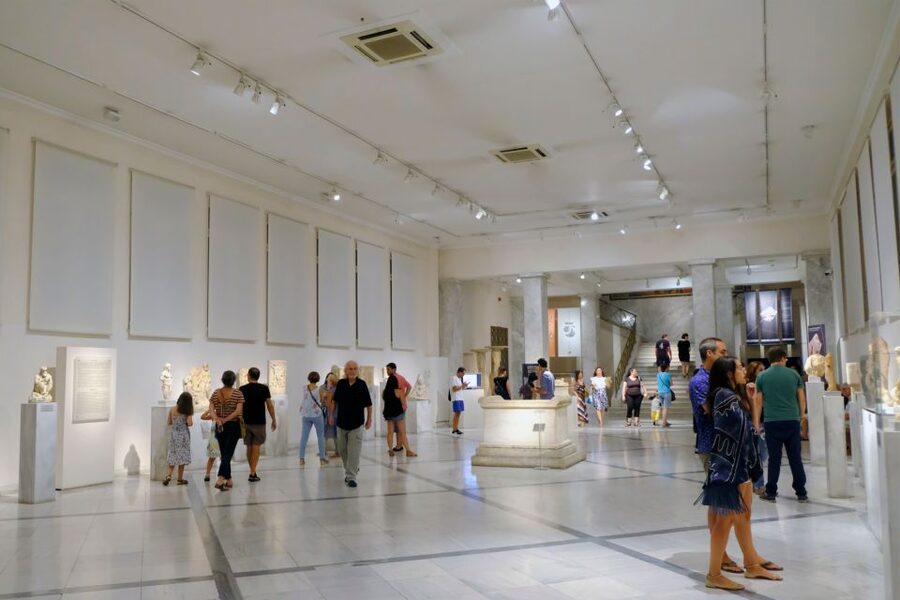
The National Archaeological Museum is the largest museum of its kind in Greece, and one of the most important places on Earth for Greek antiquity. If your mental image of ancient Greece is mostly temples and mythology, this is where the story gets real, physical, and close. You are not looking at guesses or replicas. You are seeing objects that once belonged to real people, real workshops, and real rituals across centuries.
The museum is also set up in a way that rewards attention. You move through rooms that are grouped by period and site, so you start spotting patterns, like how styles change over time, how different regions influence each other, and how the everyday and the ceremonial both show up in the collection. It is a museum you can do quickly, or one you can take apart slowly.
Tickets and entry lines: how to get in without wasting time
This experience is all about easy admission. Your ticket is sent to your email, and you scan it at the gate. The big advantage is that you can skip the longest part of the museum day, the part where people stand around deciding what line they belong in.
Here is the practical tip that matters most: at the entrance, there can be different lines for different needs. You might see a line for people buying tickets, a separate line for people already holding tickets, and another line connected to picking up an electronic narrator device if you chose the audio option. If you pick the wrong line, you lose time fast.
Before you go in, have your ID ready. The museum expects passport or ID card for verification, and a copy is accepted. Also bring headphones if you are using the audio feature. Even if everything works smoothly, you want your own comfort and volume control.
Price and value: is $30 worth it for a self-guided museum visit?
At about $30 per person, this ticket is not a bargain, but it also is not just a generic museum stamp. You are paying for two things that matter in real life: time saved and convenience built into the visit.
Time is the currency in Athens. On museum days, lines and confusion can steal an hour without warning. A pre-booked e-ticket reduces that risk. One of the strongest strengths of this option is how it can help you get inside more quickly, which is especially useful if you want to pair the museum with a Plaka or Old Town walk the same day.
The second value piece is the audio. If you select the museum audio, you are adding a self-guided layer to help you understand what you are seeing. Even when audio is not perfect, it can keep you from turning into a fast walker who just looks at labels without context. And you do not need a live guide for that benefit.
If your goal is mostly to see a few headline artifacts and you are comfortable reading at your own speed, you still get value from the e-ticket. If you want deep explanation, make sure you actually use the audio and plan your route, because the museum is large enough to make random wandering feel inefficient.
A smart museum route: don’t try to see everything in one go

The museum can feel like too much, which is both its charm and its trap. You can absolutely spend a whole day here, but if you try to see the entire collection like it is one long checklist, you will likely end up tired and slightly disappointed, even if you saw amazing things.
Instead, use a simple strategy: pick a set of rooms that match what you care about most, then add a few extras only if you still have energy.
A route that tends to work well is:
- Start with the “headline” discoveries so you get the big wow moments early
- Then move into sculpture, if that is your interest
- Finish with the cultural sections, especially the second-floor area connected to Santorini
This approach helps you avoid the most common museum problem: getting lost when your energy drops. It also keeps the visit fun, not frantic.
Agamemnon, Antikythera, and other “you’ve seen this in books” artifacts
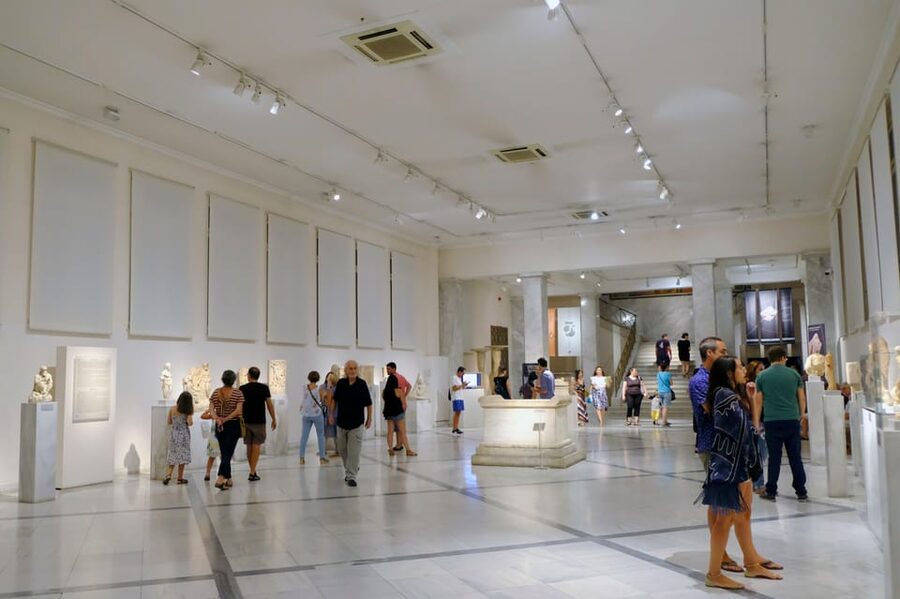
There are certain objects in this museum that people recognize instantly, even if they have never been to Athens. That is part of why it hits so hard. You can stand in front of these pieces and understand why they made history books, because they look the way you expect them to look, but also feel more intense in person.
In particular, you should expect to see:
- the Gold Deathmask of Agamemnon
- the Antikythera mechanism
- the Cup of Nestor
- the Ring of Theseus
Why these matter for your visit: they show different sides of ancient Greek life. Some artifacts connect to myth and leadership, others to science and technology, and others to everyday culture and craft. If you only focus on sculpture, you can miss how inventive these societies were across many fields.
Also, do not rush the labels. Several rooms are arranged so you can compare styles across time. Even a few minutes of careful looking can help you notice what changes, and what stays surprisingly consistent.
More Athens museums we have been round
- Athens: Acropolis, Parthenon & Acropolis Museum Guided Tour★ 4.8 · 9,316 reviews
- Athens: Mythology of Delphi, Museum and Arachova Guided Tour★ 4.6 · 4,008 reviews
- Athens: Acropolis, Parthenon & Acropolis Museum Guided Tour★ 4.8 · 3,579 reviews
- Acropolis monuments & Parthenon Walking Tour with Optional Acropolis Museum★ 5.0 · 2,678 reviews
Zeus, Poseidon, and Aphrodite: how the sculpture halls change the mood
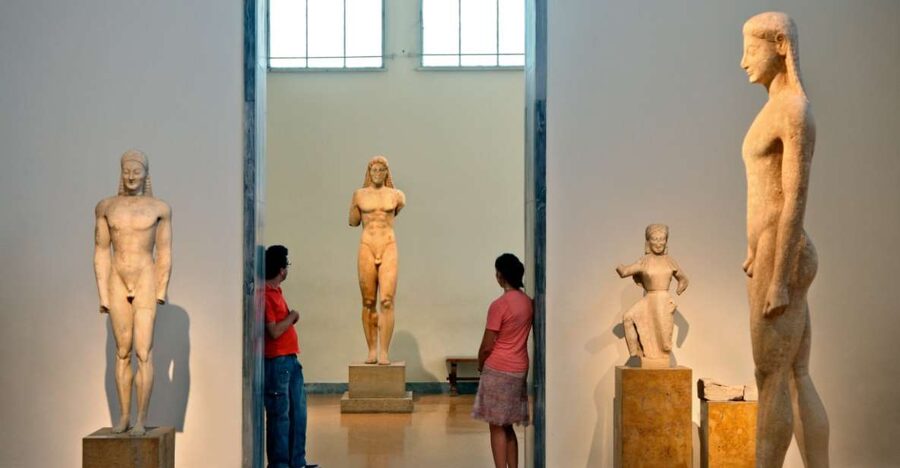
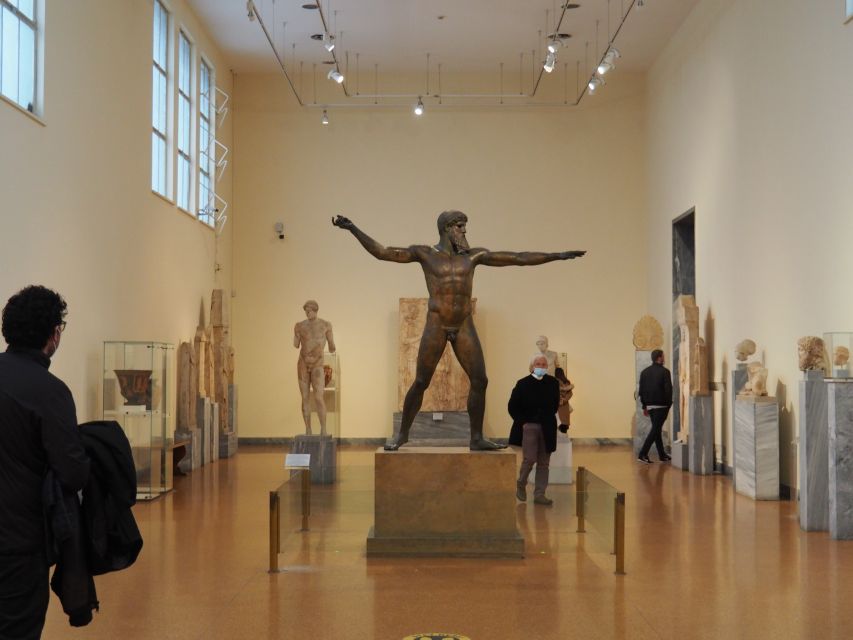
If you like sculpture, this museum delivers big time. One of the most frequently mentioned highlights is getting close to statues of Zeus and Poseidon, along with other major figures like Aphrodite.
Sculpture does something different than artifacts behind glass. You get to experience scale, pose, and material choices. When you stand close to a statue, you start thinking about the original setting, how it would have looked in a temple or sanctuary, and how people might have interacted with it visually.
Practical note: some signage and descriptions are not always super readable when lighting is dim. If you rely on text for understanding, bring the habit of looking up at the display first, then stepping to the best angle for reading.
The Santorini floor: when volcanic history becomes part of Greek antiquity
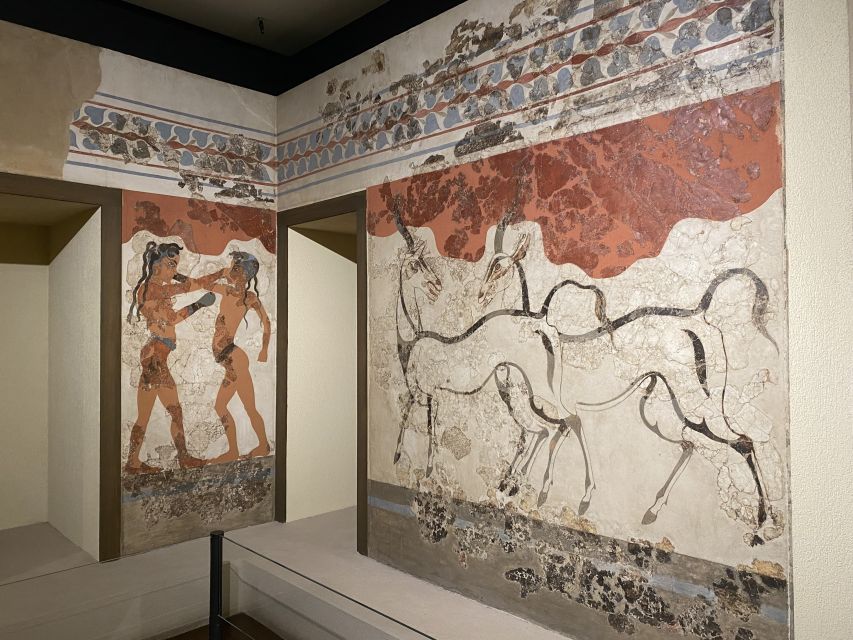
One of the museum’s standout sections is a second-floor area connected to the Santorini archipelago. You will find images and a range of artifacts tied to volcanic events, including amphorae and jars preserved by ash from the island’s famous eruption.
Why this is a smart add-on: it expands the museum beyond the mainland story. You start seeing how a natural disaster can freeze daily life in place, and you get artifacts that feel different from the more commonly pictured temples and marble sculpture.
If you only have time for a few areas, still consider saving time for this section. It is one of the clearest ways to broaden your perspective while staying inside the same ticket.
How long should you stay, and when to go to beat crowds and heat
Your ticket gives you a full day window, but your real time depends on your style. Many people move through at least some of the museum in around an hour, especially if they focus on major rooms. Others take longer because the collection is deep and there are so many objects to slow down for.
For comfort, think about the Athens weather. In summer months, some rooms can feel hot, and not every area has great seating availability. So if it is July or August, consider going earlier in the day and leaning on breaks when you find comfortable areas.
Timing also helps with crowd pressure. A morning visit can be a better match if you want more breathing room while you look.
Pair it with Plaka and Old Town using the included audio tour
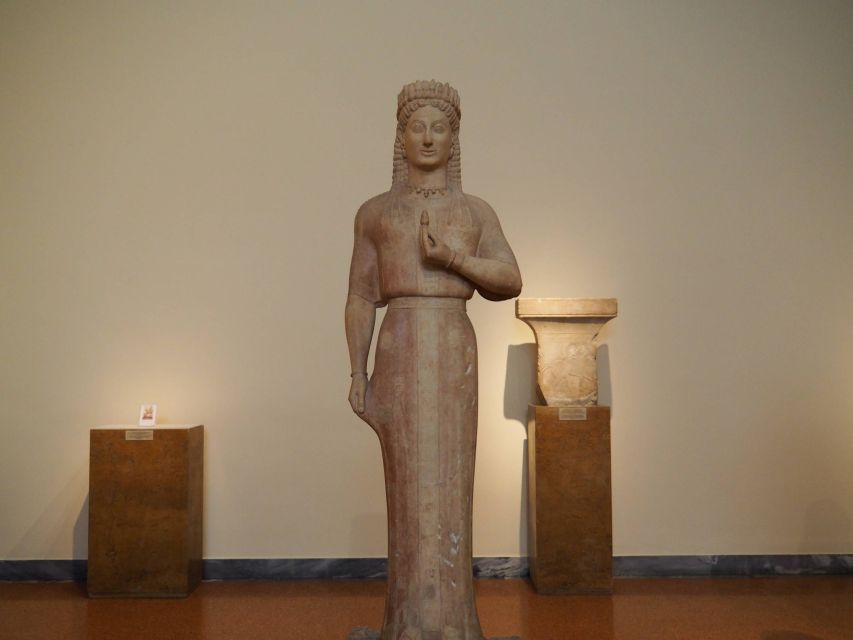
This ticket includes a self-guided audio tour for Athens Old Town and Plaka, even if you do not select the museum audio option. That is a great bonus because it turns your museum time into a two-part day.
After you leave the museum, your mind is already tuned to ancient Greece. Then Plaka brings the city’s later layers into focus, so you are not just consuming antiquity in isolation. You can walk streets and connect what you saw inside with where you are outside.
If you want a smoother day, do the museum first, then use the audio for Old Town and Plaka as your way to keep moving without feeling like you are guessing.
Common snags to plan for, from audio hiccups to signage gaps
Self-guided is great because it is flexible. It also means you are your own troubleshooting team. Based on common patterns people report, here are the main snags to watch for, and how you can reduce the odds of them ruining your day.
1) Audio route flow can be imperfect.
Some people find the audio does not perfectly match the museum layout, with references that feel on the wrong side of a room. If that happens, do not force it. Use the audio as context, then return to the physical object and label.
2) Audio apps can fail or require resets.
If the audio app is not working smoothly, expect you may need a reset or a quick re-try. Bring patience, and keep a simple fallback plan: prioritize the headline artifacts visually first.
3) Wayfinding can be tricky.
Even though the museum is arranged by time periods, you might need arrows or clearer timeline flow in certain spots. When you feel yourself getting turned around, stop, re-orient, then choose your next anchor room.
4) Some galleries might be closed during your time there.
Sometimes rooms are shut to the public for a few hours due to circumstances you cannot control. If your plan depends on one gallery, build in a backup highlight so you still leave happy.
5) Sitting areas are limited in some spots.
If you need frequent breaks, plan for that. Wear comfortable shoes, and expect that you might stand more than you think.
Should you book this National Archaeological Museum ticket?
Book it if you value smooth entry and you want a high-impact museum day without committing to a live guide. It is a strong match if you like to move at your own speed, read at your own pace, and spend time at the objects that pull you in.
Skip or reconsider if you know you get frustrated by wayfinding and tech hiccups. The museum is big, and self-guided audio can be hit or miss depending on how well it matches the day’s route. If you want a tightly structured experience, you might prefer a guided option instead.
For most people, though, this is a smart way to spend one day in Athens. You get fast access to a museum that contains major Greek treasures, plus audio help and extra context through the Old Town and Plaka track.
FAQ
Where is the nearest metro stop to reach the museum?
The nearest metro station is Omonoia.
How do I enter the museum with this ticket?
You scan your e-ticket at the gate for entry on your selected date and time slot.
What is included in the ticket price?
It includes an entry ticket to the National Archaeological Museum for the selected date and time slot, plus a self-guided audio tour for Athens Old Town and Plaka. The self-guided audio tour for the National Archaeological Museum is included only if you select that audio option.
Is there a live guide included?
No. This is self-guided, so there is no guide included.
What language is the audio guide?
The optional audio guide is available in English.
What should I bring with me?
Bring headphones. Also bring a passport or ID card, and a copy is accepted.
What age rules should I know?
This ticket is for travelers over the age of 25. Reduced-price tickets are not available online. The information provided also notes that children under 5 and EU citizens under 25 receive free or reduced admission upon providing their ID at the ticket booth at the Acropolis site, and non-EU citizens under 25 receive reduced-price entry in April-October with ID.
What are the museum opening hours?
From November 1 to March 31, Wednesday to Monday it is 8:30 AM to 3:30 PM, Tuesday 1:00 PM to 8:00 PM. From April 16 to October 31, Wednesday to Monday it is 8:00 AM to 8:00 PM, Tuesday 1:00 PM to 8:00 PM. Hours may vary for special occasions, so it is smart to check before you go.
How long do I have to use the ticket?
The ticket is valid for 1 day, with a specific date and time slot.
Can I get a refund if my plans change?
No. This activity is non-refundable.
Museums Around Athens




Every Other Athens Write-Up
- All Day Cruise -3 Islands to Agistri,Moni, Aegina with lunch and drinks included
★ 5.0 · 4,958 reviews





Other Athens Collections


Everything else we have written up around Athens







Museums, side by side.
 ★ 4.8Athens: Acropolis, Parthenon & Acropolis Museum Guided TourFrom $409,316 reviews
 ★ 4.6Athens: Mythology of Delphi, Museum and Arachova Guided TourFrom $314,008 reviews
★ 4.8Athens: Acropolis, Parthenon & Acropolis Museum Guided TourFrom $413,579 reviews
★ 4.6Athens: Mythology of Delphi, Museum and Arachova Guided TourFrom $314,008 reviews
★ 4.8Athens: Acropolis, Parthenon & Acropolis Museum Guided TourFrom $413,579 reviews
 ★ 5.0Acropolis monuments & Parthenon Walking Tour with Optional Acropolis MuseumFrom $422,678 reviews
 ★ 4.5Athens All Included: Acropolis and Museum Guided Tour with TicketFrom $1652,673 reviews
 ★ 4.4Athens: Acropolis Museum Ticket with optional Audio GuideFrom $302,652 reviews
 ★ 4.8From Athens: Small-Group Delphi, Museum & Arachova Day TripFrom $342,476 reviews
 ★ 4.1Parthenon & Acropolis Museum with Audio or Live Tour OptionFrom $702,446 reviews
Sits on these lists