

Review · ACROPOLIS & PARTHENON TOURS
Athens: The Acropolis Museum Guided Tour
That museum makes the Acropolis click. This guided tour of the Acropolis Museum turns scattered artifacts into a clear story, from Athens life in the 5th century BC to what you can still see through glass floors. You also get a short, well-paced look at the museum’s modern architecture, designed by Bernard Tschumi and Michael Photiadis, which helps you understand how the building frames ancient Athens.
I especially like how the guide walks you through the key galleries and why they matter, not just what you’re looking at. I also enjoy the way the museum uses natural light and open sightlines, so the big moments land fast, including votive offerings to Athena and the famous Caryatids. The only real consideration is that 75 minutes goes quickly, so you’ll see the highlights, not every object in a 4,000-artifact collection.
In This Review
- Key things I’d plan around before you go
- Why the Acropolis Museum matters before you climb
- Getting to the meeting point near Hadrian’s Arch
- Skip the ticket line, then let a local guide do the sorting
- The building by Tschumi and Photiadis: modern frames for ancient Athens
- First-floor Archaic Gallery: where daylight makes details readable
- Glass floors and excavations: seeing the city beneath the city
- Athena votive offerings and the Caryatids connection
- The Parthenon alignment moment you can actually picture
- Views over the Acropolis ruins: turning photos into understanding
- How to make 75 minutes feel like more
- Who this tour suits best (and who should think twice)
- Price and value: why $41 can be a smart spend
- Should you book the Acropolis Museum guided tour?
- FAQ
- How long is the Acropolis Museum guided tour?
- Is the tour offered in English?
- What is included in the $41 price?
- What extra cost should I expect on arrival?
- Where do I meet the tour staff?
- What should I bring, and is luggage allowed?
- Does the tour run in bad weather, and is it wheelchair accessible?
- Is there free cancellation and a pay-later option?
Key things I’d plan around before you go
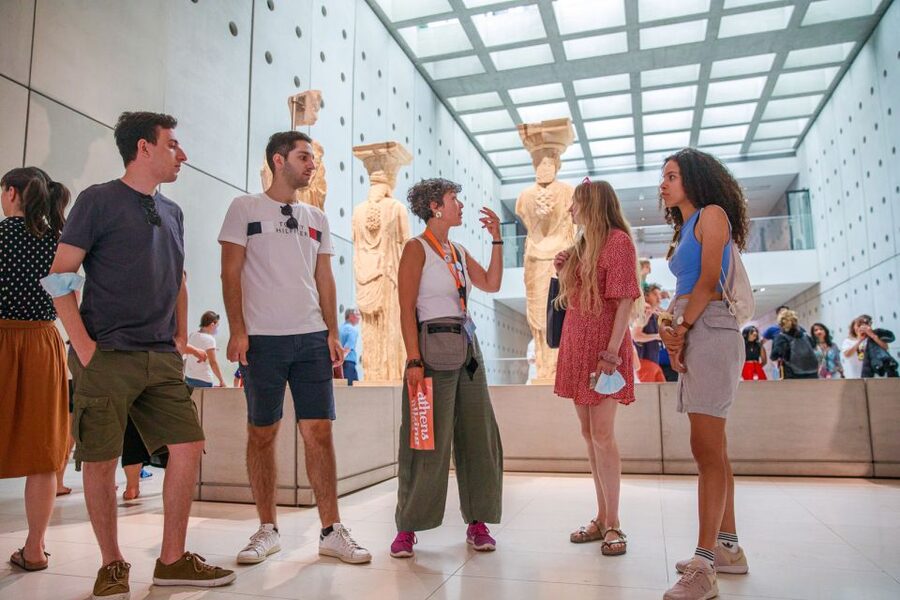
- Skip-the-ticket line service helps you start faster, which matters with timed museum visits.
- Archaic Gallery light: first-floor galleries are designed for daylight, so details read better.
- Glass floors over excavations let you literally see layers of ancient Athens.
- Athena votives and Caryatids connect myth, religion, and sculpture in one practical route.
- Parthenon alignment: the museum’s glass atrium is built to line up with the Parthenon.
- Panoramic views from inside the museum tie the artifacts back to the Acropolis ruins.
Other ways up the Acropolis, side by side




Why the Acropolis Museum matters before you climb

The Acropolis is dramatic, but it can also feel like a collection of big stone parts without context. The Acropolis Museum is the fix. In a smart 75-minute visit, you get the background you need to understand what you’re seeing, especially if you’re planning to visit the Acropolis afterward.
This museum is built for comparison. You see artifacts that used to be scattered across other collections, including items kept in storage or returned from abroad. That matters because you start connecting pieces of the same story, not just looking at isolated statues. You’ll also get the bigger picture of Athens at its creative height, particularly the 5th century BC, when art, religion, and civic life pushed each other forward.
And yes, the building is part of the teaching. The museum by Bernard Tschumi and Michael Photiadis is modernist, but it’s not a cold box. It frames views, uses light well, and makes it easier to keep your bearings while you move through ancient themes.
Getting to the meeting point near Hadrian’s Arch
You meet at 3, Dionysiou Areopagitou St., at the Lukumades and Pilino stores. Your group meets staff holding an orange Athens Walking Tours sign. This is at the start of the pedestrian walkway that runs from Hadrian’s Arch, along Syngrou Avenue, up toward the Acropolis area.
Practical tip: go early enough to find the storefronts without stress. The museum entrance is close once you’re on the pedestrian stretch, but the start point is specific, and you do not want to waste your best museum minutes standing around.
Also note the tour’s theme is walking and weather-ready. It runs in all conditions, rain or shine, so check the forecast and dress accordingly. Comfortable shoes are a must, because you will spend time moving between gallery spaces and viewing points.
Skip the ticket line, then let a local guide do the sorting

This tour includes a local licensed guide and a skip-the-ticket line service. For your time and energy, that’s the best combo you can ask for. Museums like this have enough to see that doing it alone often turns into a rushed scan. With a guide, you get a route, a reason for each stop, and the right historical context in the right order.
Your guide will show highlights from a collection of more than 4,000 artifacts. That number alone can be intimidating. The guide’s job is to translate that pile of objects into a sequence you can actually remember, including religion (Athena), public art, and the everyday urban layers of Athens.
English is the tour language, and the pace is designed for a one-and-done museum visit. It’s also wheelchair accessible, so the core experience is built to be practical for mobility needs.
The building by Tschumi and Photiadis: modern frames for ancient Athens
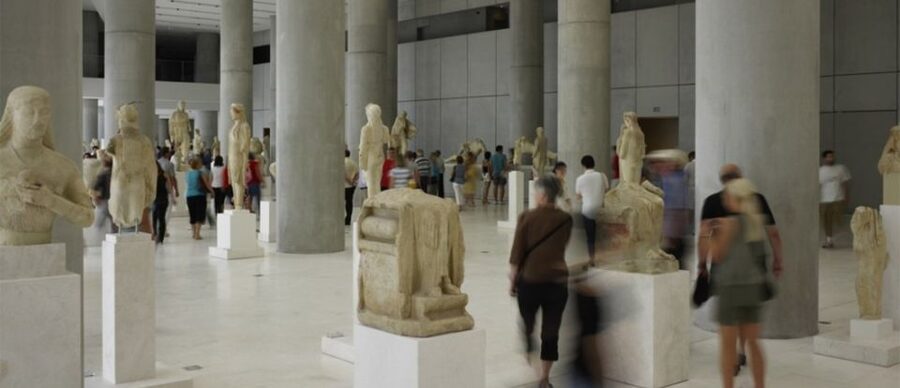
One of the smartest things about this museum is that it doesn’t treat the building as an afterthought. The modernist design by Bernard Tschumi and Michael Photiadis helps you understand the museum’s mission: connect the present visitor to the Parthenon and the ancient city around it.
As you move inside, you’ll notice how space and sightlines are planned. The museum includes a glass atrium aligned with the Parthenon, which is one of those design details that can be hard to appreciate on your own. With a guide, you learn why the alignment exists and how it changes what you see.
This matters because ancient Athens was not just marble monuments. It was a lived city. The architecture of the museum encourages you to think in layers, not in a straight line of dates.
First-floor Archaic Gallery: where daylight makes details readable
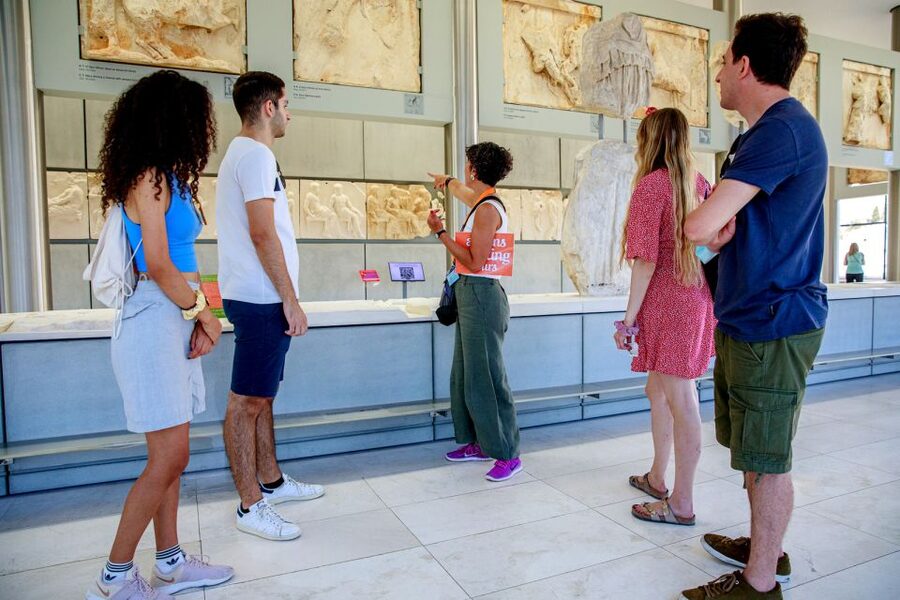
A highlight here is the 1st floor Archaic Gallery, bathed in natural light. That lighting is not decorative. It’s useful. Sculptural details, textures, and fine inscriptions are easier to read when the lighting is bright and consistent.
In this space, the guide focuses your attention on the objects that help you understand early Greek art and how Athens expressed power through sculpture and religious offerings. Even if you don’t consider yourself a museum person, this is where the museum’s tone becomes clear: it’s organized to show how forms and ideas developed.
If you’re the kind of visitor who hates feeling like you’re standing in front of a random statue, this gallery approach helps. You’re not left guessing why it’s important.
More Acropolis Museum entries we have checked
- Acropolis monuments & Parthenon Walking Tour with Optional Acropolis Museum★ 5.0 · 2,678 reviews
- Athens: Acropolis Museum Ticket with optional Audio Guide★ 4.4 · 2,652 reviews
- Athens: Acropolis, Parthenon and Acropolis Museum Guided Tour★ 5.0 · 1,778 reviews
- Acropolis of Athens and Acropolis Museum Tour★ 4.5 · 944 reviews
Glass floors and excavations: seeing the city beneath the city
One of the most memorable parts of this visit is how the museum reveals excavations through glass floors. Instead of treating the ancient site as something distant, the museum lets you see ruins and layers right where you stand.
You also get the experience of looking at an ancient Athenian neighborhood layout through modern technology: 3D exhibits and a plexiglass floor that reveals what was there. This is where the museum turns from object-viewing into city-imagining.
Why this is valuable for you: it changes how you read the Acropolis later. When you know there was a dense neighborhood below, the Acropolis feels less like a lone hilltop and more like the center of a whole urban system, with everyday life tied to worship, civic identity, and politics.
Athena votive offerings and the Caryatids connection
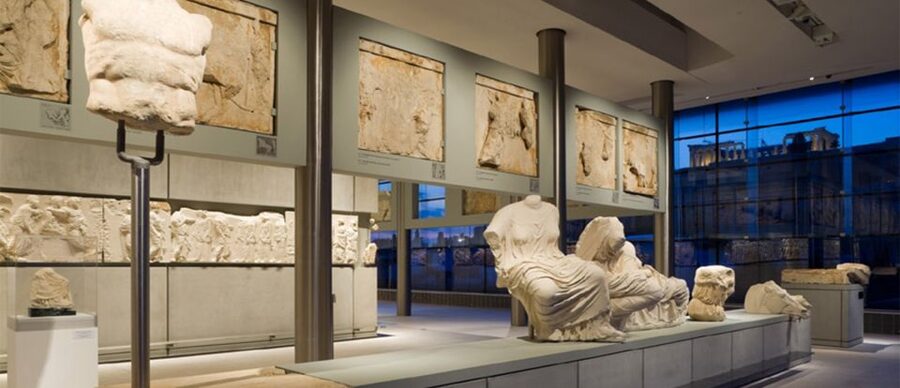
The tour highlights key religious and sculptural themes. You’ll see votive offerings to Athena, and you’ll also encounter the statues linked to the Caryatids.
Here’s the practical payoff. When you understand that these works weren’t just decoration, you start noticing patterns: how offerings express devotion, how sculpture signals status and communal pride, and how myth is built into stone and ritual objects. A guide keeps the story grounded, so it doesn’t become vague Greek-myth trivia.
Even if you’ve seen plenty of ancient statues before, the combination matters. Athena is a name you may have heard once in school. This tour helps you see how Athena shows up in what Athenians made, displayed, and honored.
The Parthenon alignment moment you can actually picture
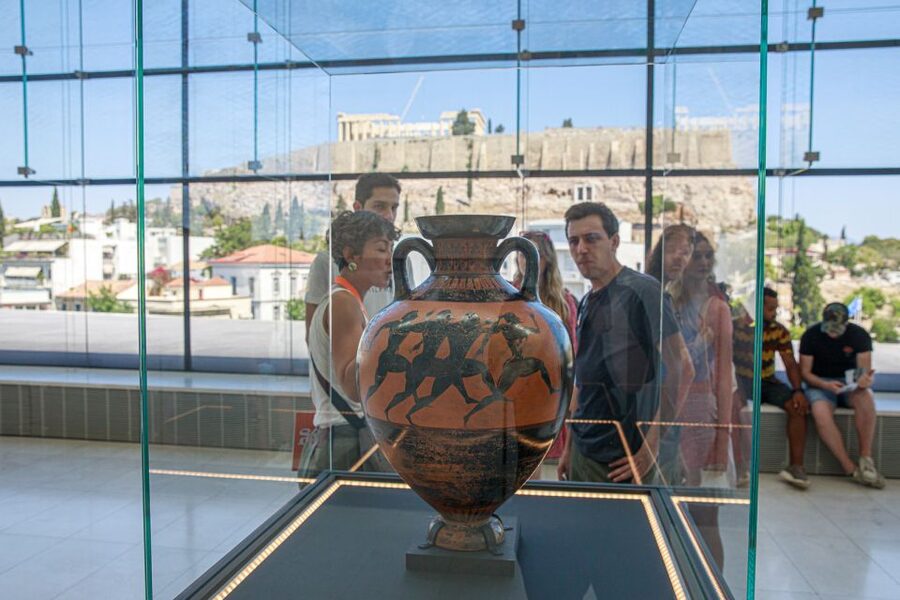
The museum’s glass atrium, designed to align with the Parthenon, is the kind of detail you might miss entirely if you walk straight through. With a live guide, you learn what you should look for and how the alignment changes the experience.
In plain terms: it helps you connect inside to outside. You’re not just staring at artifacts in a room. You’re learning how the museum was built to keep the Parthenon in your visual thinking, even when you are indoors.
This is also why doing this before the Acropolis is such a smart plan. You will be less overwhelmed on the hill. Instead of standing there trying to identify what’s what, you’ll recognize the themes the museum already explained.
Views over the Acropolis ruins: turning photos into understanding
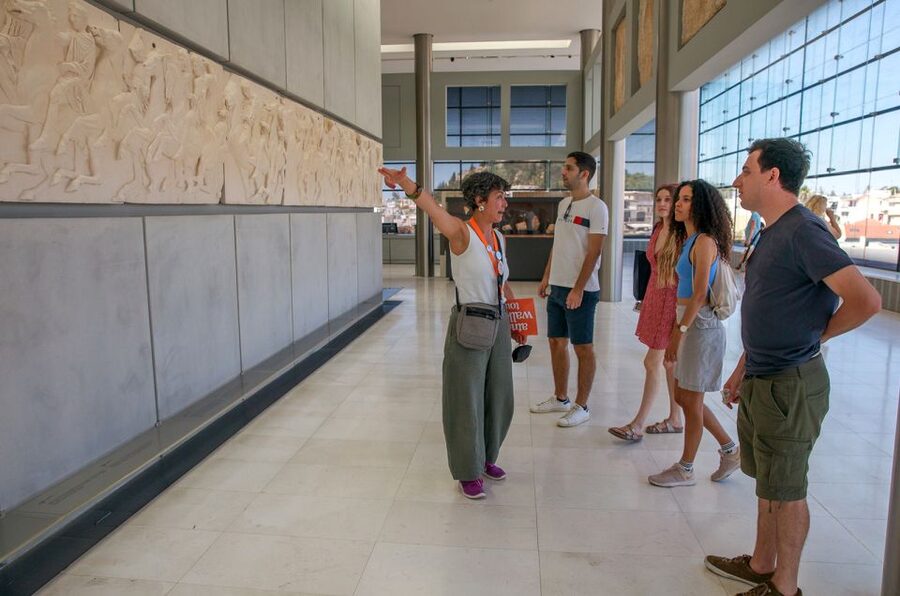
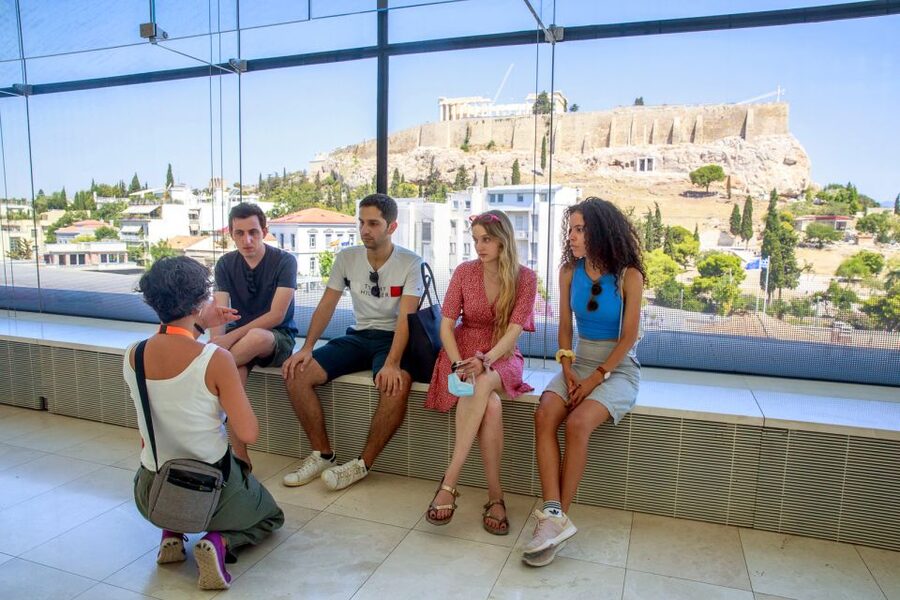
The tour includes panoramic views of the ruins of the Acropolis. This is not just a nice photo stop. It’s the final link in the museum-to-site chain.
As you look outward, you get a mental checklist: which elements connect to the artifacts, which parts relate to religious life, and how the city’s layers matter. It makes your later walk feel less like wandering and more like following a story.
If you’re planning your day tightly, treat this portion as your chance to slow down just enough to absorb the big picture. Then you can move on with confidence.
How to make 75 minutes feel like more
The tour is 75 minutes. That’s a strong amount of time for a guided highlights route, but it is still a highlights route. If you’re the type who likes to linger, read every label, and zoom in on every inscription, you may wish you had more time.
Here’s how I suggest you stretch it anyway:
- Decide what you want most, Athena and worship, sculpture and the Caryatids, or city life and the neighborhood excavations. Your guide’s route will hit these themes.
- Wear comfortable shoes, because the value comes from moving between spaces efficiently.
- Keep your expectations realistic. You’re going for structure and context, not an exhaustive museum marathon.
If you’re doing this as part of a longer plan that starts on the Acropolis first, your start time can sometimes shift. The museum portion is still designed as a complete experience, but delays from earlier segments can shrink your buffer. If you have strict timing for later meals or tours, build in extra slack.
Who this tour suits best (and who should think twice)
This is a great fit if you want:
- A guided introduction that makes the Acropolis understandable
- A route that hits the big museum moments, including glass-floor excavations and the Parthenon-aligned design
- Clear explanations in English, with a live guide who connects the dots between objects and the city
It may be less ideal if:
- You want to study every label and object with no guidance pressure
- You strongly prefer solo pacing, because the tour is structured and you’ll be moving with a group
For families and mixed-age groups, guides can be especially helpful because they can turn museum objects into stories you can follow without getting lost. The museum’s design also supports a look-and-learn flow.
Price and value: why $41 can be a smart spend
At $41 per person, the biggest value here is what your money buys: a local licensed guide plus skip-the-ticket line service. The entrance fees are not included, and you should expect around €20 per adult to get into the museum.
So you are really paying for the human guidance and the time saved at the door. In a museum like this, where context is the difference between noticing and understanding, that’s a fair trade. If you’d otherwise arrive, buy tickets, find your way, and choose stops on the fly, you would spend time and energy that a guide can use for interpretation.
If you’re counting every euro, you might consider an audio guide. But if your goal is to get the most meaning in the time you have, this guided format is a practical choice.
Should you book the Acropolis Museum guided tour?
Yes, I think you should book it if you want the Acropolis to make sense fast. This is one of those tours where the museum design does half the work, and the guide does the other half by turning architecture and artifacts into a story you can actually remember.
Book it particularly if you:
- Plan to visit the Acropolis itself the same day
- Want a route that hits Athena votives, Caryatids, glass-floor excavations, and Parthenon alignment without guesswork
- Appreciate clear, structured explanations in English
Skip or swap to another option only if you want a long, slow museum study session. With 75 minutes, you’ll leave informed, not exhaustive.
FAQ
How long is the Acropolis Museum guided tour?
The tour lasts 75 minutes.
Is the tour offered in English?
Yes. The live tour guide speaks English.
What is included in the $41 price?
The included items are a local licensed guide and skip-the-ticket line service.
What extra cost should I expect on arrival?
Entrance fees are not included, and they are approximately €20 per adult. Food and drinks are also not included.
Where do I meet the tour staff?
Meet at 3, Dionysiou Areopagitou St., at the Lukumades and Pilino stores. Staff will be holding an orange Athens Walking Tours sign at the beginning of the pedestrian walkway from Hadrian’s Arch along Syngrou Avenue to the Acropolis.
What should I bring, and is luggage allowed?
Bring your passport or ID card and wear comfortable shoes. Luggage or large bags are not allowed.
Does the tour run in bad weather, and is it wheelchair accessible?
Yes, tours run in all weather conditions, rain or shine. The tour is wheelchair accessible.
Is there free cancellation and a pay-later option?
The tour offers free cancellation up to 24 hours in advance for a full refund. It also has a reserve now and pay later option, so you can book without paying today.
Every Other Athens Write-Up
- All Day Cruise -3 Islands to Agistri,Moni, Aegina with lunch and drinks included
★ 5.0 · 4,958 reviews



Acropolis Museum, Other Entries




The Acropolis, Other Ways Up

Everything else we have written up around Athens






Acropolis & Parthenon Tours, side by side.
 ★ 4.4Athens: Acropolis & up to 5 Archaeological Sites Combo PassFrom $4812,619 reviews
 ★ 4.2Athens: Acropolis Ticket with Optional Audio or Live GuideFrom $4211,055 reviews
 ★ 4.8Athens: Acropolis, Parthenon & Acropolis Museum Guided TourFrom $409,316 reviews
 ★ 4.6Athens: Acropolis and Parthenon Guided Walking TourFrom $385,882 reviews
★ 4.8Athens: Acropolis, Parthenon & Acropolis Museum Guided TourFrom $413,579 reviews
★ 4.6Athens: Acropolis and Parthenon Guided Walking TourFrom $385,882 reviews
★ 4.8Athens: Acropolis, Parthenon & Acropolis Museum Guided TourFrom $413,579 reviews
 ★ 4.0Athens: Acropolis Ticket with Audio GuideFrom $473,575 reviews
 ★ 4.7Acropolis: Acropolis and Parthenon Guided Walking TourFrom $363,442 reviews
 ★ 5.0Acropolis monuments & Parthenon Walking Tour with Optional Acropolis MuseumFrom $422,678 reviews
Sits on these lists