
Review · ANCIENT CORINTH & THE CANAL
Biblical Tour Letters ToThe Corinthians St Paul’s Footsteps 6Hour
Paul’s story turns into street-level reality. This half-day tour strings together the key Athens and Corinth stops behind Paul’s letters, then slows down enough for you to actually look around. I especially like the air-conditioned private vehicle with hotel or port pickup, plus a very “you are here, not just reading about it” approach to the Bible.
Second, I like how the day balances big ideas with short, clear time blocks. You get complimentary Wi-Fi and bottled water on the ride, and your driver ties locations to Paul’s life, including his work in Corinth and references tied to the Corinthians letters. One thing to watch: several major sites charge extra entry, including Ancient Corinth (€15) and the Isthmia archaeological site (€5), so your final total can be a bit higher than the base price.
In This Review
- Key highlights you will actually care about
- A private Paul and Corinth day trip that fits real schedules
- Pickup, mini-van comfort, and how the day stays calm
- Areopagus Hill, Mars Hill energy, and the Unknown God thread
- Daphni Monastery: Byzantine mosaics with a layered past
- Corinth Canal and the 2000-year shipping dream
- Isthmia museum stops and why they help before you walk the ruins
- Isthmia games: why Paul ties into sports and crowds
- Ancient Corinth and the Bema: where public teaching becomes real
- Temple of Poseidon and Amphitrite at Isthmia
- Stadium and Sanctuary details that make the games story feel physical
- The meeting grounds and theater mosaics
- Kenchreai (Cenchreae): Paul, Phoebe, and a port you can almost smell
- Temple of Apollo at Corinth, plus the Gallio storyline
- Apostolou Pavlou Church in Corinth: the finish that feels anchored
- Price and value: what you get for $170.50 and what may cost extra
- Who this tour suits best, and who might want a different plan
- Should you book the Footsteps of Paul tour from Athens?
- FAQ
- How long is the Footsteps of Paul tour?
- What is the pickup and drop-off like?
- Is transportation included?
- What group size is this tour?
- Which admissions are included?
- Which entrances cost extra?
- Does the driver go inside archaeological sites?
- Is lunch included?
- Is the tour in English?
- Is the tour weather dependent?
Key highlights you will actually care about
- Private, small-group comfort with A/C and Wi-Fi, so the day feels easy from minute one.
- Paul-focused route that follows the logic of 1 and 2 Corinthians, plus Acts connections.
- Agora and Bema time in Ancient Corinth, linking Paul’s public teaching to a specific forum feature.
- Isthmia on multiple levels, from the games story to the Temple of Poseidon grounds.
- Kenchreai (Cenchreae) stop for Phoebe and Paul’s Acts 18:18 connection.
- Driver cannot escort inside sites, but you can add a licensed guide for interiors on request.
Other stops at ancient Corinth and the canal

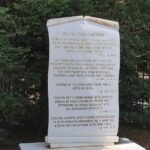
A private Paul and Corinth day trip that fits real schedules
This tour is built for people who want the most important Paul sites without turning the day into a blur. You are not just stopping for photos. You are getting the “why this place matters” story right in the car, then short, practical blocks of time at each landmark.
The vibe is also tuned for limited time. If you are on a cruise, this kind of structured route matters because you cannot drift all day and hope you make it back.
Pickup, mini-van comfort, and how the day stays calm
The logistics are refreshingly simple. Your personal driver picks you up from your hotel, Airbnb, or the cruise port, then returns you to the same place after the tour.
You travel in a premium luxury minivan (small groups, and it can handle up to 8 passengers). The big practical wins are A/C, Wi-Fi, and bottled water right in the vehicle. There is also luggage storage available in the car, depending on how many bags you bring, which helps if you are doing airport or port-related travel.
One other detail I really like: your driver is assigned as an English-speaking guide with a focus on ancient Greek context and Paul’s life. The commentary is designed to connect Paul’s path from his early life through his missionary journeys and later impact.
Areopagus Hill, Mars Hill energy, and the Unknown God thread
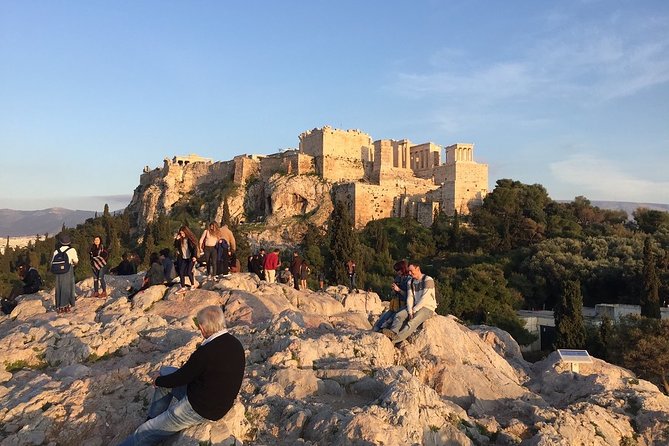
Your first meaningful stop is Areopagus Hill, also connected with what many people know as Mars Hill. The stop is short, about 15 minutes, but it is not random window dressing.
This is where Paul delivered one of his most dramatic speeches to the Athenians about the Unknown God. That matters because it frames Paul as someone who knew his audience. Instead of preaching in a vacuum, he engages the ideas already floating around Athens.
Practical note: since your time block is brief, go in with a plan for your walk. Look up, read signage if you can, and try to connect the view you see today with the speech setting that the tour is aiming at.
Daphni Monastery: Byzantine mosaics with a layered past
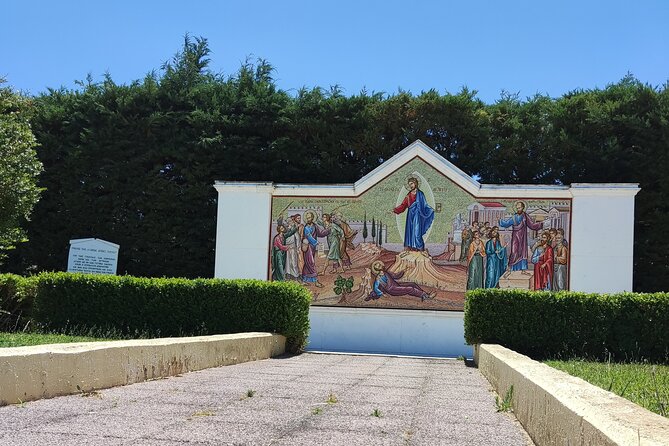
Next is the Monastery of Daphni, perched on the slopes of Mount Aigaleo. You get about 20 minutes here, with admission included.
This stop is more than a scenic religious building. The tour’s framing highlights that the monastery sits on a site linked to an ancient temple of Apollo, with a likely connection to the Daphneion Apollo sanctuary. Over the centuries, the area shifts hands and uses: Cistercian monks during the Frankish period, then Orthodox control again after the Ottoman conquest.
The monastery was also battered by earthquakes, and major restoration work has helped preserve its stunning mosaics. If you like art you can trace to real turning points in time, this is one of the best “pause and look” moments of the day.
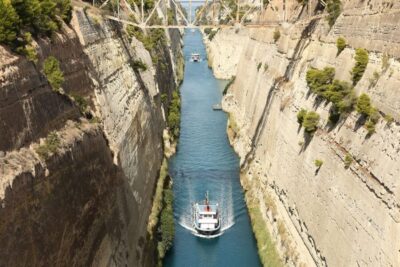
Corinth Canal and the 2000-year shipping dream
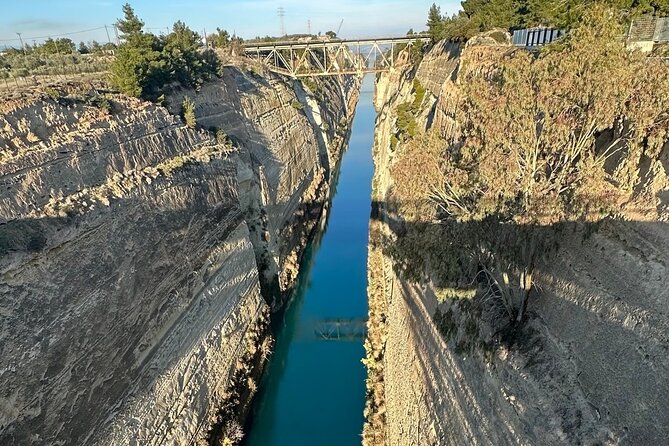
Then you hit the Corinth Canal for around 20 minutes, and entry is free.
The canal physically separates Greece’s mainland from the Peloponnese, and that alone makes it important for understanding ancient travel routes. But the story the tour leans into is the time scale. The idea goes back roughly 2000 years. Before construction, ships wanting to cross the Aegean toward the Adriatic had to circle the Peloponnese, adding a long detour.
The tour also connects the dream to Periander, the tyrant of Corinth, who is linked with the early idea. The tour mentions his diolkos concept, a stone road used to move ships over land on wheeled platforms. That kind of “Roman and Greek engineers before the big machines” angle helps the canal feel less like a modern ditch and more like a culmination.
- Athens: Acropolis & up to 5 Archaeological Sites Combo Pass★ 4.4 · 12,619 reviews
- Athens: Acropolis, Parthenon & Acropolis Museum Guided Tour★ 4.8 · 9,316 reviews
- Athens: Cape Sounion & Poseidon Temple Sunset Half-Day Trip★ 4.8 · 8,241 reviews
- Athens: Acropolis and Parthenon Guided Walking Tour★ 4.6 · 5,882 reviews
Isthmia museum stops and why they help before you walk the ruins
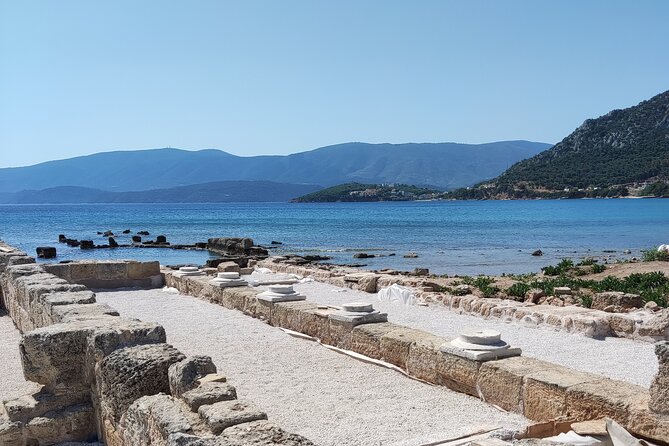
One of the smarter rhythm choices is doing the Archaeological Museum of Isthmia before some of the larger outdoor site time. You get about 20 minutes, and museum entry is not included.
Why it helps: the museum includes objects tied to the harbor world, cult practice, and everyday life. The tour’s description points out an archaic marble pediment from the late 7th century BC, and also glazing of Kechreon. Those colored glass pieces arrived in pairs on a ship from Alexandria and were found submerged near the Temple of Isis on the south pier of the harbor.
It is the kind of detail that changes how you look at the later site. You start noticing what kind of visitors and worshippers this region attracted, not just what looks impressive from the outside. The museum also includes an imperial statue in the type of Zeus, an epinician stele tied to a Corinthian musician, and animal figurines, including a golden bull described as a vow offering.
Isthmia games: why Paul ties into sports and crowds
Your next major block is Isthmia, about 1 hour, with admission included. This is where the day becomes very “Letters to the Corinthians” in spirit, even when the stops are not directly labeled that way.
The tour explains that Isthmia hosted the second most important sports competitions in the ancient world, after Olympia. From a Paul perspective, the tour treats his presence in the Isthmian region as significant, connecting it to his work as a tent maker for athletes and visitors.
It also emphasizes a bold idea: Paul proclaimed Christ to crowds at these games. Even if you take that as more tradition than laboratory fact, it still helps you read Paul’s letters as something born from real public contact, not just private study.
If you want to get the most from this stop, use your hour to do two things. First, look for the main monumental features. Second, let your driver’s Paul story set the mood, so you understand what kind of audience Paul would have been speaking to.
Ancient Corinth and the Bema: where public teaching becomes real
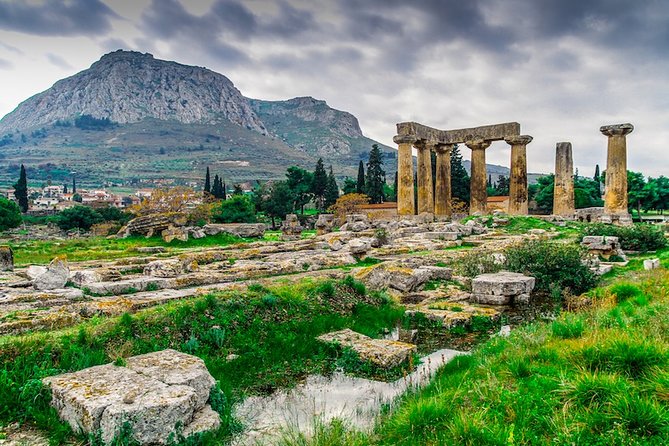
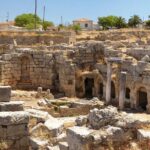
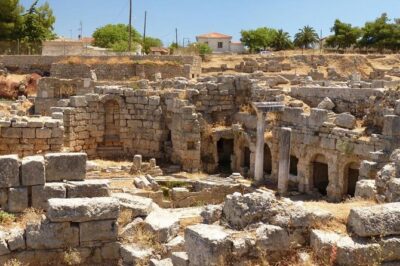
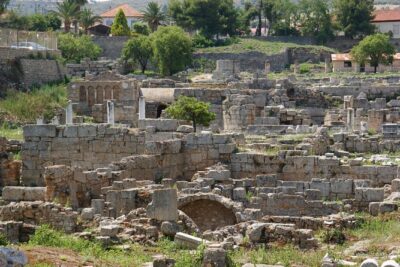
Now the tour reaches Ancient Corinth for about 1 hour. Admission here is not included (budget for €15 per person).
Corinth matters in the Bible because it is front and center in Paul’s New Testament letters. The tour context connects the city-state location on the isthmus, between Athens and Sparta, and it also ties Corinth to Paul’s missionary travel. It notes that Romans demolished Corinth in 146 BC, rebuilt it later in 44 BC, and made it the provincial capital.
Most importantly, the tour highlights the Agora, including the podium or Bema, linked to the public speech moments in Paul’s Corinth period. It also mentions Paul’s trial before the proconsul Gallio, with the tradition that the Bema area is tied to that public judgment setting. The detail about the Bema being transformed into a Christian church in Byzantine times adds a powerful continuity layer.
One practical drawback to flag: since Ancient Corinth entry is extra, decide early if you want a full “site deep look” approach or a “hit the key points” approach. With a driver framing the story well, you can keep it focused without feeling like you missed everything.
Temple of Poseidon and Amphitrite at Isthmia
The tour continues at another Isthmia archaeological site block that is around 30 minutes for the Temple of Poseidon and Amphitrite, with admission not included (and separate €5 for the Isthmia site).
The tour includes the building story in timeline form. The first temple phase dates to about 690 to 650 BC. Fires damaged it around 450 BC, after which a larger Doric version was built. Another destruction came around 390 BC, and the rebuilding again followed Doric style.
Later, the tour mentions damage from Romans in 148 BC, then reconstruction and beautification in the late first century AD. Activity fades in the context of later invasions, described as ending with the Visigoth invasion of Alaric in the early 5th century AD.
If you like ruins that have a “history of hits and rebuilds,” this is your stop. It also helps you understand why the site feels layered rather than frozen.
Stadium and Sanctuary details that make the games story feel physical
Still in the Isthmia area, you get mention of the stadium and the Sanctuary of Palaimon for sailors. The stadium is described as originally built around 550 BC, with a later stage built around the 3rd century BC for the games.
The tour also references a preserved athlete release system called the “ysplex,” described as a unique triangular release area. That is the kind of detail that sounds technical but actually helps your brain picture how events worked.
The Sanctuary of Palaimon connects religion to daily life. Palaimon is linked with Melikertis-Palaimon and is treated as a patron of sailors. In Roman times, the tour description says nocturnal services were held, with bulls sacrificed.
If you are the kind of person who likes to see how the Bible connects to the surrounding culture, this stop supports that. Paul’s world was full of public festivals, and festivals were backed by religious structures.
The meeting grounds and theater mosaics
The tour description also points you toward the Conference and Meeting Space at Isthmia, with a timeline of important gatherings, including Persian-related assemblies in 481 and 480 BC, proclamations involving Philip II and Alexander the Great, and later events shaping political autonomy under Roman rule.
Then there is the theater, described as being built around 400 BC for musical competitions and later work completed around 150 to 160 AD, possibly attributed to Herod Atticus. The tour calls out mosaic themes involving the sea troupe, including an octopus with seven tentacles, and mosaics described as similar to those at Ostia and Pompeii.
This is a good example of why the tour is not only religious stops. It keeps reminding you that Paul taught into a culture of arts, ceremonies, and public spectacles.
Kenchreai (Cenchreae): Paul, Phoebe, and a port you can almost smell
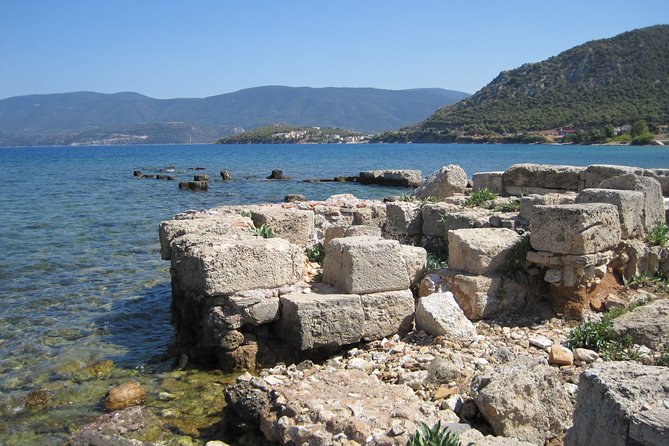
Next comes Kechries (Kenchreai or Cenchreae) for about 30 minutes, with entry free.
This stop is tied to a specific biblical location. The tour connects Kenchreai with Acts 18:18, where Paul shaves his head after being there for a while, linked to a vow. It also connects Kenchreai to the epistle to the Romans through Phoebe, described in the local assembly context.
The port angle matters because it explains how Paul’s travel network worked. Cities did not rise just from religion. They rose from movement of people, goods, and letters.
Temple of Apollo at Corinth, plus the Gallio storyline
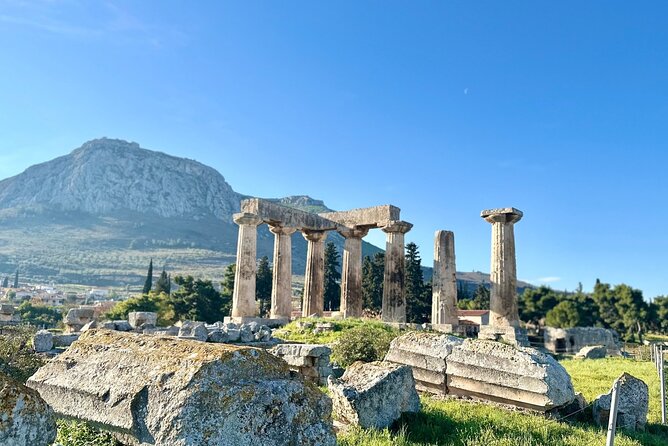
You also get time for the Temple of Apollo at Corinth, about 10 minutes, with admission not included.
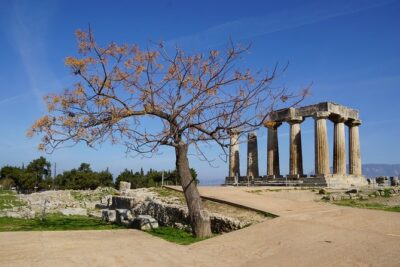
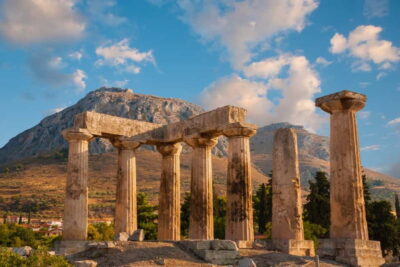
The tour notes it was constructed around 550 BC and highlights it as one of the earliest Doric temples in the Peloponnese and Greek mainland, with monolithic columns described as rare for the ancient world. It is a short stop, but it gives you that temple backdrop that ancient Corinth would have projected.
The tour then circles back to Paul’s legal confrontation. It describes Paul being brought for judgment before Gallio and the tradition that the Bema rostrum at the center of the Roman Forum is the linked site. It also says the Bema was converted into a Christian church during the Byzantine period.
Even with short timing, that narrative thread helps you connect archaeology to the text you already know.
Apostolou Pavlou Church in Corinth: the finish that feels anchored
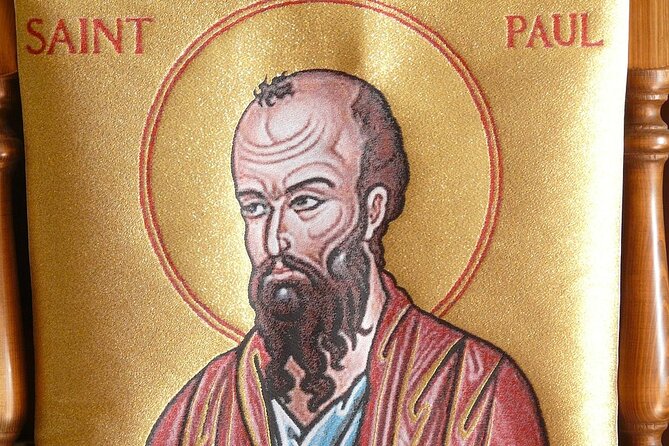
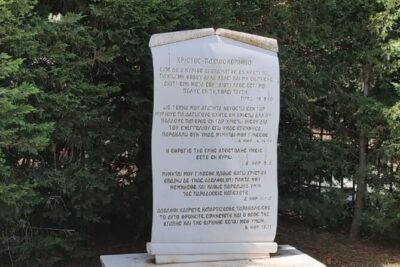
Your last major stop is Apostolou Pavlou Church, also called the church of St Paul in Corinth. It is about 20 minutes and admission is free.
The tour frames this church as the metropolitan church connected to Paul’s time in Corinth, described as around 51 to 52 AD, lasting about one and a half years. It also emphasizes the strong tie to Acts and Paul’s two Corinthian letters.
This ending works well if you like a clean “bookend” to the day. You spend hours looking at the city’s public spaces, then you end in a place that makes Paul feel less like a traveling concept and more like a person rooted in one community.
Price and value: what you get for $170.50 and what may cost extra
At $170.50 per person, you are paying for more than a seat on a bus. You are paying for private vehicle comfort, timed stops, and a driver who provides the Paul story from start to finish.
Included items that add real value:
- Pickup and drop-off from Athens area hotels, Airbnb, or the cruise port
- Air-conditioned private vehicle
- Complimentary Wi-Fi and bottled water on board
- Admission included at Areopagus Hill and the Monastery of Daphni
- Canal stop entry is free
- Isthmia stop entry is free
- Kechries and Apostolou Pavlou Church are free
Extra costs you should plan for:
- Ancient Corinth entrance fee is €15 per person
- Archaeological site of Isthmia entrance is €5 per person
- Museum of Isthmia admission is not included
- Temple of Apollo admission is not included
- Optional licensed guide inside archaeological sites can be arranged for €160 per booking (depends on availability)
Also note the basic rule: in Greece, only officially licensed guides can lead inside archaeological sites. Your driver can explain from outside and in transit, and they can coordinate a licensed guide on request, but it is not automatic. If you care most about inside-the-site explanations, ask about the licensed guide option early.
Who this tour suits best, and who might want a different plan
This tour is a great match if you want a relaxed religious and Bible-connected day that still covers major archaeological ground. It is especially suited to cruise passengers because timing and return to the port are built into the design.
It also suits first-time visitors who do not want to rent a car or figure out complicated routes. The “small group private” style makes it easier to ask questions and adjust your pace slightly during the site time blocks.
If you are the kind of visitor who wants a long, slow, museum-like day at a single site, you might feel the pacing is tight at short stops like Areopagus Hill and Apollo Temple. In that case, you may prefer a longer standalone archaeological visit.
Should you book the Footsteps of Paul tour from Athens?
Yes, if you want Paul’s story tied to actual locations, with comfort and real structure built in. The combination of hotel or port pickup, air-conditioned private transport, and a driver who connects Athens and Corinth into one narrative is exactly the kind of value that makes a half-day feel like a win.
Book it when you are okay with paying separate entrance fees for places like Ancient Corinth and the Isthmia archaeological site. If you do want inside-the-site guiding, plan for the optional licensed guide add-on ahead of time. With that, you will get a day that feels like the Bible comes alive in front of you, without the chaos of self-guided logistics.
FAQ
How long is the Footsteps of Paul tour?
It runs about 6 hours 15 minutes.
What is the pickup and drop-off like?
You are picked up from your hotel, Airbnb residence, or the cruise ship port, then returned back to the same place after the tour.
Is transportation included?
Yes. You ride in a private, air-conditioned vehicle with Wi-Fi and bottled water.
What group size is this tour?
It is designed for small groups, described as intimate and private, with up to around 2 to 6 passengers depending on the setup.
Which admissions are included?
Areopagus Hill and the Monastery of Daphni include admission. Corinth Canal is free. Isthmia and Kechries stops are described as free. The St Paul church stop is also free.
Which entrances cost extra?
Ancient Corinth has an entrance fee listed as €15 per person. The Archaeological Site of Isthmia has a listed entrance fee of €5 per person. The Museum of Isthmia and the Temple of Apollo are not included.
Does the driver go inside archaeological sites?
No. The driver can provide explanations, but Greek legislation limits who can accompany you inside archaeological sites. A licensed guide can be arranged for interiors on request, depending on availability.
Is lunch included?
Meals are not included. Lunch stops are scheduled, but meal costs are on you.
Is the tour in English?
Yes, it is offered in English.
Is the tour weather dependent?
Yes. It requires good weather, and if it is canceled due to poor weather, you will be offered another date or a full refund.
The Rest of Athens

Every Other Athens Write-Up
- All Day Cruise -3 Islands to Agistri,Moni, Aegina with lunch and drinks included
★ 5.0 · 4,958 reviews



Ancient Corinth and the Canal
Everything else we have written up around Athens

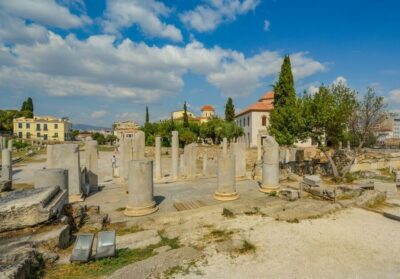
Ancient Corinth & the Canal, side by side.
 ★ 4.6From Athens: Ancient Corinth Day Trip with Canal & VR GuideFrom $411,073 reviews
 ★ 5.0Private Biblical Tour Ancient Corinth & Isthmus Canal from AthensFrom $301762 reviews
 ★ 4.8Athens: Ancient Corinth & Nafplio Full Day Trip with SwimFrom $44523 reviews
 ★ 5.0Private Tour of Apostle Paul’s Footsteps in Ancient CorinthFrom $169275 reviews
 ★ 4.5Corinth Half-Day Trip from Athens with Entrance TicketsFrom $91242 reviews
 ★ 4.7Athens: Ancient Corinth & Nafplion Guided Premium TourFrom $34237 reviews
 ★ 4.4Athens: Corinth Canal, Mycenae and Nafplio Day TourFrom $33233 reviews
 ★ 4.6From Athens: Ancient Corinth Tour Official Guide & TicketsFrom $86208 reviews
Sits on these lists