
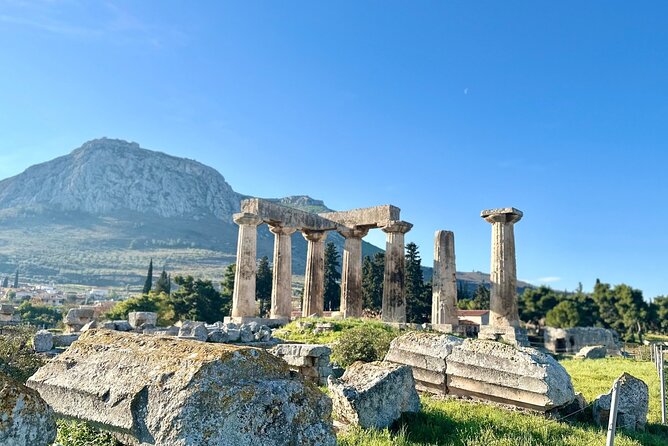
Review · MYCENAE, EPIDAURUS & NAFPLIO
Full Day Biblical Ancient Corinth Canal Mycenae Epidauvro Nafplio
Paul’s route leaves clues.
This full-day drive is built around the places tied to Christianity’s early story, while also giving you real, walkable sites like Ancient Corinth and the Nafplio 999-steps climb. I also like how the day mixes big-picture views with specific stops you can connect to the Bible, from Kenchreai to the Bema at Corinth, and it’s handled by professionals who show up on time. In the driver lineup, names like Gianny, Chris, Yiannes, Costas, Ioannis, Dimitrios, and Michael have stood out for being careful, friendly, and solid at explaining what you’re looking at.
There is one catch to plan for: entrance fees are not included, and most of the day is spent at archaeological sites and viewpoints where ticket lines can add time.
In This Review
- Key highlights to look for on your day
- From Athens to Corinth Canal: why this stop feels bigger than it looks
- Kenchreai and Paul: the Bible stop you can connect to real place
- Ancient Corinth, Gallio’s Bema, and the Agora where speeches mattered
- Corinth’s Temple of Apollo and museum time: don’t rush the middle
- Acrocorinth: the fortress above the city you can’t ignore
- Mycenae: Lion Gate first, then the beehive tomb that steals the show
- Nafplio arrives: Palamidi’s climb, then sea-air lunch
- Old Town Nafplio details: Syntagma Square, Acronauplia, Bourtzi, and the Lion of the Bavarians
- Price and logistics: is $277.09 per person a good deal?
- Before you go: tickets, walking stamina, and the Epidauvro question
- Should you book this Athens to Corinth-Mycenae-Nafplio day?
- FAQ
- How long is the tour?
- What is the pickup and drop-off like?
- Is this tour private?
- What language is the tour in?
- Are entrance fees included?
- Is lunch included?
- Do you provide a licensed guide inside the archaeological sites?
- What is included with the transportation?
- How many steps are at Palamidi Castle?
- What happens if weather is bad?
- What if I need a custom schedule?
Key highlights to look for on your day
- Corinth Canal, the shipping “shortcut” dream: a story that’s about geography, trade, and why the Aegean mattered.
- Kenchreai (Bible stop): Paul’s stop at the port town of Cenchreae, including the hair-cut vow detail.
- Ancient Corinth’s Bema: the elevated judgment spot tied to Gallio and Paul’s trial tradition.
- Mycenae’s Bronze Age power: Cyclopean walls, the Lion Gate, and the Treasury of Atreus.
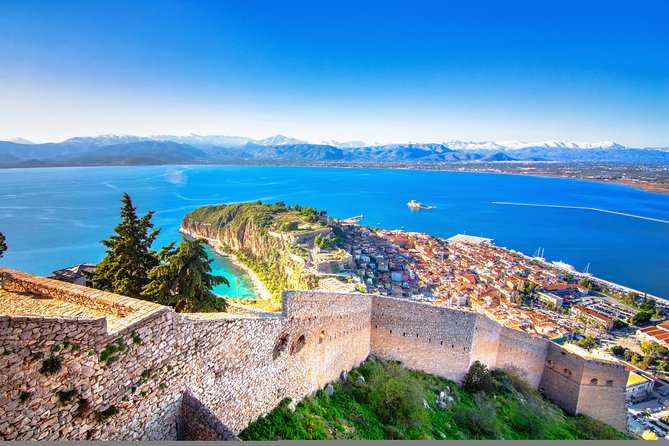
- Palamidi’s climb to big views: Fortress of Nafplio with the famous 999 steps feel.
- Old Town Nafplio with postcard moments: Syntagma Square, Acronauplia, and the Lion of the Bavarians.
More of Mycenae, Epidaurus and Nafplio

From Athens to Corinth Canal: why this stop feels bigger than it looks
Your day starts with a door-to-door pickup around Athens, in either a luxe sedan for 1 to 3 people or a mini van for 4 to 7. You also get practical comforts for the road: WiFi, air conditioning, and bottled water, which matters on a 9 to 10 hour day where you still want to enjoy the sites.
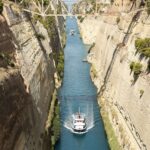
The first major scene is the Corinth Canal. On paper it’s just a narrow waterway slicing the isthmus. In person, it helps you understand why ancient travel was slow and expensive before modern engineering. The canal links the Gulf of Corinth with the Saronic Gulf, so instead of circling the Peloponnese by sea (about 185 nautical miles extra), ships can shorten the route.
Here’s what you should keep in mind during your quick look: the canal was a late 19th century project, but the idea was around for ages. The stop is brief, but it’s a great setup for the rest of the day, because the Peloponnese is geography first, and history second.
Tip for your photos: keep an eye on the angles of the canal walls. Even from a short stop, you can get dramatic depth if you wait for a moment when the light hits the concrete edges.
Kenchreai and Paul: the Bible stop you can connect to real place
Next you’ll head to the Corinthia region and the village connected with Kenchreai, the ancient port town mentioned in the Bible. This is one of those stops that can feel surprisingly personal, because it’s not only ruins or a fortress. It’s a real place with a name that carries an early Christian thread.
The story point here is from Acts 18:18, where Paul stops at Kenchreai during his second missionary journey and has his hair cut to fulfill a vow, likely a Nazirite vow. The stop also links to Paul’s letter to the Romans through the mention of Phoebe connected with the local assembly.
I like this part of the day because it avoids the usual trap of treating biblical references as trivia. You actually get a setting you can picture: a port, a religious community, and the practical travel reality of ships moving through ports along the Aegean.
Practical note: this is a short stop, so if you want extra time for questions, ask your driver early. In well-run tours, the driver can adjust the pace at the edge of the scheduled times.
Ancient Corinth, Gallio’s Bema, and the Agora where speeches mattered
Ancient Corinth is the heart of the day for many people, because it ties together archaeology and that “why Paul’s story happened here” feeling.
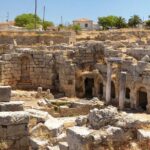
One highlight stop is the Bema, the elevated rostrum where tradition places Paul’s judgment tied to the proconsul Lucius Junius Gallio Annaeanus, also known as Gallio. The background is that Gallio refused to judge what he treated as a religious dispute. Later, the tradition says the Bema became a church during Byzantine times, which is a reminder that the same stone can get new meanings across centuries.
Then you move through the Agora area, including the long stretch of the central market zone, with the podium or Bema concept repeated in the layout. This helps you “see” the city as a communication hub, not just as a pile of columns. It was a place for public events, official talk, and everyday commerce.
What you should look for: the way the ruins are arranged still guides your eye. Even if you don’t memorize names, you’ll get a sense for where crowds would have stood and where officials would have addressed people.
If you’re the type who enjoys walking with meaning, this is where the driver’s storytelling can make a big difference. In particular, several drivers with strong guest reviews were praised for making these connections while still keeping the pace realistic.
Corinth’s Temple of Apollo and museum time: don’t rush the middle
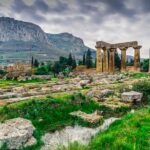
After the main Agora walk, you’ll see the Temple of Apollo, built around 550 BC. It’s noted as an early Doric temple in the Peloponnese, with rare monolithic columns for the ancient world. A short stop here can still be worthwhile, because Apollo temples are a key part of how Corinth signaled importance.
Then there’s museum time at the Archaeological Museum of Ancient Corinth. This museum is designed to display finds from excavations and sits within the broader archaeological area. Even without a deep history lesson, it’s a smart pause. In a full-day program, museums help you shift from “wow, big stones” to “okay, now what are these pieces telling me?”
Some site features mentioned for this museum context include the Hadgimoustafa spring, Lechaion Road, a Basilica, the Fountain of Peirene, the Stoa, the Agora, and the Odion. Whether or not you catch every term, the value is the clarity you get when you’re not trying to take it all in at walking speed.
My practical advice: if you want the best photos, aim for museum time to break up the outdoor sun and let your brain reboot before the next fortress view.
Acrocorinth: the fortress above the city you can’t ignore
Now you tackle Acrocorinth, the upper citadel, perched on a rock above the ruins. This spot is mainly about control. Its position, water access, and fortification history made it a last line of defense, guarding the approach into the Peloponnese.
You can think of Acrocorinth as the day’s “strategic view” chapter. From up here, Corinth’s location makes more sense. You understand why an acropolis mattered, not just for aesthetics but for security and long-distance awareness.
Even if you only have around 15 minutes, the goal is simple: take in the panorama, then look down for how the ruins connect. It’s one of the fastest ways to upgrade your understanding of what you saw earlier at ground level.
Other stops at ancient Corinth and the canal
- From Athens: Ancient Corinth Day Trip with Canal & VR Guide★ 4.6 · 1,073 reviews
- Biblical Tour Letters ToThe Corinthians St Paul’s Footsteps 6Hour★ 5.0 · 1,065 reviews
- Private Biblical Tour Ancient Corinth & Isthmus Canal from Athens★ 5.0 · 762 reviews
- Private Tour of Apostle Paul’s Footsteps in Ancient Corinth★ 5.0 · 275 reviews
Mycenae: Lion Gate first, then the beehive tomb that steals the show
If Ancient Corinth is about cities and public life, Mycenae is about power and walls. The fortified citadel is tied to mythical King Agamemnon, and it’s also a major archaeological anchor for the Mycenaean civilization.
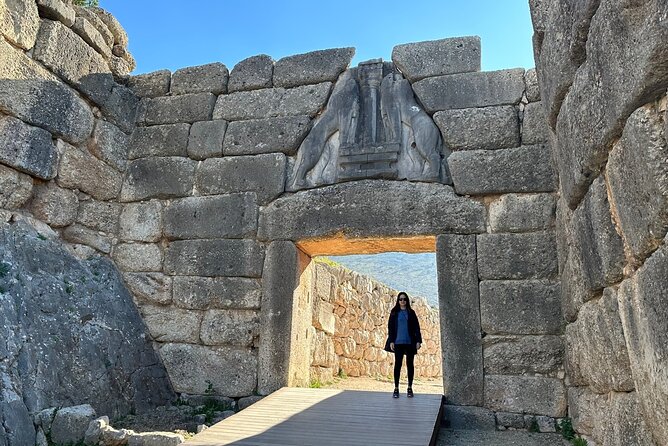
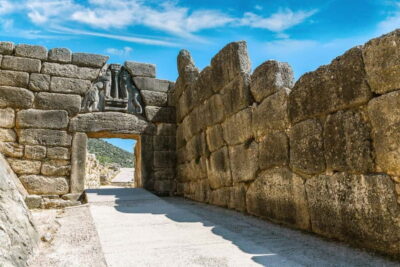
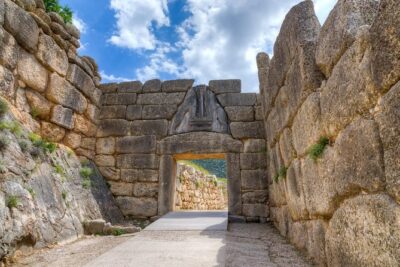
You’ll spend time at the Mycenae citadel, where the site is well preserved enough to help you grasp scale. Look for the Cyclopean walls and the Lion’s Gate as your key entry symbolism. This is also where the “Mycenaean” label comes from, because the era roughly from 1600 BC to 1100 BC got its name from Mycenae’s prominence.
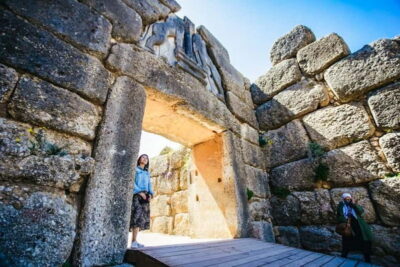
Next comes the Lion Gate itself, erected around the 13th century BC. It’s named for the relief sculpture of lionesses or lions above the entrance. This is described as the sole surviving monumental piece of Mycenaean sculpture and a major iconographic survival from Bronze Age Greece.
You might not know every art-history term, but you’ll feel the impact. It’s big, direct, and it turns the gateway into a statement of authority.
Then you move to the Archaeological Museum of Ancient Mycenae. Like the Corinth museum, it gives you a pause from climbing. It focuses on the acropolis and surrounding funerary and habitation sites, with many visible monuments dating to the peak floruit between 1350 BC and 1200 BC.
After that, the centerpiece for many people is the Citadel and Treasury of Atreus, also known as the Tomb of Agamemnon. This is a tholos or beehive tomb on Panagitsa Hill, constructed around 1250 BC. The scale details are part of what makes it memorable. The stone lintel above the doorway is said to weigh about 120 tons, and dimensions are given as roughly 8.3 by 5.2 by 1.2 meters.
Even on a short stop, it’s the kind of monument where you quickly start wondering how builders managed the engineering. That curiosity is a big part of why Mycenae keeps pulling people back.
Nafplio arrives: Palamidi’s climb, then sea-air lunch
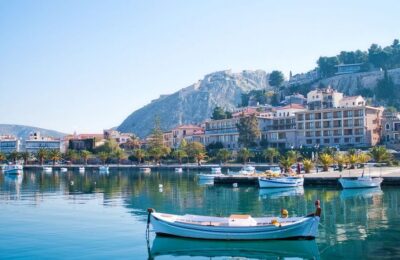
Once you leave the Bronze Age sites behind, you’ll reach Nafplio, a city known for its scenic old town, fortresses, and mix of Venetian, neoclassical, and oriental architectural elements. This is where the day shifts from “ancient stone” to “living city vibes.”
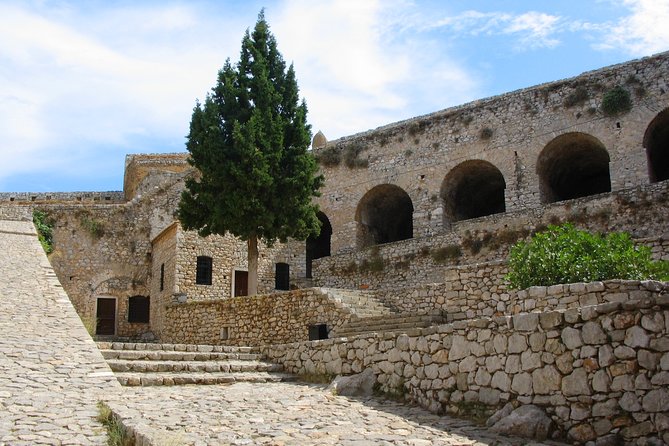
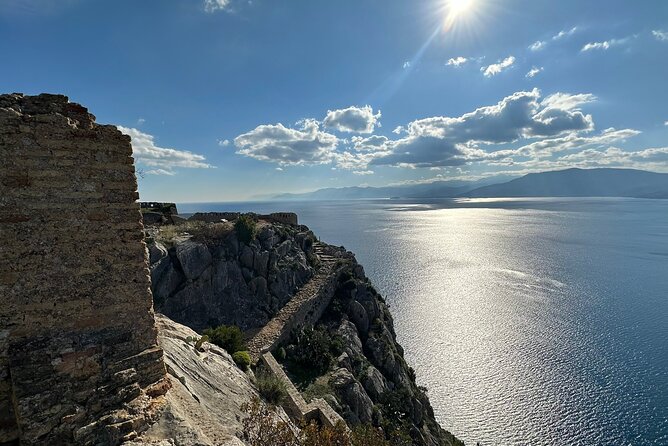
The tour includes Palamidi Castle on a hill, built by the Venetians during their second occupation of the area (1686 to 1715). The views over the Argolic Gulf and across Nafplio are the whole point. To get there, you’re dealing with a famous stairway. It’s commonly described as 913 steps, while locals say it’s 999 steps to the top.
If you’re planning footwear, this is the day to wear shoes that work on stone steps and hills. Also, consider that you’ll likely want to pause on the route for photos, so don’t treat the climb like a race.
After Palamidi and some old-town wandering, lunch is scheduled at a traditional tavern by the sea. The meal cost isn’t included, but it’s a built-in reset. You’ll feel it after Mycenae, because Nafplio can be slower and softer, more about strolling.
Old Town Nafplio details: Syntagma Square, Acronauplia, Bourtzi, and the Lion of the Bavarians
Now for the part where Nafplio earns its reputation.
You’ll start around Syntagma Square, which is described as the zero point of the old town. The area has layered stories, including the Parliament of the newly formed Greek state built during the reign of Kapodistrias, with today’s Municipal Gallery on the ground floor.
Then there’s Akronafplia Fortress, the oldest part of the city. You’ll hear how it was transformed into fortifications after the Venetians and Franks, and that it was used as a prison before the view helped convince authorities to build tourism-focused infrastructure, including a hotel complex still standing.
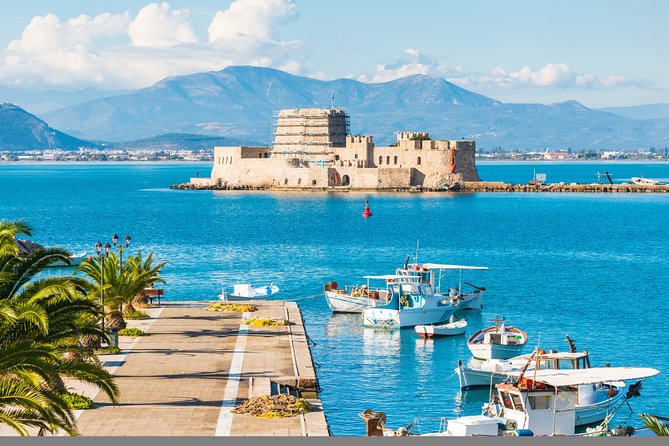
If you want a “wait, what is that?” moment, check out Bourtzi, the small fortress on an islet connected to viewpoints and photos. It was built by the Venetians in 1473 and later became a prison, then a luxury hotel in the 1960s. Today it’s known as a sunset postcard stop, and you can expect a short boat transfer during the visit time.
Finally, you’ll see the Lion of the Bavarians, carved into rock above Michael Iatrou Street. The story is tied to the German sculptor Christian Ziegel, commissioned by King Louis. It commemorates Bavarian soldiers who died in Nafplio in 1833 of typhoid. Locals also have a less official explanation involving bitter food, because every city has to keep a sense of humor.
These last stops are ideal for winding down. If you’re traveling with someone who loves photography, this is your payoff stretch.
Price and logistics: is $277.09 per person a good deal?
At $277.09 per person, you’re paying for a lot of moving parts: a full day, pickup and drop-off in Athens (hotel, Airbnb, or port), private transportation, and an expert English-speaking driver guiding the story across multiple sites.
The big value argument is simple: you avoid the headache of arranging separate rides to Corinth and Mycenae, and you get a single coherent route with historical commentary built in. The private nature is also a practical win, especially if you want to linger at one stop or need to shift timing.
What reduces value a bit: entrance fees and the meal in Nafplio are not included. Also, a licensed guide inside archaeological sites is not included. Your driver can provide interpretation, but the day relies on what they know and what the sites offer on-site.
One more practical note: because this is described as private and also because crowds can affect timing, I suggest you confirm that your vehicle is reserved exclusively for your party. If you want a truly private feel, ask the day-of question about whether anyone else will be in your car. It keeps expectations clean.
Given the stops, this tour tends to suit couples or small groups who want maximum value from one long day without juggling logistics.
Before you go: tickets, walking stamina, and the Epidauvro question
A full-day Peloponnese route is not just “sit and look.” You’re combining flat-ish viewing with fortress stairs and stone paths. Palamidi’s steps and the fortress feel at Acrocorinth mean you should plan for walking time even if many stops are scheduled for only 10 to 45 minutes.
Also, plan your budget beyond the base price:
- Entrance tickets are not included
- Lunch cost is not included, even though you’ll have a planned lunch stop
- Museum and site entry likely account for a meaningful chunk of extra spending
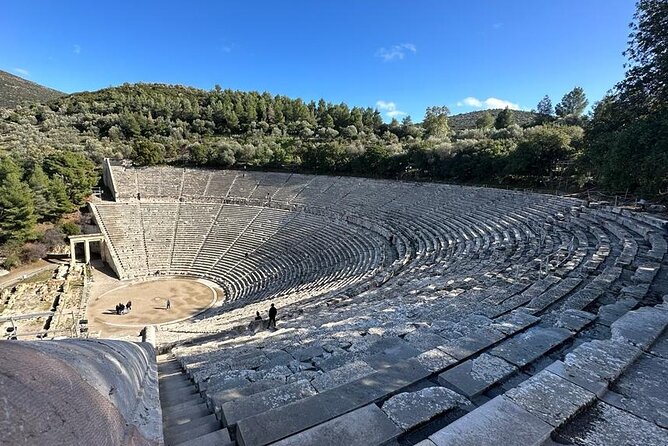
One thing you might want to double-check before you book: the day title you shared mentions Epidauvro, but the detailed stop list you provided does not include a specific Epidauvro visit. If Epidauvro matters to you, message the operator and confirm what’s actually scheduled.
Finally, bring patience for crowds. Corinth and Mycenae can get busy, especially in peak season. A good driver, like the ones praised for being considerate in popular sites, can help you time photos and transitions without turning the day into a sprint.
Should you book this Athens to Corinth-Mycenae-Nafplio day?
Book it if you want a single, structured day that links biblical reference points with some of Greece’s most dramatic ancient sites, then finishes in a city where you can slow down and enjoy the views. The mix of Corinth Canal, Ancient Corinth, Mycenae’s Lion Gate and Treasury of Atreus, and Nafplio’s Palamidi plus old-town wandering is exactly the kind of route that feels efficient but not rushed.
Skip or reconsider if you only care about one site and hate long road time, or if you’re unwilling to pay extra for entrances and a paid lunch. Also, if Epidauvro is a must-have for you, confirm it’s included in your exact departure.
FAQ
How long is the tour?
The tour runs about 9 to 10 hours.
What is the pickup and drop-off like?
Pickup is offered from Athens Hotel, Airbnb residence, or the Port, and the tour ends back at the meeting point. Your driver picks you up and returns you to the same place or to another point you prefer.
Is this tour private?
It is described as a private tour where only your group participates.
What language is the tour in?
The tour is offered in English.
Are entrance fees included?
No. Entrance fees for all attractions are not included.
Is lunch included?
Lunch is scheduled at a traditional tavern by the sea in Nafplio, but meal costs are not included.
Do you provide a licensed guide inside the archaeological sites?
No. A licensed guide to accompany you into archaeological sites is not included.
What is included with the transportation?
The vehicle includes WiFi, air conditioning, and bottled water.
How many steps are at Palamidi Castle?
Palamidi is reached by stairways with about 913 steps, and locals often say there are 999 steps to the top.
What happens if weather is bad?
This experience requires good weather. If it is canceled due to poor weather, you will be offered a different date or a full refund.
What if I need a custom schedule?
The tour is private and can be customized according to your needs, and pickup time can be adjustable upon your request.
Every Other Athens Write-Up
- All Day Cruise -3 Islands to Agistri,Moni, Aegina with lunch and drinks included
★ 5.0 · 4,958 reviews





Ancient Corinth and the Canal
Mycenae, Epidaurus and Nafplio

Everything else we have written up around Athens





Mycenae, Epidaurus & Nafplio, side by side.
 ★ 4.8From Athens: Mycenae, Epidaurus & Nafplio Full Day TripFrom $332,438 reviews
 ★ 4.5From Athens: Mycenae, Epidaurus & Nafplio Full-Day TourFrom $331,580 reviews
 ★ 4.54-Day Classical Greece Tour: Epidaurus, Mycenae, Olympia, Delphi, MeteoraFrom $766732 reviews
 ★ 4.8Athens: Ancient Corinth & Nafplio Full Day Trip with SwimFrom $44523 reviews
 ★ 4.5Mycenae and Nafplion Day Trip from Athens with Official guideFrom $78501 reviews
 ★ 4.2Argolis: Full-Day Tour in Mycenae & NafplioFrom $41350 reviews
 ★ 4.53-Day Classical Greece Tour: Epidaurus, Mycenae, Nafplion, Olympia, DelphiFrom $520342 reviews
 ★ 5.0Mycenae, Epidaurus, Nafplio Full Day Private Tour from AthensFrom $229270 reviews
Sits on these lists