
Review · ACROPOLIS & PARTHENON TOURS
Visit of the Acropolis with an official guide in Spanish
Marble tells stories fast. This official Spanish Acropolis tour ties together myths, architecture, and ancient life into a tight walk that makes the UNESCO site make sense, fast. You get a real guide, not just a loose explanation, plus wireless audio so you can hear clearly as you move.
What I love most is the official guide in Spanish only. That language focus keeps the story coherent, and the tour feels built for understanding rather than rushing. I also like how the route follows the landmarks in a way that helps you connect the dots, with clear time at the Parthenon and the most photo-friendly structures like the Caryatids at the Erechtheion.
One drawback to plan around: the Acropolis entrance ticket is not included, and you need to have your own entry ticket for the 8:00 to 9:00 window. If you do not line that up, the day can start with stress instead of history.
In This Review
- Key things to know before you go
- Why this Acropolis tour works so well in about 2 hours
- Spanish-only, official guiding plus wireless audio makes a difference
- Price and logistics, the real value math
- The 8:30 meeting point and why arriving ready matters
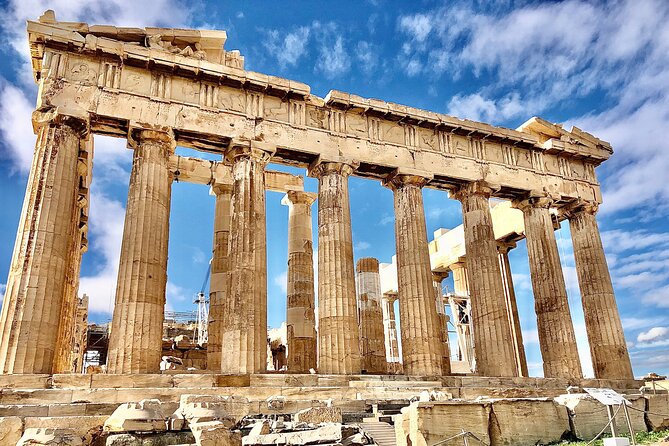
- Stop 1, the Acropolis overview that makes everything else click
- Parthenon time: optical refinements, church and mosque phases, and restoration stories
- Propylaea: the marble gate and the war-time funnel
- Athena Nike and the idea of victory turned into stone
- Erechtheion: Caryatids, multiple gods, and the olive tree question
- Herod Atticus Odeon, Asclepios, and Dionysus theater, in compact snapshots
- What the best guides do for you, and what to look for
- Mobility and comfort, how to prepare for the walking
- Who this tour is best for
- Should you book this Acropolis guided tour?
Key things to know before you go
- Spanish-only, official guiding: clear explanations without language switching.
- Wireless audio system: easier listening on windy, open stone paths.
- All on foot with moderate stamina needed: you will climb and walk throughout.
- Structured stops with photo time at the top: the tour ends at the Acropolis for extra viewing.
- Entrance ticket sold separately: timing matters because entry is tied to an 8:00 to 9:00 window.
- Small-ish group size: max 27 travelers for more manageable pacing.
Other ways up the Acropolis, side by side


Why this Acropolis tour works so well in about 2 hours
The Acropolis can feel like a blur if you show up without a guide. You see the big names, snap a few pictures, and still feel like you missed the point. This tour is designed to fix that, with enough time to understand what you are looking at, not just where to stand.
The big win is pacing. You are not wandering randomly. The route moves from the broader Acropolis context into the Parthenon area, then flows through the monumental entrance structures and the key temples and theaters around the hill. Each stop is brief enough to keep momentum, but long enough for real explanations, especially at the Parthenon.
And the structure matters because the Acropolis is not one temple. It is a whole civic and religious machine built across centuries, reshaped by different rulers, and decorated with optical tricks that only make sense when someone explains the ideas behind them.
Spanish-only, official guiding plus wireless audio makes a difference

You have two main types of Acropolis tours: ones that feel like a soundtrack, and ones that feel like a conversation. This one leans hard toward the second type because it is an official guide tour with Spanish explanations throughout.
That Spanish-only format might be exactly what you want, or it might be a deal-breaker if your group needs another language. For Spanish speakers, it is a huge comfort. You can follow names, myths, architectural terms, and the timeline of changes without translating in your head.
The wireless audio system helps even when the group shifts or the wind is up. The Acropolis is open terrain. Sound carries unevenly. Having a system means you can keep your eyes on the stones, not your ears on your neighbor.
Price and logistics, the real value math
At $44.03 per person, this is not trying to be the cheapest way up the hill. You are paying for an official Spanish guide, wireless audio, and a route that hits the major monuments in a compact window.
The part that changes the value is what is not included. Entrance to the Acropolis is not included, and you still need your own ticket. When you add that to your total, the tour is still often worth it because most of the value is the guided interpretation. With the right guide, the Parthenon and the rest stop being impressive objects and start becoming a readable story.
So here is how I would judge it: if you care about understanding the why behind the what, the price is fair for the time and effort saved. If you only want photos and quick headlines, you might prefer a self-guided approach and spend less.
The 8:30 meeting point and why arriving ready matters
The tour starts at 8:30 am. You meet at the Greek National Tourism Organisation Information Point on Dionysiou Areopagitou 18. The walk continues from there, and the tour ends at the top of the Acropolis area, giving you extra free time to photograph the monuments.
A morning start is practical on the hill. It usually means less heat and fewer crowds than later in the day, and it also gives you the rest of the day for the rest of Athens. But your real homework is earlier than the morning climb: your entry ticket needs to match the 8:00 to 9:00 window.
If you plan to do this tour, I strongly suggest lining up your Acropolis entrance ticket the same day you booked the tour, and keeping it accessible on your phone along with the time details.
Stop 1, the Acropolis overview that makes everything else click
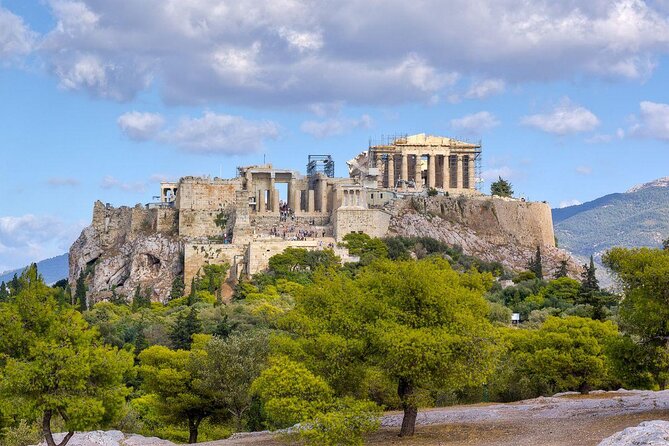
You begin at the Acropolis itself, with the guide setting the historical, mythological, social, and cultural context. This is where the tour earns its keep. When the guide explains what the Acropolis meant to Athenians, later stops feel like chapters, not separate monuments.
You also get the UNESCO framing. The Acropolis is listed as a UNESCO site, but the label only helps if you understand why it is important. This stop is where you learn the significance beyond the postcard.
Expect this to be the broad orientation. Then the tour narrows down to the major structures, so your brain has landmarks to organize the details.
Other Athens bookings where a guide comes along
- Athens: Cape Sounio & Poseidon Temple Trip with Audio Guide★ 4.4 · 4,521 reviews
- Athens: Mythology of Delphi, Museum and Arachova Guided Tour★ 4.6 · 4,008 reviews
- Acropolis: Acropolis and Parthenon Guided Walking Tour★ 4.7 · 3,442 reviews
- From Athens: Delphi Full Day V.R. Audio Guided Tour★ 4.6 · 3,028 reviews
Parthenon time: optical refinements, church and mosque phases, and restoration stories
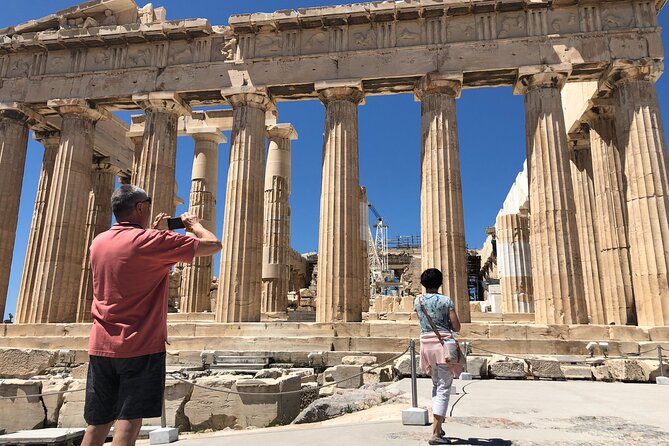
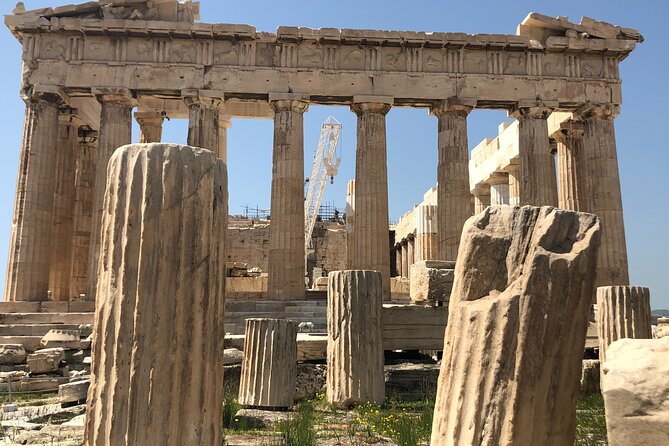
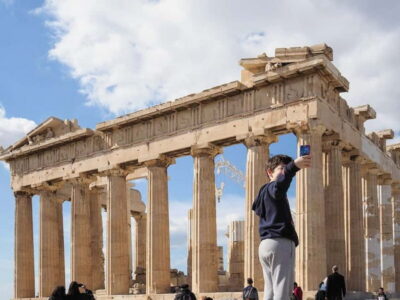
The Parthenon is the headline, but the tour treats it like more than a photo op. You spend about 20 minutes here, and the guide links its beauty to design choices.
They explain the history of its construction and the phases when it became a church in the Byzantine period and later a mosque during Ottoman occupation. That alone is useful, because it reminds you the building was not frozen in time. People used it, adapted it, and left marks.
The tour also covers decoration and looting, plus the restoration work that is active today. That can be sobering, but it is also part of a realistic museum experience. You are not just admiring perfection. You are seeing how long-term history shapes what survives.
Practical tip: in Parthenon areas, your best photos often come from specific sightlines. If your guide points you toward a position, take it. It is usually there for a reason.
Propylaea: the marble gate and the war-time funnel
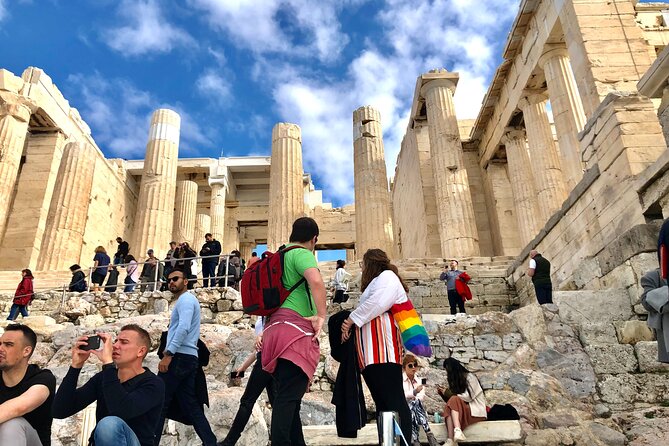
Next you move to the Propylaea, the monumental entrance built entirely of marble. You get about 10 minutes here, focused on how the architecture works and why it mattered.
The guide emphasizes its strategic role. Because of its topography, it functioned like a funnel in times of war. That is a great example of why guided tours add value. You can walk past an impressive doorway and miss the practical intent behind it.
They also point out why different types of columns were used. That detail matters because it tells you the entrance was not just decorative. It was designed to manage movement, impressions, and symbolism all at once.
Athena Nike and the idea of victory turned into stone
There is a stop at the small but famous temple structure built to honor Athena Victorious. This is where you connect the Acropolis to a specific moment in Athenian pride.
The guide explains that it was carried out by Athenians just after victories against the Persians. That context changes the meaning of what you see. Instead of a standalone structure, it becomes a marker for a turning point.
If you care about how political events become religious art, this is a highlight.
Erechtheion: Caryatids, multiple gods, and the olive tree question
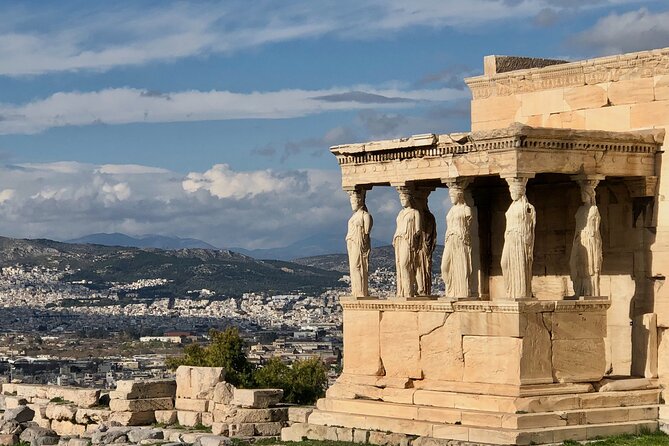
The Erechtheion is one of the most photogenic parts of the Acropolis, mainly because of the Caryatids, the female-shaped columns. You get about 10 minutes, which is perfect for both photos and explanations.
The guide also ties it to a cluster of divinities, including Athena, Poseidon, and Erectios, with the note that Erectios is linked to being the first mythological king of Athens.
One of the most interesting details you will hear here involves the olive tree and why it was sacred. That is the kind of local religious symbolism that makes the Acropolis feel human and lived-in, not just monumental.
For photos: come prepared to pause. This is the part where you will want to take multiple angles, and the Caryatids reward that effort.
Herod Atticus Odeon, Asclepios, and Dionysus theater, in compact snapshots
After the temples, the tour shifts to performance and healing spaces. These stops are shorter, but they add variety and help you see the Acropolis as a full civic landscape.
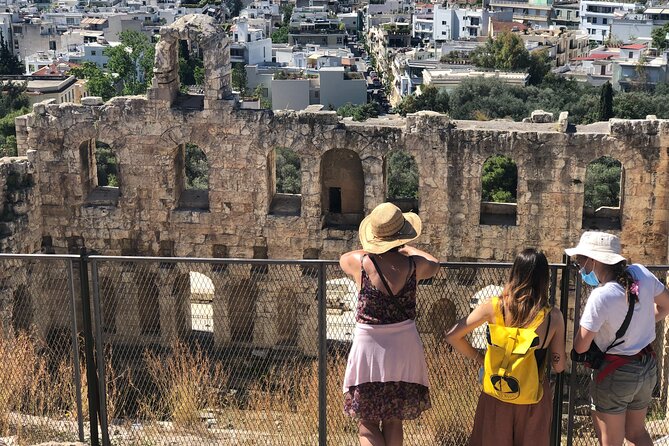
Herod Atticus Odeon gets about 10 minutes. You learn it held around 5,000 spectators and was built by a Roman governor in Athens, dedicated to his wife Regina. You also hear that it is today the only fully restored ancient building in use. If you like seeing ancient spaces still doing their job, this is the stop.
Then it moves to the Temple of Asclepios, about 5 minutes. This is dedicated to the god of medicine. The guide explains how ancient Athenians treated patients in this setting and what types of votive offerings people gave in thanks. This is a quick but memorable contrast to the militaristic and monumental feel of other areas.
Finally, the Theatre of Dionysus Eleuthereus is about 10 minutes. You learn it is one of the oldest theaters in the world built entirely of marble, with a capacity of about 17,000 and designed for acoustics via its slope position. The guide also connects it to major dramatists, naming Euripides, Aeschylos, Sophocles, and Aristophanes as key figures associated with first performances.
Even with short time, these stops make the Acropolis feel like a place where real people gathered, watched, healed, and debated.
What the best guides do for you, and what to look for
The strongest part of this experience is the guide. Over and over, the praised guides are described as passionate, engaging, and focused on helping the group understand rather than just reciting facts.
You will likely see guides who ask questions and encourage you to imagine what happened there. Names you may hear in this tour world include Efi, Ari, Simon, and Maria, each praised for strong delivery and keeping the group connected, including families and mixed-age groups.
A detail I really appreciate in the better-guided versions of this tour style is practical help. Some guides take time to help you with tickets and keep the timing smooth. If your Spanish guide does that, it can save you a lot of confusion right when you arrive.
Mobility and comfort, how to prepare for the walking
This tour involves walking around the Acropolis and does not include transfers. It requires at least moderate physical fitness. That means sturdy shoes are not optional.
If you are sensitive to heat or you tire quickly on stairs, consider booking early and plan a slower pace afterward. The route is designed for viewing, but you will still be on stone steps and slopes.
Good news: group size is limited to a maximum of 27, so the pacing is usually manageable and you are not stuck behind a huge crowd.
Who this tour is best for
Book this if you:
- Want an official Spanish guide and you can comfortably follow Spanish explanations.
- Like to understand meaning, not just landmarks.
- Want a compact plan that covers the most important monuments in about 2 hours.
- Plan to visit other sights after, since the tour ends at the top with time for photos.
You might skip or look for an alternative if you:
- Do not have a Spanish-speaking group member.
- Are not ready for separate Acropolis entrance ticket planning, including the 8:00 to 9:00 entry window.
- Prefer long, self-paced wandering with zero structure.
Should you book this Acropolis guided tour?
If you want the Acropolis to feel readable, not random, I think this is a smart booking. You get official guidance, wireless audio, and a structured loop that hits the monuments people travel across the world to see, including the Parthenon, Erechtheion Caryatids, and the theaters and healing space.
The key decision is the entrance ticket setup. If you already have your Acropolis ticket ready for the 8:00 to 9:00 window, this tour becomes a smooth, high-value way to understand what you are looking at. If you do not, pause and handle that first, so your morning starts with confidence instead of scrambling.
When you get it right, you leave with more than photos. You leave with a story you can actually tell.
A Guide Comes Along in Athens
Every Other Athens Write-Up
- All Day Cruise -3 Islands to Agistri,Moni, Aegina with lunch and drinks included
★ 5.0 · 4,958 reviews



The Acropolis, Other Ways Up

Everything else we have written up around Athens




Acropolis & Parthenon Tours, side by side.
 ★ 4.4Athens: Acropolis & up to 5 Archaeological Sites Combo PassFrom $4812,619 reviews
 ★ 4.2Athens: Acropolis Ticket with Optional Audio or Live GuideFrom $4211,055 reviews
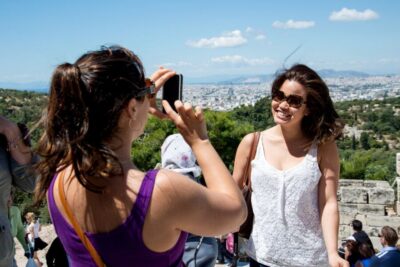 ★ 4.8Athens: Acropolis, Parthenon & Acropolis Museum Guided TourFrom $409,316 reviews
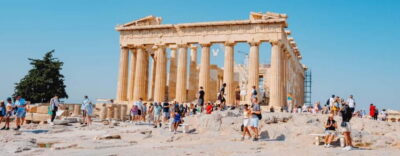 ★ 4.6Athens: Acropolis and Parthenon Guided Walking TourFrom $385,882 reviews
★ 4.8Athens: Acropolis, Parthenon & Acropolis Museum Guided TourFrom $413,579 reviews
★ 4.6Athens: Acropolis and Parthenon Guided Walking TourFrom $385,882 reviews
★ 4.8Athens: Acropolis, Parthenon & Acropolis Museum Guided TourFrom $413,579 reviews
 ★ 4.0Athens: Acropolis Ticket with Audio GuideFrom $473,575 reviews
 ★ 4.7Acropolis: Acropolis and Parthenon Guided Walking TourFrom $363,442 reviews
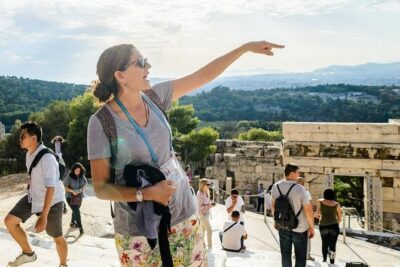 ★ 5.0Acropolis monuments & Parthenon Walking Tour with Optional Acropolis MuseumFrom $422,678 reviews
Sits on these lists