
Review · MYCENAE, EPIDAURUS & NAFPLIO
Ancient Corinth, Mycenae, Epidaurus, Nafplio Full Day Private Tour From Athens
Want the Peloponnese in one day? This private outing is built to save you from the stress of coordinating separate trips, while your driver shares historical facts as you ride. You also get the comfort of a personal group setup, so the pace feels human instead of factory-fast.
I also like the way the schedule checks three UNESCO sites in one sweep, then adds Nafplio so you end with something real and not just ruins. The main thing to watch is cost creep, because the big archaeological admissions at Corinth, Mycenae, and Epidaurus are not included.
In This Review
- Key Points That Make This Tour Worth Considering
- A Private Peloponnese Day That Gets You More Than One Big Monument
- Corinth Canal: A Quick Stop With a Big, Visual Payoff
- Ancient Corinth and the Paul Connection You Can Feel in Your Walk
- Museum Time: A Short Reset Before Mycenae
- Mycenae: Lion Gate, Cyclopean Walls, and Agamemnon’s Citadel Vibe
- Archaeological Museum of Mycenae: Fast, Useful, and Right at the Entrance
- Treasury of Atreus: The Beehive Tomb That Still Feels Unreal
- Epidaurus Theatre and the Sanctuary of Asclepius: Art, Acoustics, and Healing Legends
- Sanctuary of Asklepios: A Healing World That Rivaled Big Name Sites
- Nafplio in the Afternoon: Lunch, Harbor Views, and Castle Stairs
- Bourtzi: A Photo Stop That Changes the Mood
- Palamidi Castle and the Step Reality Check
- Acronauplia: The Oldest Part of Town With a Prison Past
- What You Learn From the Driver, and Why It Changes the Ruin Experience
- Price and Admissions: Where the Real Budget Ends Up
- Practical Tips for a Smooth 9 to 10 Hour Day
- Who This Tour Suits Best
- Should You Book This Ancient Corinth, Mycenae, Epidaurus, Nafplio Private Tour?
- FAQ
- How long is the tour?
- Does the price include pickup from Athens?
- Are entrance fees to the archaeological sites included?
- Will we have a licensed guide inside the archaeological sites?
- Is this tour private?
- What if the weather is bad?
Key Points That Make This Tour Worth Considering
- Private transportation for your group in an air-conditioned luxury car or minivan
- Driver-led storytelling on the way so you understand what you are seeing before you step out
- Three UNESCO World Heritage sites on one efficient day
- Ancient Corinth, Mycenae, and Epidaurus in sequence (less backtracking, more momentum)
- Nafplio time with real breaks for lunch, harbor views, and castle stairs
- Admissions are extra for the archaeological sites, so plan your budget
More of Mycenae, Epidaurus and Nafplio
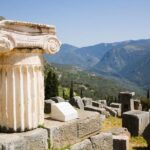

A Private Peloponnese Day That Gets You More Than One Big Monument
From Athens, the Peloponnese highlights are spread out enough that self-planning can turn into a long string of transit time. This tour fixes that by clustering the must-sees into one coherent route, with a single pickup and a single drop-off.
What makes it work for day-trippers is the balance between set stops and breathing room. You get clear, timed segments for the major sites, but you are not stuck in a rigid mass-group rhythm. In past groups, drivers such as Dimitris and George were praised for keeping things smooth and on schedule, while still allowing personal pacing at the ruins.
Corinth Canal: A Quick Stop With a Big, Visual Payoff
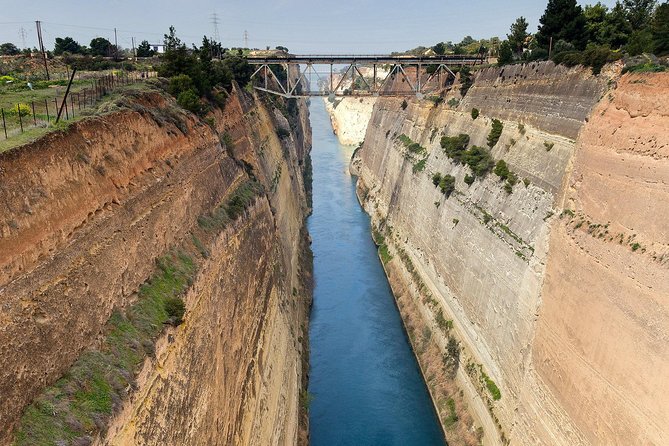
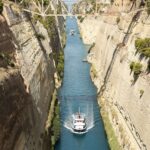
At the Corinth Canal, you get a short window with an excellent “wait, that makes sense” moment. The canal links the Gulf of Corinth to the Saronic Gulf, cutting through the narrow Isthmus of Corinth. In practical terms, it is the kind of landmark that helps you grasp why the Peloponnese can feel separated from Greece even when it is technically connected by land.
A few details you can keep in your head while you look down: the canal is 6.4 kilometers long and only about 21.4 meters wide at its base, and it has no locks. That narrow width is a reminder that modern shipping is limited here. Even if you are not a ship-spotter, the steep limestone walls and the canal’s shape make it a memorable first stop.
Tip: Wear comfortable shoes even for a “short” stop. The best viewpoints can require walking on uneven ground and stairs.
Ancient Corinth and the Paul Connection You Can Feel in Your Walk
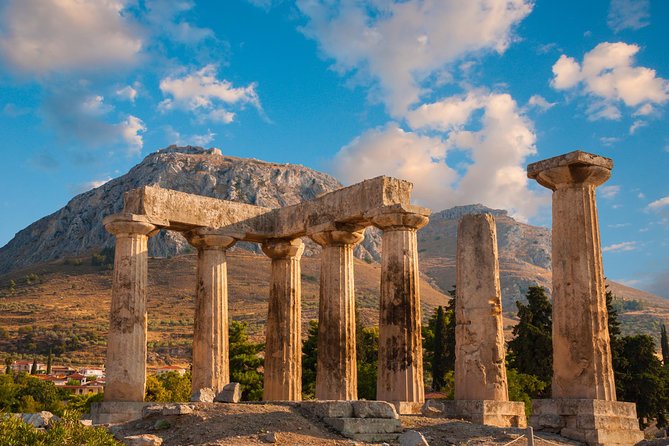
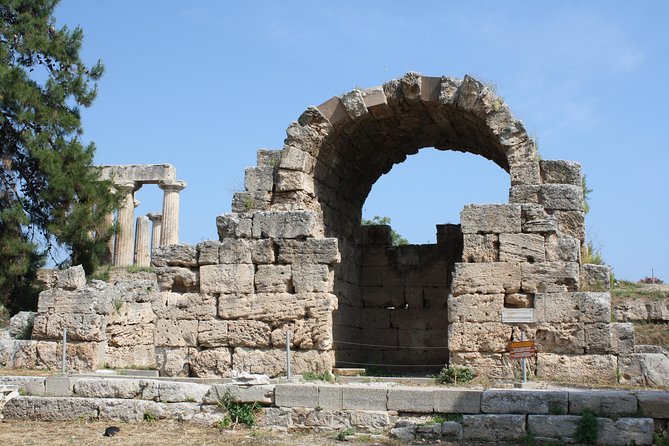
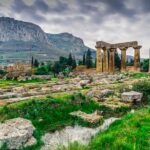
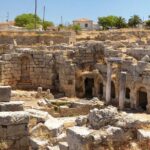
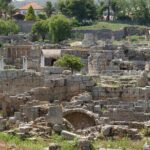
Ancient Corinth was a major city-state on the Isthmus, roughly halfway between Athens and Sparta. That geographic note matters because Corinth was not just a place people visited, it was the kind of crossroad that shaped trade and movement.
You will also get the specific angle many visitors care about: Corinth’s connection to Saint Paul through the New Testament letters and Paul’s missionary travels described in Acts. The site itself can feel less like a single monument and more like a layered city. That is why having a driver who can provide context helps. It turns a scatter of ruins into something you can place in time.
Museum Time: A Short Reset Before Mycenae
Right after the main area, there is a quick pass through the Archaeological Museum of Ancient Corinth. It was built in the early 1930s to display excavations from the area, and it sits within the broader ancient site. The value here is simple: you get artifacts and labels that make the ruins you just saw easier to interpret.
The tradeoff is time. This is not a long, slow museum visit, so if you love museums, you might want to focus your attention on the pieces that relate directly to what you see outside.
Mycenae: Lion Gate, Cyclopean Walls, and Agamemnon’s Citadel Vibe
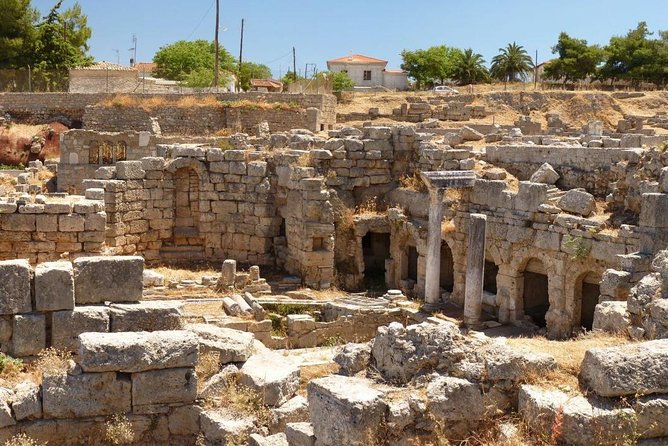
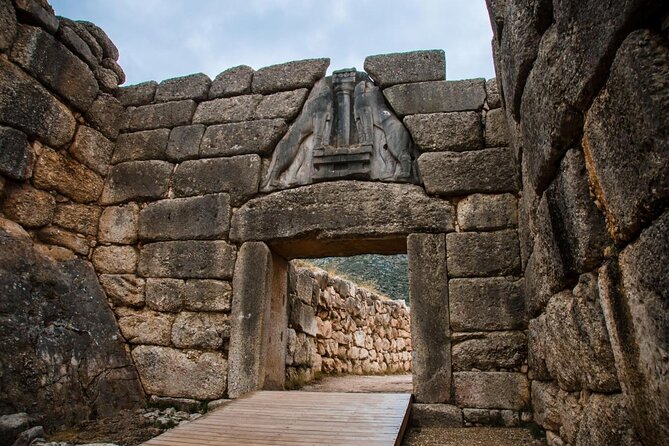
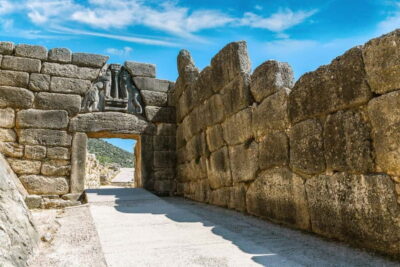
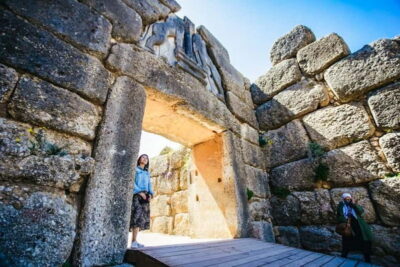
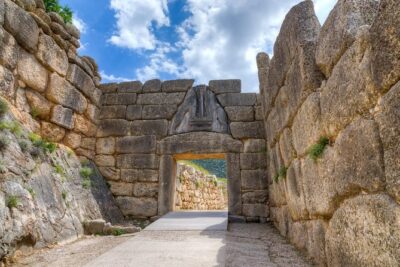
Mycenae is where the day starts to feel epic in a very physical way. The citadel is the seat of the mythical King Agamemnon, but the real power is that the place looks built for defense. You will see the fortified layout, the famous Lion’s Gate, and the Cyclopean-style stonework that makes you wonder how people managed massive building projects without modern tools.
You also learn the big historical arc: the Mycenaean period (about 1600 BC to 1100 BC) is named after this civilization. At its peak around 1350 BC, the citadel and lower town supported a population estimated at 30,000. That scale helps you understand why Mycenae mattered across southern Greece and beyond.
Other stops at ancient Corinth and the canal
- From Athens: Ancient Corinth Day Trip with Canal & VR Guide★ 4.6 · 1,073 reviews
- Biblical Tour Letters ToThe Corinthians St Paul’s Footsteps 6Hour★ 5.0 · 1,065 reviews
- Private Biblical Tour Ancient Corinth & Isthmus Canal from Athens★ 5.0 · 762 reviews
- Private Tour of Apostle Paul’s Footsteps in Ancient Corinth★ 5.0 · 275 reviews
Archaeological Museum of Mycenae: Fast, Useful, and Right at the Entrance
The museum sits near the entrance, just before you move fully into the site. It is short by design, but it gives you a quick anchor point: names, objects, and context that make the citadel features easier to connect.
If you want to see Mycenae and already know the basics, you can treat the museum like a warm-up. If you are new to this world, it is a good way to avoid leaving confused.
Treasury of Atreus: The Beehive Tomb That Still Feels Unreal
Next comes the Citadel and Treasury of Atreus, also known as the Tomb of Agamemnon. This is a tholos, often described as a beehive tomb, built around 1250 BC. One detail sticks: the stone lintel above the doorway weighs about 120 tons. That is the kind of fact that changes how you look at the architecture. You stop thinking in terms of “ruins” and start thinking in terms of engineering.
The structure is also famous because Pausanias mentioned it in the 2nd century AD, and it remained visible enough for Schliemann to notice it in the 19th century. For many visitors, that makes the place feel like a thread connecting ancient writers, later explorers, and modern archaeology.
Time note: This part is brief, so if you want extra lingering, plan to prioritize what you care about most, then let the rest pass without guilt.
Epidaurus Theatre and the Sanctuary of Asclepius: Art, Acoustics, and Healing Legends
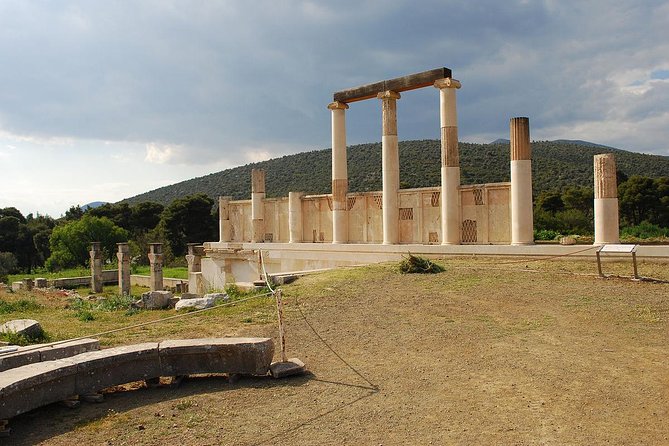
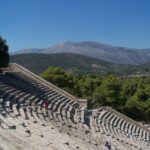
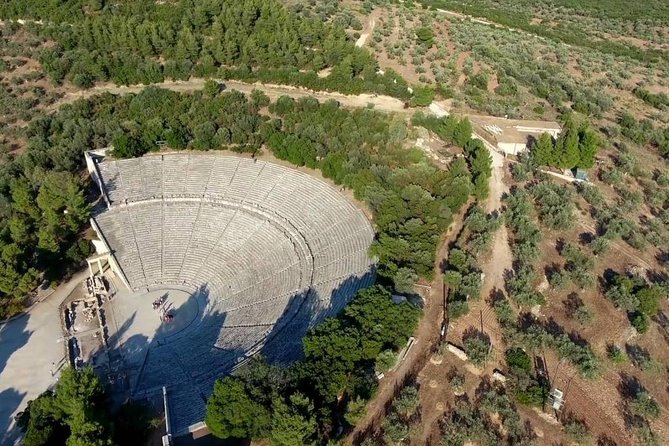
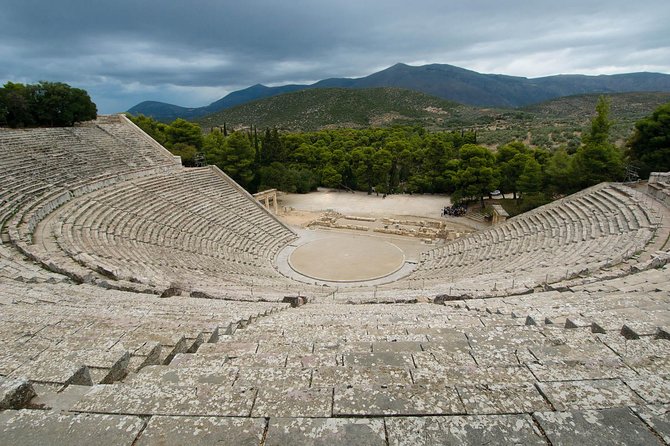
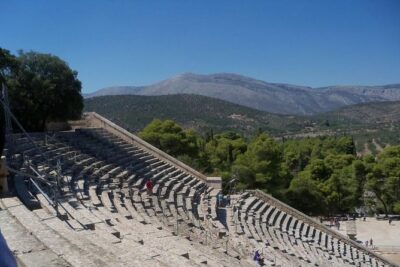
Epidaurus is one of those stops where you realize why ancient Greeks cared about design. The Ancient Theatre is often praised for its acoustics and its visual harmony. You do not need to be an acoustics nerd to feel the intention. The theatre has the classic structure with a theatron, orchestra, and skene, and it kept its Hellenistic form well, even during Roman times.
You will spend time at the theatre in a way that is easy to follow: you arrive, you understand what you are looking at, and you get a chance to take in how the space was made for performance. Even if you do not catch a show, it is worth treating this as a “watch with your eyes” moment, not only a “look at ruins” moment.
Sanctuary of Asklepios: A Healing World That Rivaled Big Name Sites
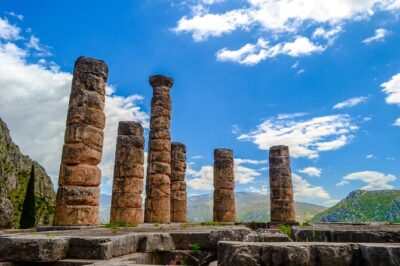
After the theatre, you move to the Sanctuary of Asklepios, the main holy site dedicated to Asclepius. The sanctuary was a rival to other major cult centers such as Olympia and Delphi. That comparison matters because it tells you this was not a small local belief. It was significant enough to compete with the most famous religious destinations of the era.
The temple dates to the early 4th century BC. The story becomes sharper when you learn about the later end of non-Christian worship during late Roman times, when Christian emperors issued edicts that shut down or restricted pagan worship. It adds a real-world ending to a place that once functioned as a living religious site.
If you are short on stamina, this segment can be your slower pace break compared with the more visually intense ruins. Let your eyes adjust. The best part is often noticing details, not rushing to “finish.”
Nafplio in the Afternoon: Lunch, Harbor Views, and Castle Stairs
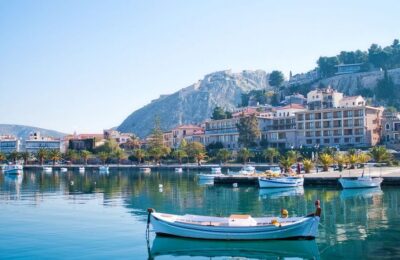
After the heavy archaeology, Nafplio is a smart reset. It is known for Venetian architecture and cobbled squares, and people often call it the Naples of the East. The day’s energy shifts from “how did they build this” to “how did they live here.”
You will have time for lunch, coffee, or shopping, and then room to wander the back streets. The key is that you are not forced to stay with an anchor point. If you like to browse, this is where you get to slow down without turning the day into chaos.
Bourtzi: A Photo Stop That Changes the Mood
There is also time to enjoy views of the water castle of Bourtzi, a Venetian castle sitting in the harbor. Standing where you can see it from the water side can turn a normal harbor walk into something more memorable, especially if the light hits well.
Palamidi Castle and the Step Reality Check
Palamidi is where you earn those wide views over Nafplio and the Argolic Gulf. The fortress sits on a 216-meter hill. If you do the climb, plan for the step count reality. One reference says 913 steps from town to fortress, and locals often jokingly say there are 999. Either way, it is not a gentle stroll.
The upside is the view, and the value is that this is one of the easiest ways to understand how Nafplio is arranged across the hills and coast. The drawback is obvious: if you are not comfortable with stairs, you may want to skip this and keep your time for the harbor and squares instead.
Acronauplia: The Oldest Part of Town With a Prison Past
Acronauplia is the oldest part of Nafplion and used to function as its own town. When the Venetians and Franks arrived, it became part of the fortifications. Later, it was used as a prison, then eventually the Greek government made use of the views for tourism, including building a hotel complex there.
This stop adds a bit of “why Nafplio looks like this” context. You start to see the fortification logic behind the town layout.
What You Learn From the Driver, and Why It Changes the Ruin Experience
A licensed guide inside every site is not included, so your learning depends heavily on what the driver does while you are traveling and on-site. The good news is that this tour is structured for that. Your driver provides history facts as you move, which means you arrive at each stop with a clearer idea of what matters.
In other words, you are not reading labels cold. You are primed. That makes the difference between seeing ruins and understanding them.
Also, this is private transportation just for your group. That means questions are actually possible without waiting for the whole schedule to catch up.
One more practical note: the driver is described as safe and careful in the way they handle the day. That matters on a full day route where roads, timing, and parking all add stress.
Price and Admissions: Where the Real Budget Ends Up
At $259.03 per person, you are paying for a private day of transportation, an air-conditioned ride, bottled water, and a driver who shares context throughout the trip. You are also paying for efficient routing that saves you time compared with piecing together separate rides and admissions.
The big cost you should plan for is admissions at the major archaeological sites:
- Mycenae: €20 per person
- Ancient Corinth: €15 per person
- Epidaurus: €20 per person
Those add up to €55 per person for the main archaeological fees mentioned. Food and drinks are not included, so your lunch will be on your own tab.
Is it worth it? For many people, yes, if you want a smooth day that hits the key Peloponnese locations without logistics headaches. If you are traveling as a couple and you would otherwise rent a car, the private setup can still feel fair, because parking stress and transit planning disappear. If you are traveling solo, you might feel the price more sharply, so budget the admissions and lunch from the start.
Practical Tips for a Smooth 9 to 10 Hour Day
This is a long day by definition, roughly 9 to 10 hours. That is not a complaint, it is just a reality. You should prepare like you are doing a serious outing, not a light stroll.
Bring:
- Comfortable walking shoes, especially if you plan Palamidi
- Water, even though bottled water is provided
- Sunscreen and a hat, since outdoor ruins take time in direct light
- A small snack or plan for lunch so hunger does not derail your pacing
Wear:
- Clothes you can handle for stairs and uneven ground
Timing mindset:
- Treat each archaeological stop as a “see the essentials” window. If you want to go deeper, you will need extra time or a licensed guide at one site.
Who This Tour Suits Best
This tour is a great fit if you want:
- A hassle-free way to cover dispersed highlights from Athens
- A private setup where you can set your own rhythm within the schedule
- A driver-led day that explains what you are looking at before you get stuck staring at stone
It is especially good for first-timers to the Peloponnese, and for people who want the big UNESCO names but also want an enjoyable town afternoon in Nafplio.
It may be less ideal if:
- You dislike long days and multiple walking segments
- You cannot handle stairs, and you were counting on reaching Palamidi for the best views
Should You Book This Ancient Corinth, Mycenae, Epidaurus, Nafplio Private Tour?
Book it if you want an efficient Peloponnese day that keeps you moving between top sites, with a private group comfort level and history context that helps you understand the ruins instead of just photographing them.
Think twice if you are extremely price-sensitive once admissions and lunch are added, or if you know stairs are a deal-breaker for you. In that case, you might still enjoy the day if you adjust your Nafplio plan, but you should go in with your expectations clear.
If you want a one-day hit of Corinth Canal, Ancient Corinth, Mycenae, Epidaurus, and Nafplio without handling logistics yourself, this is the kind of tour that earns its spot on your Athens trip.
FAQ
How long is the tour?
It runs about 9 to 10 hours.
Does the price include pickup from Athens?
Yes, pickup is offered from any accommodation in Athens. Airport pickup or airport area pickup/drop off costs extra.
Are entrance fees to the archaeological sites included?
No. Admissions for the archaeological sites at Mycenae (€20), Corinth (€15), and Epidaurus (€20) are not included.
Will we have a licensed guide inside the archaeological sites?
A licensed tour guide is not included by default. It may be available upon request depending on availability.
Is this tour private?
Yes. It is private, and only your group participates.
What if the weather is bad?
If the experience is canceled due to poor weather, you will be offered a different date or a full refund.
Every Other Athens Write-Up
- All Day Cruise -3 Islands to Agistri,Moni, Aegina with lunch and drinks included
★ 5.0 · 4,958 reviews






Ancient Corinth and the Canal

Mycenae, Epidaurus and Nafplio

Everything else we have written up around Athens






Mycenae, Epidaurus & Nafplio, side by side.
 ★ 4.8From Athens: Mycenae, Epidaurus & Nafplio Full Day TripFrom $332,438 reviews
 ★ 4.5From Athens: Mycenae, Epidaurus & Nafplio Full-Day TourFrom $331,580 reviews
 ★ 4.54-Day Classical Greece Tour: Epidaurus, Mycenae, Olympia, Delphi, MeteoraFrom $766732 reviews
 ★ 4.8Athens: Ancient Corinth & Nafplio Full Day Trip with SwimFrom $44523 reviews
 ★ 4.5Mycenae and Nafplion Day Trip from Athens with Official guideFrom $78501 reviews
 ★ 4.2Argolis: Full-Day Tour in Mycenae & NafplioFrom $41350 reviews
 ★ 4.53-Day Classical Greece Tour: Epidaurus, Mycenae, Nafplion, Olympia, DelphiFrom $520342 reviews
 ★ 5.0Mycenae, Epidaurus, Nafplio Full Day Private Tour from AthensFrom $229270 reviews
Sits on these lists