
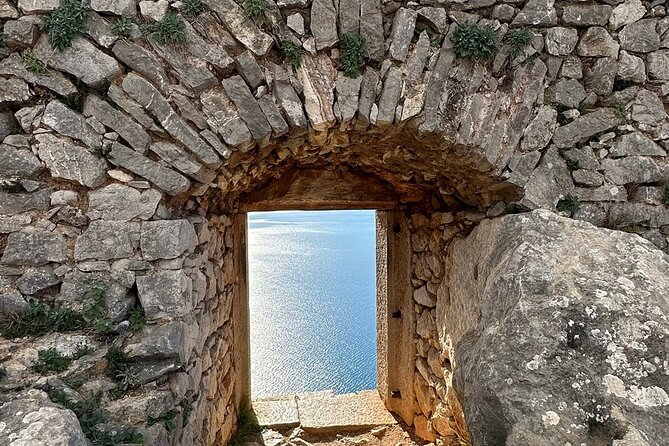
Review · MYCENAE, EPIDAURUS & NAFPLIO
Biblical Ancient Corinth Canal Epidaurus Nafplio Private Tour
Corinth and Epidaurus in one long day makes great sense. You get a private route from Athens that strings together the Corinth Canal, Ancient Corinth, and Epidaurus theater acoustics, then finishes in Nafplio with big views and castle time. I like the practical mix here: big landmark moments plus real time to breathe, shop, and refuel.
Two things I especially like. First, the air-conditioned private vehicle with WiFi and bottled water keeps the day comfortable, even when the sun is doing its best work. Second, the experience is built for you, not for a schedule template, with the option to adjust timing and add small changes on the fly with drivers like Giannis, Themos, or Chris.
One drawback to plan for: the day covers several archaeological stops, and site entrance fees are not included. Budget extra for places like Ancient Corinth, Epidaurus, and Palamidi, and consider hiring an on-site guide if you want deeper context inside the ruins.
In This Review
- Key points before you go
- The value play: what you’re paying for
- Corinth Canal: the engineering story that feels surprisingly human
- Ancient Corinth, plus the Paul connection you can’t un-know
- Corinth Archaeological Museum: the “slow down and read” stop
- Temple of Apollo and Acrocorinth: two looks at power
- The long-drive payoff: Epidaurus and why the theater matters
- Nafplio: castle views, harbor photos, and time to wander
- Comfort and pacing: why private access matters here
- Entrance fees: don’t let them surprise your budget
- Who this tour suits best
- Should you book this private Corinth and Epidaurus day?
- FAQ
- Is this a private tour for only my group?
- Where can the driver pick you up in Athens?
- What vehicle do we ride in?
- Is the tour guided in English?
- Are entrance fees included for archaeological sites and museums?
- What is included for comfort during the day?
- How long is the tour?
- What happens if weather is bad?
Key points before you go
- Private pickup and drop-off from Athens hotels, Airbnbs, or port, with the driver waiting and monitoring flights if needed.
- A/C and WiFi in the car, plus bottled water, which matters a lot on a day that can run long in summer.
- A history-heavy route that links Corinth Canal engineering, Paul’s Corinth, and the cult of Asclepius at Epidaurus.
- Flexibility built in, including the ability to customize the day and opportunities to linger when you want.
- Castle and harbor viewpoints in Nafplio, including Palamidi and quick time for Bourtzi photos.
More of Mycenae, Epidaurus and Nafplio

The value play: what you’re paying for
At $240.93 per person for about 8.5 hours, this isn’t a budget bus tour. But the value is in the format: you’re not fighting a crowd, and you’re not spending your day decoding buses and timetables. It’s also truly private, so your pace is your pace.
You get hotel or port pickup and drop-off, fuel and tolls covered, and a modern first-class vehicle with A/C, WiFi, and bottled water. That combination matters on this route because you have long drives between Corinth area sites, Epidaurus, and Nafplio. The tour also tends to be booked ahead (on average, about 37 days), which usually means you should lock in your day early if you want a specific pickup time window.
The main cost you should expect on top is entrance fees. Ancient Corinth (Archaia Korinthos) is €15 per person, Palamidi Castle is €20 per person, and the Archaeological Site of Epidaurus is also €20 per person. Some museum time and a few sanctuary or theater stops are listed as free, but several key stops are not.
Corinth Canal: the engineering story that feels surprisingly human
The day starts with the Corinth Canal, a waterway cutting through the narrow isthmus and splitting mainland Greece from the Peloponnese. It’s one of those spots where you realize the Greeks have been dreaming up shortcuts for ages. This canal was carried out in the late 19th century, but the idea goes back around 2,000 years.
What I like about making this your first stop is the perspective. You hear how ships wanting to cross from the Aegean toward the Adriatic, or to anchor in Corinth, used to go the long way around the Peloponnese. That extra route could add about 185 nautical miles, which is huge.
There’s also a great older detail: Periander, the tyrant of Corinth (around 602 BC), is credited with conceiving the canal. Since the technology wasn’t there yet, he built the diolkos, a stone road that let ships move over land on wheeled platforms. Even if you’re not an engineering person, this makes the whole later Corinth story feel more grounded.
Tip for your visit: treat this as a quick photo stop where you get the big idea, then move on. The rest of the day keeps building momentum.
Ancient Corinth, plus the Paul connection you can’t un-know
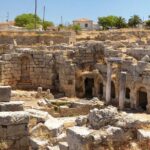
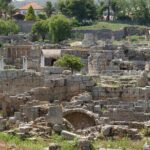
Next comes Ancient Corinth (Archaia Korinthos), a major city-state on the isthmus connecting Peloponnese and mainland Greece. The site also matters to Christians because Corinth shows up in the New Testament through Paul’s letters and Acts, and it’s discussed in Pausanias’ Description of Greece.
This is also one of those places where layers matter. Corinth was a major hub with a population cited around 90,000 in 400 BC. The Romans demolished it in 146 BC, rebuilt in 44 BC, and later made it the provincial capital of Greece. So you’re not just walking ruins, you’re watching centuries of change in one area.
What to plan for on the ground: you’ll spend about 1.5 hours here, which is enough time to see the layout and key remains without rushing. Still, the tour does not include a licensed guide for site entry. If you care about interpretation, consider hiring a guide at the site. A little extra context can transform a walk through foundations into a story you can actually follow.
Corinth Archaeological Museum: the “slow down and read” stop
The Archaeological Museum of Ancient Corinth is on-site, built in the early 1930s to showcase recent excavations. If you’re the type who likes inscriptions, architecture, and explanations, this is your payoff stop after being outside all morning.
Even though it’s shorter time (around 40 minutes), the museum’s strength is how it organizes major parts of the broader site. Think of it as a map in object form, covering things like the Fountain of Peirene, parts of the Agora, and key structures such as the Basilica, Lechaion Road, Stoa, and the Theatre in the wider complex.
Practical advice: wear something comfortable for stairs and uneven floors. Museums can feel compact, but you’ll still want a moment to look closely at what’s actually displayed, not just snap photos and keep moving.
Temple of Apollo and Acrocorinth: two looks at power
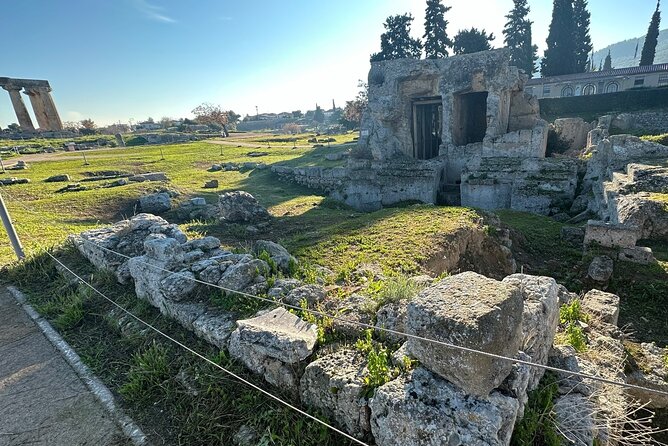
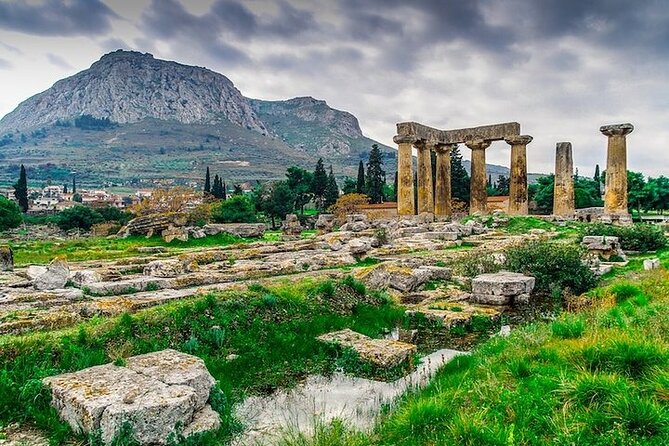
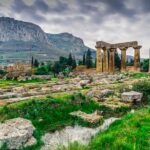
You’ll then stop for the Temple of Apollo, built around 550 BC and described as one of the earlier Doric temples in the Peloponnese and mainland Greece. The temple’s monolithic columns are noted as rare in the ancient world, and it sits in the broader Corinth landscape as a reminder that these weren’t just trading hubs, they were religious and civic centers.
After that comes Acrocorinth (Acrocorinthos), the “Upper Corinth” acropolis on a massive rock overlooking the city. This fortress is often used as a last line of defense because it controlled land access into the Peloponnese peninsula. If you want one spot that helps you understand why Corinth was strategic, this is it.
Your time here is about 30 minutes, so don’t expect a full history lecture. Expect great views, a sense of the terrain, and enough time to orient yourself so the rest of the ruins make more sense.
Other stops at ancient Corinth and the canal
- From Athens: Ancient Corinth Day Trip with Canal & VR Guide★ 4.6 · 1,073 reviews
- Biblical Tour Letters ToThe Corinthians St Paul’s Footsteps 6Hour★ 5.0 · 1,065 reviews
- Private Biblical Tour Ancient Corinth & Isthmus Canal from Athens★ 5.0 · 762 reviews
- Private Tour of Apostle Paul’s Footsteps in Ancient Corinth★ 5.0 · 275 reviews
The long-drive payoff: Epidaurus and why the theater matters
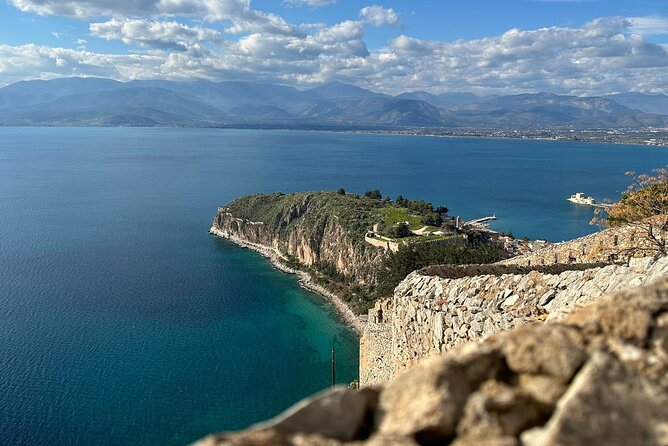
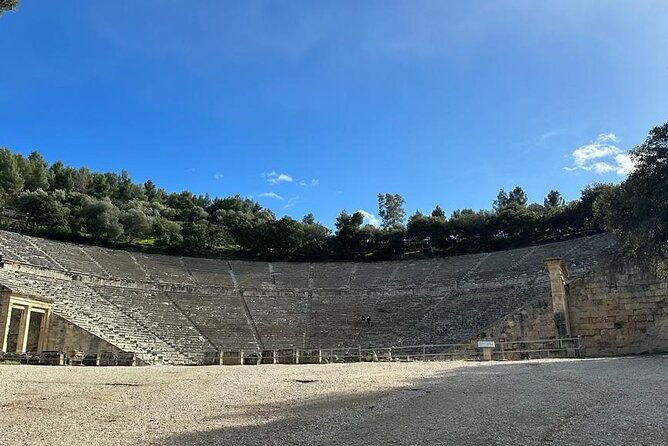
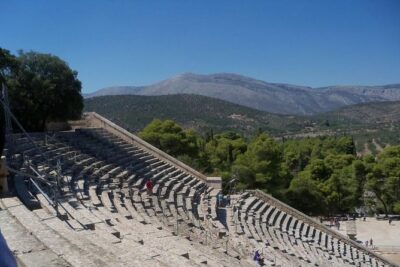
Epidaurus is where this day turns into a true “wow” experience, especially if you’ve heard about the place. The big headline is the Ancient Theatre of Epidaurus, famous for classic Greek construction and legendary acoustics.
This tour also frames Epidaurus as an arts-and-medicine junction. You’ll hear about performances from authors like Euripides, Sophocles, Aristophanes, and Aeschylus. There’s also a practical party trick vibe: the theater is said to carry sound even from far back seats if you drop a pin or coin on the stage.
The route also includes the Epidaurus Archaeological Museum for about 30 minutes, where you can see reconstructions of temples and columns with inscriptions. If you want to know what you’re looking at outside, this museum helps.
Then comes the Sanctuary of Asklepios, dedicated to Asclepius, the ancient Greek medicine figure. It’s described as a major cult site, rivaling huge centers like Olympia and Delphi. You’re given short time here (around 15 minutes), so think of it as orienting yourself to the sacred landscape rather than a full guided walkthrough.
Finally, you’ll visit the theatre itself with about 45 minutes. That’s enough time to find a good seat location for views, walk the edges, and take in the architectural design. If you’re sensitive to heat, arrive with water and take advantage of any shaded moments before you commit to a long sit.
Nafplio: castle views, harbor photos, and time to wander
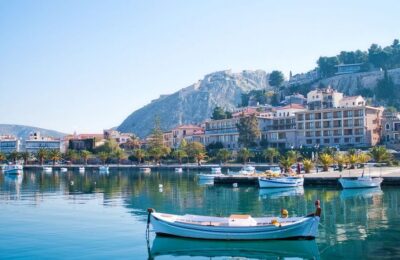
After Epidaurus, the day shifts from ruins and sanctuaries to a real town with a real rhythm. Nafplio is a seaport town on the Argolic Gulf, expanded up the hills near the north end of the gulf. It was important through the Middle Ages, part of the lordship of Argos and Nafplia, and it even served as capital during the early Greek revolutionary period and the Greek kingdom.
The tour gives you free time for lunch, coffee, and shopping, roughly 1 hour. This is the moment I’d protect in your head as the mental reset. Use it for a slow meal or a long coffee where you can actually taste what you’re eating instead of rushing between stops.
You’ll also see the Lion of the Bavarians, a massive carved lion above Michael Iatrou Street. It commemorates Bavarian soldiers tied to Otto’s dynasty who died in 1833 in Nafplio during a typhoid epidemic. There’s also an unofficial local story tied to the lion, but the main point is that the monument is huge, easy to spot, and very photo-friendly.
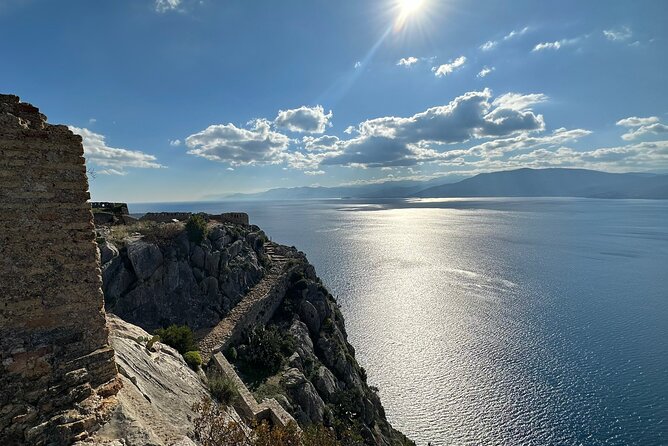
Then you’ll go up to Palamidi Castle, one of the best preserved fortresses in Greece. It was built by the Venetians during their second occupation (1686 to 1715), and it sits on a hill with a commanding view over the Argolic Gulf and the city. The big detail here is the climb. The fortress is reached by a winding stairway with 913 steps, and locals describe it with a joke-like number of 999 steps.
Your allocated time is about 30 minutes, so plan accordingly. If you want the views without turning the castle climb into a workout you didn’t sign up for, pace yourself and stop as soon as you get the view you came for.
After Palamidi, you have additional sights in Nafplio: the Akronauplia, noted as the oldest part of the city and transformed into fortifications by Venetians and Franks, plus a short visit to Bourtzi, the water-side Venetian castle in the harbor. Bourtzi is quick but great for photos, especially from the harbor side.
Comfort and pacing: why private access matters here
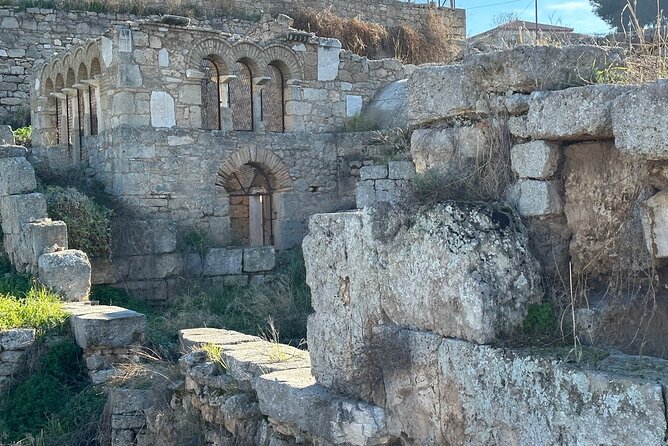
This kind of day trip succeeds or fails on fatigue. Here, the format helps. Your pickup is arranged from where you’re staying, the driver waits for you at the lobby or building entrance, and the car includes WiFi, A/C, and bottled water. Groups of 1 to 3 ride in a luxurious sedan, while 4 to 7 use a mini van. If you have anyone who needs extra comfort, the vehicle choice is a big deal.
Pacing is another big factor. The private format means you can pause for shade, adjust timing, or spend extra minutes at views and landmarks that click for you. In past days, drivers like Giannis, Themos, and Chris have been praised for careful driving and flexibility, including adding small stops and helping guests find great lunch choices in Nafplio.
That said, this is still a packed day. You’re not strolling for hours in one place. The reward is seeing multiple major sites without the hassle of switching taxis, arranging tickets, and building your own route.
Entrance fees: don’t let them surprise your budget
Because entrance fees for key sites are not included, you should plan a simple “day expenses” number before you go. The data points you should know are:
- Ancient Corinth (Archaia Korinthos): €15 per person
- Palamidi Castle: €20 per person
- Archaeological Site of Epidaurus: €20 per person
- Archaeological Museum of Corinth: not included (fee not specified in the data)
- Archaeological Museum of Epidaurus: not included (fee not specified in the data)
Some parts are marked as free, including the Corinth Canal (listed free for admission) and the Asclepius sanctuary area (listed free for admission). But other big-ticket stops are paid entries.
If you’re traveling with teens or older kids who will actually care about inscriptions, coins, and temple layouts, this spend is more likely to feel worth it. If not, you might focus on the exterior architecture and views, and spend money only where you truly want it.
Who this tour suits best
This tour fits best if you want a structured, private day that hits the big names: Corinth Canal, Ancient Corinth, Epidaurus theatre and Asklepios sanctuary, and Nafplio. It’s also a good choice for mixed ages and different interests because you get both landmark time and breaks.
It’s especially good for:
- Couples who want a “greatest hits” day without planning stress
- Families who need A/C and predictable timing
- Travelers who like the story behind places, from ancient engineering to Paul’s Corinth to the medicine sanctuary at Epidaurus
- Anyone who wants flexibility, like swapping a bit of free time in Nafplio for a slower lunch
Should you book this private Corinth and Epidaurus day?
I think you should book if you want one smooth, private day that links major ancient sites with a real Greek town finish, and you value convenience enough to pay for it. The combination of A/C comfort, private pickup and drop-off, and the ability to tailor small parts of the day makes it a strong choice when time is limited.
I wouldn’t book if you hate ticket budgeting. Since multiple major sites have separate entrance fees, you’ll need to plan your cash and decide in advance which stops you truly want to pay for.
If you want the best outcome, bring sun protection, keep some flexibility in your schedule mindset, and be ready to choose whether you want deeper context at ruins by hiring a guide on-site when it’s offered.
FAQ
Is this a private tour for only my group?
Yes. It is a private tour/activity, meaning only your group participates.
Where can the driver pick you up in Athens?
Pickup is offered from your hotel, Airbnb residence, or the port. The driver waits in the hotel lobby, at the building entrance for apartments, or at the port gate holding a sign with your name.
What vehicle do we ride in?
For groups of 1 to 3 people, it’s a luxurious sedan. For groups of 4 to 7 people, it’s a comfortable mini van.
Is the tour guided in English?
Yes, the tour includes expert English-speaking tour drivers with historical knowledge.
Are entrance fees included for archaeological sites and museums?
No. Entrance fees for Ancient Corinth, Palamidi Castle, and the Archaeological Site of Epidaurus are not included. Museum entrance fees and other specific sites are also not included.
What is included for comfort during the day?
Your transportation is in a modern first-class private vehicle with WiFi, A/C, and bottled water.
How long is the tour?
The duration is approximately 8 hours 30 minutes.
What happens if weather is bad?
This experience requires good weather. If it’s canceled due to poor weather, you’ll be offered a different date or a full refund.
Every Other Athens Write-Up
- All Day Cruise -3 Islands to Agistri,Moni, Aegina with lunch and drinks included
★ 5.0 · 4,958 reviews






Ancient Corinth and the Canal
Mycenae, Epidaurus and Nafplio

Everything else we have written up around Athens


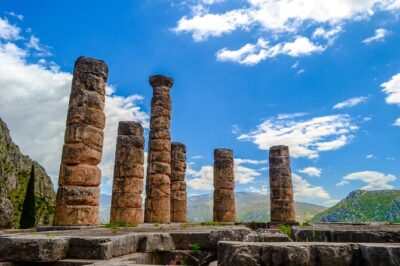



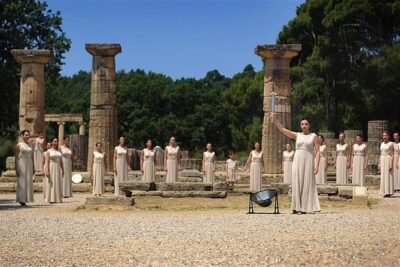

Mycenae, Epidaurus & Nafplio, side by side.
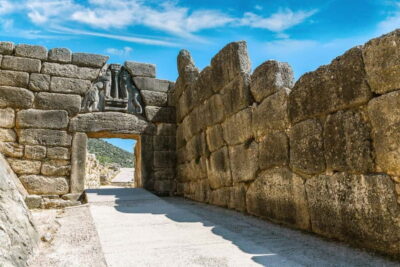 ★ 4.8From Athens: Mycenae, Epidaurus & Nafplio Full Day TripFrom $332,438 reviews
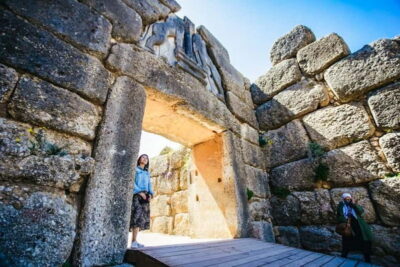 ★ 4.5From Athens: Mycenae, Epidaurus & Nafplio Full-Day TourFrom $331,580 reviews
 ★ 4.54-Day Classical Greece Tour: Epidaurus, Mycenae, Olympia, Delphi, MeteoraFrom $766732 reviews
 ★ 4.8Athens: Ancient Corinth & Nafplio Full Day Trip with SwimFrom $44523 reviews
 ★ 4.5Mycenae and Nafplion Day Trip from Athens with Official guideFrom $78501 reviews
 ★ 4.2Argolis: Full-Day Tour in Mycenae & NafplioFrom $41350 reviews
 ★ 4.53-Day Classical Greece Tour: Epidaurus, Mycenae, Nafplion, Olympia, DelphiFrom $520342 reviews
 ★ 5.0Mycenae, Epidaurus, Nafplio Full Day Private Tour from AthensFrom $229270 reviews
Sits on these lists